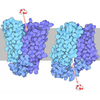
+
Open data
-
Basic information
| Entry | ![]() | |||||||||
|---|---|---|---|---|---|---|---|---|---|---|
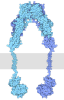
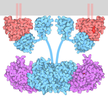
| Title | Insulin Receptor bound to Ins-AC-S2 | |||||||||
Map data | ||||||||||
Sample |
| |||||||||
Keywords | Antagonist / receptor tyrosine kinase / MEMBRANE PROTEIN | |||||||||
| Function / homology | Function and homology informationregulation of female gonad development / positive regulation of meiotic cell cycle / insulin-like growth factor II binding / positive regulation of developmental growth / insulin receptor complex / insulin-like growth factor I binding / insulin receptor activity / positive regulation of protein-containing complex disassembly / adrenal gland development / dendritic spine maintenance ...regulation of female gonad development / positive regulation of meiotic cell cycle / insulin-like growth factor II binding / positive regulation of developmental growth / insulin receptor complex / insulin-like growth factor I binding / insulin receptor activity / positive regulation of protein-containing complex disassembly / adrenal gland development / dendritic spine maintenance / insulin binding / negative regulation of glycogen catabolic process / negative regulation of fatty acid metabolic process / Signaling by Insulin receptor / PTB domain binding / IRS activation / cargo receptor activity / Insulin processing / negative regulation of feeding behavior / regulation of protein secretion / positive regulation of peptide hormone secretion / negative regulation of acute inflammatory response / neuronal cell body membrane / positive regulation of respiratory burst / Regulation of gene expression in beta cells / relaxation of vascular associated smooth muscle / alpha-beta T cell activation / amyloid-beta clearance / acute-phase response / heart morphogenesis / positive regulation of receptor internalization / Synthesis, secretion, and deacylation of Ghrelin / insulin receptor substrate binding / negative regulation of gluconeogenesis / fatty acid homeostasis / negative regulation of protein secretion / positive regulation of brown fat cell differentiation / positive regulation of dendritic spine maintenance / positive regulation of insulin receptor signaling pathway / positive regulation of glycogen biosynthetic process / Signal attenuation / FOXO-mediated transcription of oxidative stress, metabolic and neuronal genes / protein kinase activator activity / negative regulation of lipid catabolic process / positive regulation of lipid biosynthetic process / negative regulation of respiratory burst involved in inflammatory response / negative regulation of oxidative stress-induced intrinsic apoptotic signaling pathway / nitric oxide-cGMP-mediated signaling / regulation of protein localization to plasma membrane / phosphatidylinositol 3-kinase binding / Insulin receptor recycling / transport across blood-brain barrier / COPI-mediated anterograde transport / transport vesicle / positive regulation of nitric-oxide synthase activity / negative regulation of reactive oxygen species biosynthetic process / NPAS4 regulates expression of target genes / insulin-like growth factor receptor binding / positive regulation of D-glucose import across plasma membrane / positive regulation of mitotic nuclear division / neuron projection maintenance / endoplasmic reticulum-Golgi intermediate compartment membrane / receptor-mediated endocytosis / male gonad development / hormone activity / positive regulation of glycolytic process / regulation of embryonic development / Insulin receptor signalling cascade / learning / endosome lumen / dendrite membrane / positive regulation of protein secretion / wound healing / insulin receptor binding / positive regulation of long-term synaptic potentiation / positive regulation of cytokine production / positive regulation of neuron projection development / positive regulation of cell differentiation / negative regulation of protein catabolic process / Regulation of insulin secretion / memory / receptor protein-tyrosine kinase / vasodilation / positive regulation of protein localization to nucleus / regulation of synaptic plasticity / caveola / Golgi lumen / cognition / insulin receptor signaling pathway / positive regulation of nitric oxide biosynthetic process / cellular response to insulin stimulus / glucose homeostasis / late endosome / cell-cell signaling / protein autophosphorylation / positive regulation of cell growth / amyloid-beta binding / regulation of protein localization / PI5P, PP2A and IER3 Regulate PI3K/AKT Signaling / protease binding Similarity search - Function | |||||||||
| Biological species | Homo sapiens (human) | |||||||||
| Method | single particle reconstruction / cryo EM / Resolution: 3.64 Å | |||||||||
Authors | Vogel A / Hill CP / Blakely A | |||||||||
| Funding support | United States, 1 items
| |||||||||
Citation | Journal: Proc Natl Acad Sci U S A / Year: 2026Title: Structural basis of transcription-coupled RNA damage by incorporation of oxidized ribonucleotides. Authors: Peini Hou / Chanjoo Lee / Jenny Chong / Juntaek Oh / Dong Wang / ![]() Abstract: Oxidative stress induces damage to DNA, RNA, and nucleotide pools. Unlike well-studied DNA damage, the formation of RNA damage and the impact of an oxidized ribonucleotide pool on transcription ...Oxidative stress induces damage to DNA, RNA, and nucleotide pools. Unlike well-studied DNA damage, the formation of RNA damage and the impact of an oxidized ribonucleotide pool on transcription fidelity are poorly understood. Here, we investigate the structural basis of transcription-coupled RNA damage and the effect of 8-oxo-guanosine triphosphate (8-oxo-rGTP) on RNA polymerase II (Pol II) transcription fidelity control steps. We revealed that the incorporation efficiency of 8-oxo-rGTP opposite a dC template is comparable to that of GTP. In contrast, the incorporation efficiency of 8-oxo-rGTP opposite a dA template is ~150-fold more efficient than that of GTP. For the extension step, Pol II extends substantially faster from a 3'-8-oxo-rG:dC base pair than from a 3'-8-oxo-rG:dA base pair. For the proofreading step, strikingly, Pol II EC with 3'-8-oxo-rG:dA base pair is much more resistant to backtracking and proofreading than Pol II EC with 3'-8-oxo-rG:dC base pair. Using X-ray crystallography, we revealed that 8-oxo-rGTP adopts different prechemistry binding sites depending on whether it is paired with a dC or a dA template. Upon incorporation, the nucleobase of 8-oxo-rG flips to the -conformation to form a Hoogsteen pair with a dA template, whereas it remains in the -conformation to form a Watson-Crick pair with a dC template. Collectively, our work demonstrates that nucleotide-pool oxidation can directly affect Pol II fidelity control steps and elongation dynamics and induce RNA damage in a transcription-coupled manner. | |||||||||
| History |
|
-
Structure visualization
| Supplemental images |
|---|
-
Downloads & links
-EMDB archive
| Map data | emd_71878.map.gz | 118.1 MB | EMDB map data format | |
|---|---|---|---|---|
| Header (meta data) | emd-71878-v30.xml emd-71878.xml | 22.5 KB 22.5 KB | Display Display | EMDB header |
| FSC (resolution estimation) | emd_71878_fsc.xml | 10.6 KB | Display | FSC data file |
| Images | emd_71878.png | 40.3 KB | ||
| Filedesc metadata | emd-71878.cif.gz | 6.7 KB | ||
| Others | emd_71878_half_map_1.map.gz emd_71878_half_map_2.map.gz | 116.1 MB 116.1 MB | ||
| Archive directory | https://data.pdbj.org/pub/emdb/structures/EMD-71878 ftp://data.pdbj.org/pub/emdb/structures/EMD-71878 | HTTPS FTP |
-Related structure data
| Related structure data | ![]() 9puwMC ![]() 9puvC ![]() 9pvoC M: atomic model generated by this map C: citing same article ( |
|---|---|
| Similar structure data | Similarity search - Function & homology F&H Search |
-
Links
| EMDB pages | EMDB (EBI/PDBe) / EMDataResource |
|---|---|
| Related items in Molecule of the Month |
-
Map
| File | Download / File: emd_71878.map.gz / Format: CCP4 / Size: 125 MB / Type: IMAGE STORED AS FLOATING POINT NUMBER (4 BYTES) | ||||||||||||||||||||||||||||||||||||
|---|---|---|---|---|---|---|---|---|---|---|---|---|---|---|---|---|---|---|---|---|---|---|---|---|---|---|---|---|---|---|---|---|---|---|---|---|---|
| Projections & slices | Image control
Images are generated by Spider. | ||||||||||||||||||||||||||||||||||||
| Voxel size | X=Y=Z: 1.06 Å | ||||||||||||||||||||||||||||||||||||
| Density |
| ||||||||||||||||||||||||||||||||||||
| Symmetry | Space group: 1 | ||||||||||||||||||||||||||||||||||||
| Details | EMDB XML:
|
-Supplemental data
-Half map: #2
| File | emd_71878_half_map_1.map | ||||||||||||
|---|---|---|---|---|---|---|---|---|---|---|---|---|---|
| Projections & Slices |
| ||||||||||||
| Density Histograms |
-Half map: #1
| File | emd_71878_half_map_2.map | ||||||||||||
|---|---|---|---|---|---|---|---|---|---|---|---|---|---|
| Projections & Slices |
| ||||||||||||
| Density Histograms |
-
Sample components
-Entire : Insulin Receptor-A isoform complexed with two Ins-AC-S2 molecules.
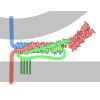
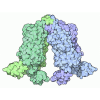
| Entire | Name: Insulin Receptor-A isoform complexed with two Ins-AC-S2 molecules. |
|---|---|
| Components |
|
-Supramolecule #1: Insulin Receptor-A isoform complexed with two Ins-AC-S2 molecules.
| Supramolecule | Name: Insulin Receptor-A isoform complexed with two Ins-AC-S2 molecules. type: complex / ID: 1 / Parent: 0 / Macromolecule list: all |
|---|---|
| Source (natural) | Organism: Homo sapiens (human) |
-Macromolecule #1: Isoform Long of Insulin receptor
| Macromolecule | Name: Isoform Long of Insulin receptor / type: protein_or_peptide / ID: 1 / Number of copies: 4 / Enantiomer: LEVO / EC number: receptor protein-tyrosine kinase |
|---|---|
| Source (natural) | Organism: Homo sapiens (human) |
| Molecular weight | Theoretical: 109.477617 KDa |
| Recombinant expression | Organism: Homo sapiens (human) |
| Sequence | String: HLYPGEVCPG MDIRNNLTRL HELENCSVIE GHLQILLMFK TRPEDFRDLS FPKLIMITDY LLLFRVYGLE SLKDLFPNLT VIRGSRLFF NYALVIFEMV HLKELGLYNL MNITRGSVRI EKNNELCYLA TIDWSRILDS VEDNYIVLNK DDNEECGDIC P GTAKGKTN ...String: HLYPGEVCPG MDIRNNLTRL HELENCSVIE GHLQILLMFK TRPEDFRDLS FPKLIMITDY LLLFRVYGLE SLKDLFPNLT VIRGSRLFF NYALVIFEMV HLKELGLYNL MNITRGSVRI EKNNELCYLA TIDWSRILDS VEDNYIVLNK DDNEECGDIC P GTAKGKTN CPATVINGQF VERCWTHSHC QKVCPTICKS HGCTAEGLCC HSECLGNCSQ PDDPTKCVAC RNFYLDGRCV ET CPPPYYH FQDWRCVNFS FCQDLHHKCK NSRRQGCHQY VIHNNKCIPE CPSGYTMNSS NLLCTPCLGP CPKVCHLLEG EKT IDSVTS AQELRGCTVI NGSLIINIRG GNNLAAELEA NLGLIEEISG YLKIRRSYAL VSLSFFRKLR LIRGETLEIG NYSF YALDN QNLRQLWDWS KHNLTITQGK LFFHYNPKLC LSEIHKMEEV SGTKGRQERN DIALKTNGDQ ASCENELLKF SYIRT SFDK ILLRWEPYWP PDFRDLLGFM LFYKEAPYQN VTEFDGQDAC GSNSWTVVDI DPPLRSNDPK SQNHPGWLMR GLKPWT QYA IFVKTLVTFS DERRTYGAKS DIIYVQTDAT NPSVPLDPIS VSNSSSQIIL KWKPPSDPNG NITHYLVFWE RQAEDSE LF ELDYCLKGLK LPSRTWSPPF ESEDSQKHNQ SEYEDSAGEC CSCPKTDSQI LKELEESSFR KTFEDYLHNV VFVPRKTS S GTGAEDPRPS RKRRSLGDVG NVTVAVPTVA AFPNTSSTSV PTSPEEHRPF EKVVNKESLV ISGLRHFTGY RIELQACNQ DTPEERCSVA AYVSARTMPE AKADDIVGPV THEIFENNVV HLMWQEPKEP NGLIVLYEVS YRRYGDEELH LCVSRKHFAL ERGCRLRGL SPGNYSVRIR ATSLAGNGSW TEPTYFYVTD YLDVPSNIAK SSGPSGSHHH HHHGSDYKDD DDKDYKDDDD K UniProtKB: Insulin receptor |
-Macromolecule #2: Ins-AC-S2 chain A
| Macromolecule | Name: Ins-AC-S2 chain A / type: protein_or_peptide / ID: 2 / Number of copies: 2 / Enantiomer: LEVO |
|---|---|
| Source (natural) | Organism: Homo sapiens (human) |
| Molecular weight | Theoretical: 5.52004 KDa |
| Sequence | String: GIVEQCCTSI CSLYQLENYC GGSLPETGGG SLEEEWAQIQ SEVWGRGCPS Y |
-Macromolecule #3: Insulin chain B
| Macromolecule | Name: Insulin chain B / type: protein_or_peptide / ID: 3 / Number of copies: 2 / Enantiomer: LEVO |
|---|---|
| Source (natural) | Organism: Homo sapiens (human) |
| Molecular weight | Theoretical: 3.332849 KDa |
| Sequence | String: FVNQHLCGSH LVEALYLVCG ERGFFYTPK UniProtKB: Insulin |
-Experimental details
-Structure determination
| Method | cryo EM |
|---|---|
Processing | single particle reconstruction |
| Aggregation state | particle |
-
Sample preparation
| Buffer | pH: 7.5 |
|---|---|
| Vitrification | Cryogen name: ETHANE |
-
Electron microscopy
| Microscope | TFS KRIOS |
|---|---|
| Image recording | Film or detector model: GATAN K3 BIOQUANTUM (6k x 4k) / Average electron dose: 50.0 e/Å2 |
| Electron beam | Acceleration voltage: 300 kV / Electron source: FIELD EMISSION GUN |
| Electron optics | Illumination mode: OTHER / Imaging mode: BRIGHT FIELD / Nominal defocus max: 2.2 µm / Nominal defocus min: 0.8 µm |
| Experimental equipment | ![]() Model: Titan Krios / Image courtesy: FEI Company |
Movie
Controller
About Yorodumi


Keywords
Homo sapiens (human)
Authors
United States, 1 items
Citation


Z (Sec.)
Y (Row.)
X (Col.)


Processing
FIELD EMISSION GUN