[English] 日本語
Yorodumi
- EMDB-71158: Structure of human cardiac sodium channel Nav1.5 in intermediate ... -

+
Open data


ID or keywords:

Loading...

-
Basic information

Entry
Database: EMDB / ID: EMD-71158
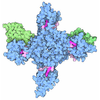
TitleStructure of human cardiac sodium channel Nav1.5 in intermediate open state
Map data
Sample
  • Organelle or cellular component: Sodium channel protein type 5 subunit alpha
    • Protein or peptide: Sodium channel protein type 5 subunit alpha
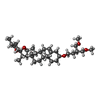
  • Ligand: (3beta,14beta,17beta,25R)-3-[4-methoxy-3-(methoxymethyl)butoxy]spirost-5-en
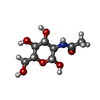
  • Ligand: 2-acetamido-2-deoxy-beta-D-glucopyranose
  • Ligand: SODIUM ION
KeywordsVoltage gated sodium channel / Nav1.5 / Ion Transport / MEMBRANE PROTEIN
Function / homology
Function and homology information


voltage-gated sodium channel activity involved in AV node cell action potential / voltage-gated sodium channel activity involved in bundle of His cell action potential / voltage-gated sodium channel activity involved in Purkinje myocyte action potential / voltage-gated sodium channel activity involved in SA node cell action potential / bundle of His cell action potential / regulation of ventricular cardiac muscle cell membrane depolarization / AV node cell action potential / SA node cell action potential / AV node cell to bundle of His cell communication / membrane depolarization during SA node cell action potential ...voltage-gated sodium channel activity involved in AV node cell action potential / voltage-gated sodium channel activity involved in bundle of His cell action potential / voltage-gated sodium channel activity involved in Purkinje myocyte action potential / voltage-gated sodium channel activity involved in SA node cell action potential / bundle of His cell action potential / regulation of ventricular cardiac muscle cell membrane depolarization / AV node cell action potential / SA node cell action potential / AV node cell to bundle of His cell communication / membrane depolarization during SA node cell action potential / response to denervation involved in regulation of muscle adaptation / membrane depolarization during atrial cardiac muscle cell action potential / regulation of atrial cardiac muscle cell membrane repolarization / cardiac ventricle development / voltage-gated sodium channel activity involved in cardiac muscle cell action potential / brainstem development / membrane depolarization during AV node cell action potential / regulation of atrial cardiac muscle cell membrane depolarization / membrane depolarization during bundle of His cell action potential / positive regulation of action potential / atrial cardiac muscle cell action potential / membrane depolarization during Purkinje myocyte cell action potential / cardiac conduction system development / telencephalon development / membrane depolarization during cardiac muscle cell action potential / positive regulation of sodium ion transport / membrane depolarization during action potential / regulation of sodium ion transmembrane transport / ventricular cardiac muscle cell action potential / regulation of ventricular cardiac muscle cell membrane repolarization / cardiac muscle cell action potential involved in contraction / voltage-gated sodium channel complex / regulation of cardiac muscle cell contraction / Interaction between L1 and Ankyrins / voltage-gated sodium channel activity / ankyrin binding / odontogenesis of dentin-containing tooth / sodium ion transport / Phase 0 - rapid depolarisation / regulation of heart rate by cardiac conduction / fibroblast growth factor binding / nitric-oxide synthase binding / intercalated disc / lateral plasma membrane / membrane depolarization / cardiac muscle contraction / T-tubule / regulation of heart rate / cellular response to calcium ion / cerebellum development / positive regulation of epithelial cell proliferation / sodium ion transmembrane transport / sarcolemma / caveola / Z disc / scaffold protein binding / transmembrane transporter binding / calmodulin binding / protein domain specific binding / ubiquitin protein ligase binding / protein kinase binding / nucleolus / perinuclear region of cytoplasm / enzyme binding / cell surface / endoplasmic reticulum / nucleoplasm / membrane / plasma membrane
Similarity search - Function
Voltage gated sodium channel, alpha-5 subunit / Voltage-gated Na+ ion channel, cytoplasmic domain / Cytoplasmic domain of voltage-gated Na+ ion channel / Sodium ion transport-associated / Voltage-gated sodium channel alpha subunit, inactivation gate / : / Sodium ion transport-associated / SCN5A-like, C-terminal IQ motif / Voltage gated sodium channel, alpha subunit / Voltage-gated cation channel calcium and sodium ...Voltage gated sodium channel, alpha-5 subunit / Voltage-gated Na+ ion channel, cytoplasmic domain / Cytoplasmic domain of voltage-gated Na+ ion channel / Sodium ion transport-associated / Voltage-gated sodium channel alpha subunit, inactivation gate / : / Sodium ion transport-associated / SCN5A-like, C-terminal IQ motif / Voltage gated sodium channel, alpha subunit / Voltage-gated cation channel calcium and sodium / Voltage-dependent channel domain superfamily / Ion transport domain / Ion transport protein
Similarity search - Domain/homology
Sodium channel protein type 5 subunit alpha
Similarity search - Component
Biological speciesMammalia (mammals) / Homo sapiens (human)
Methodsingle particle reconstruction / cryo EM / Resolution: 3.48 Å
AuthorsBiswas R / Chinthalapudi K
Funding support United States, 1 items
OrganizationGrant numberCountry
National Institutes of Health/National Heart, Lung, and Blood Institute (NIH/NHLBI)R01HL094450 United States
CitationJournal: Nat Commun / Year: 2026
Title: Structural and functional mechanisms underlying activation gate dynamics and IFM motif accessibility in human Na1.5.
Authors: Rupam Biswas / Ana Laura López-Serrano / Apoorva Purohit / Angelina Ramirez-Navarro / Hsiang-Ling Huang / Xiaolin Cheng / Sarah M Heissler / Isabelle Deschênes / Krishna Chinthalapudi /
Abstract: Voltage-gated sodium channels are vital for regulating excitability in muscle and nerve cells, and their dysregulation is linked to a range of diseases. However, therapeutic targeting of Na channels ...Voltage-gated sodium channels are vital for regulating excitability in muscle and nerve cells, and their dysregulation is linked to a range of diseases. However, therapeutic targeting of Na channels remains challenging due to a limited understanding of their gating mechanisms. Here, we present a cryo-EM structure of human Na1.5 in an intermediate open state, stabilized by interactions between the N-terminal domain and the S6 segment. This structure reveals a possible Na binding site adjacent to the conserved inactivation (IFM) motif. Molecular dynamics simulations demonstrate that monovalent cations stably occupy this site, while electrophysiological recordings demonstrate that ion binding modulates IFM motif docking and fast inactivation kinetics. Our findings reveal that IFM accessibility is dynamically regulated in this intermediate state, refining the canonical door-wedge model of fast inactivation. Collectively, our study provides a revised structural framework for Na1.5 gating mechanisms, suggesting an alternative pathway for ion accessibility that may inform better mechanistic and therapeutic strategies for treating Na1.5-related cardiac arrhythmias.
History
DepositionJun 11, 2025-
Header (metadata) releaseApr 8, 2026-
Map releaseApr 8, 2026-
UpdateApr 8, 2026-
Current statusApr 8, 2026Processing site: RCSB / Status: Released

-
Structure visualization

Supplemental images

Downloads & links

-
Map

FileDownload / File: emd_71158.map.gz / Format: CCP4 / Size: 125 MB / Type: IMAGE STORED AS FLOATING POINT NUMBER (4 BYTES)
Projections & slices

Image control

Size
Brightness
Contrast
Others
AxesZ (Sec.)Y (Row.)X (Col.)
0.9 Å/pix.
x 320 pix.
= 287.68 Å
0.9 Å/pix.
x 320 pix.
= 287.68 Å
0.9 Å/pix.
x 320 pix.
= 287.68 Å

Surface

Projections

Slices (1/3)

Slices (1/2)

Slices (2/3)

Images are generated by Spider.

Voxel sizeX=Y=Z: 0.899 Å
Density
Contour LevelBy AUTHOR: 0.079
Minimum - Maximum-0.59759396 - 0.888025
Average (Standard dev.)0.0009940794 (±0.021642607)
SymmetrySpace group: 1
Details

EMDB XML:

Map geometry
Axis orderXYZ
Origin000
Dimensions320320320
Spacing320320320
CellA=B=C: 287.68 Å
α=β=γ: 90.0 °

-
Supplemental data

-
Mask #1

Fileemd_71158_msk_1.map
Projections & Slices
AxesZYX

Projections

Slices (1/2)
Density Histograms

-
Half map: #1

Fileemd_71158_half_map_1.map
Projections & Slices
AxesZYX

Projections

Slices (1/2)
Density Histograms

-
Half map: #2

Fileemd_71158_half_map_2.map
Projections & Slices
AxesZYX

Projections

Slices (1/2)
Density Histograms

-
Sample components

-
Entire : Sodium channel protein type 5 subunit alpha

EntireName: Sodium channel protein type 5 subunit alpha
Components
  • Organelle or cellular component: Sodium channel protein type 5 subunit alpha
    • Protein or peptide: Sodium channel protein type 5 subunit alpha
  • Ligand: (3beta,14beta,17beta,25R)-3-[4-methoxy-3-(methoxymethyl)butoxy]spirost-5-en
  • Ligand: 2-acetamido-2-deoxy-beta-D-glucopyranose
  • Ligand: SODIUM ION

-
Supramolecule #1: Sodium channel protein type 5 subunit alpha

SupramoleculeName: Sodium channel protein type 5 subunit alpha / type: organelle_or_cellular_component / ID: 1 / Parent: 0 / Macromolecule list: #1
Source (natural)Organism: Mammalia (mammals)
Molecular weightTheoretical: 226.9 KDa

-
Macromolecule #1: Sodium channel protein type 5 subunit alpha

MacromoleculeName: Sodium channel protein type 5 subunit alpha / type: protein_or_peptide / ID: 1 / Number of copies: 1 / Enantiomer: LEVO
Source (natural)Organism: Homo sapiens (human)
Molecular weightTheoretical: 227.152156 KDa
Recombinant expressionOrganism: Homo sapiens (human)
SequenceString: MANFLLPRGT SSFRRFTRES LAAIEKRMAE KQARGSTTLQ ESREGLPEEE APRPQLDLQA SKKLPDLYGN PPQELIGEPL EDLDPFYST QKTFIVLNKG KTIFRFSATN ALYVLSPFHP IRRAAVKILV HSLFNMLIMC TILTNCVFMA QHDPPPWTKY V EYTFTAIY ...String:
MANFLLPRGT SSFRRFTRES LAAIEKRMAE KQARGSTTLQ ESREGLPEEE APRPQLDLQA SKKLPDLYGN PPQELIGEPL EDLDPFYST QKTFIVLNKG KTIFRFSATN ALYVLSPFHP IRRAAVKILV HSLFNMLIMC TILTNCVFMA QHDPPPWTKY V EYTFTAIY TFESLVKILA RGFCLHAFTF LRDPWNWLDF SVIIMAYTTE FVDLGNVSAL RTFRVLRALK TISVISGLKT IV GALIQSV KKLADVMVLT VFCLSVFALI GLQLFMGNLR HKCVRNFTAL NGTNGSVEAD GLVWESLDLY LSDPENYLLK NGT SDVLLC GNSSDAGTCP EGYRCLKAGE NPDHGYTSFD SFAWAFLALF RLMTQDCWER LYQQTLRSAG KIYMIFFMLV IFLG SFYLV NLILAVVAMA YEEQNQATIA ETEEKEKRFQ EAMEMLKKEH EALTIRGVDT VSRSSLEMSP LAPVNSHERR SKRRK RMSS GTEECGEDRL PKSDSEDGPR AMNHLSLTRG LSRTSMKPRS SRGSIFTFRR RDLGSEADFA DDENSTAGES ESHHTS LLV PWPLRRTSAQ GQPSPGTSAP GHALHGKKNS TVDCNGVVSL LGAGDPEATS PGSHLLRPVM LEHPPDTTTP SEEPGGP QM LTSQAPCVDG FEEPGARQRA LSAVSVLTSA LEELEESRHK CPPCWNRLAQ RYLIWECCPL WMSIKQGVKL VVMDPFTD L TITMCIVLNT LFMALEHYNM TSEFEEMLQV GNLVFTGIFT AEMTFKIIAL DPYYYFQQGW NIFDSIIVIL SLMELGLSR MSNLSVLRSF RLLRVFKLAK SWPTLNTLIK IIGNSVGALG NLTLVLAIIV FIFAVVGMQL FGKNYSELRD SDSGLLPRWH MMDFFHAFL IIFRILCGEW IETMWDCMEV SGQSLCLLVF LLVMVIGNLV VLNLFLALLL SSFSADNLTA PDEDREMNNL Q LALARIQR GLRFVKRTTW DFCCGLLRQR PQKPAALAAQ GQLPSCIATP YSPPPPETEK VPPTRKETRF EEGEQPGQGT PG DPEPVCV PIAVAESDTD DQEEDEENSL GTEEESSKQQ ESQPVSGGPE APPDSRTWSQ VSATASSEAE ASASQADWRQ QWK AEPQAP GCGETPEDSC SEGSTADMTN TAELLEQIPD LGQDVKDPED CFTEGCVRRC PCCAVDTTQA PGKVWWRLRK TCYH IVEHS WFETFIIFMI LLSSGALAFE DIYLEERKTI KVLLEYADKM FTYVFVLEML LKWVAYGFKK YFTNAWCWLD FLIVD VSLV SLVANTLGFA EMGPIKSLRT LRALRPLRAL SRFEGMRVVV NALVGAIPSI MNVLLVCLIF WLIFSIMGVN LFAGKF GRC INQTEGDLPL NYTIVNNKSQ CESLNLTGEL YWTKVKVNFD NVGAGYLALL QVATFKGWMD IMYAAVDSRG YEEQPQW EY NLYMYIYFVI FIIFGSFFTL NLFIGVIIDN FNQQKKKLGG QDIFMTEEQK KYYNAMKKLG SKKPQKPIPR PLNKYQGF I FDIVTKQAFD VTIMFLICLN MVTMMVETDD QSPEKINILA KINLLFVAIF TGECIVKLAA LRHYYFTNSW NIFDFVVVI LSIVGTVLSD IIQKYFFSPT LFRVIRLARI GRILRLIRGA KGIRTLLFAL MMSLPALFNI GLLLFLVMFI YSIFGMANFA YVKWEAGID DMFNFQTFAN SMLCLFQITT SAGWDGLLSP ILNTGPPYCD PTLPNSNGSR GDCGSPAVGI LFFTTYIIIS F LIVVNMYI AIILENFSVA TEESTEPLSE DDFDMFYEIW EKFDPEATQF IEYSVLSDFA DALSEPLRIA KPNQISLINM DL PMVSGDR IHCMDILFAF TKRVLGESGE MDALKIQMEE KFMAANPSKI SYEPITTTLR RKHEEVSAMV IQRAFRRHLL QRS LKHASF LFRQQAGSGL SEEDAPEREG LIAYVMSENF SRPLGPPSSS SISSTSFPPS YDSVTRATSD NLQVRGSDYS HSED LADFP PSPDRDRESI V

UniProtKB: Sodium channel protein type 5 subunit alpha

-
Macromolecule #2: (3beta,14beta,17beta,25R)-3-[4-methoxy-3-(methoxymethyl)butoxy]sp...

MacromoleculeName: (3beta,14beta,17beta,25R)-3-[4-methoxy-3-(methoxymethyl)butoxy]spirost-5-en
type: ligand / ID: 2 / Number of copies: 1 / Formula: 9Z9
Molecular weightTheoretical: 544.805 Da
Chemical component information

ChemComp-9Z9:
(3beta,14beta,17beta,25R)-3-[4-methoxy-3-(methoxymethyl)butoxy]spirost-5-en / detergent*YM

-
Macromolecule #3: 2-acetamido-2-deoxy-beta-D-glucopyranose

MacromoleculeName: 2-acetamido-2-deoxy-beta-D-glucopyranose / type: ligand / ID: 3 / Number of copies: 8 / Formula: NAG
Molecular weightTheoretical: 221.208 Da
Chemical component information

ChemComp-NAG:
2-acetamido-2-deoxy-beta-D-glucopyranose

-
Macromolecule #4: SODIUM ION

MacromoleculeName: SODIUM ION / type: ligand / ID: 4 / Number of copies: 1
Molecular weightTheoretical: 22.99 Da

-
Experimental details

-
Structure determination

Methodcryo EM
Processingsingle particle reconstruction
Aggregation stateparticle

-
Sample preparation

BufferpH: 7.4
GridModel: UltrAuFoil R1.2/1.3 / Material: GOLD
VitrificationCryogen name: ETHANE

-
Electron microscopy

MicroscopeTFS KRIOS
Image recordingFilm or detector model: GATAN K3 BIOQUANTUM (6k x 4k) / Average electron dose: 60.0 e/Å2
Electron beamAcceleration voltage: 300 kV / Electron source: FIELD EMISSION GUN
Electron opticsIllumination mode: FLOOD BEAM / Imaging mode: BRIGHT FIELD / Nominal defocus max: 2.5 µm / Nominal defocus min: 0.5 µm
Experimental equipment
Model: Titan Krios / Image courtesy: FEI Company

+
Image processing

CTF correctionType: PHASE FLIPPING AND AMPLITUDE CORRECTION
Startup modelType of model: PDB ENTRY
PDB model - PDB ID:
Final reconstructionResolution.type: BY AUTHOR / Resolution: 3.48 Å / Resolution method: FSC 0.143 CUT-OFF / Software - Name: cryoSPARC / Number images used: 90155
Initial angle assignmentType: MAXIMUM LIKELIHOOD
Final angle assignmentType: MAXIMUM LIKELIHOOD
FSC plot (resolution estimation)

+
About Yorodumi

-
News

-
Feb 9, 2022. New format data for meta-information of EMDB entries

New format data for meta-information of EMDB entries

  • Version 3 of the EMDB header file is now the official format.
  • The previous official version 1.9 will be removed from the archive.

Related info.:EMDB header

External links:wwPDB to switch to version 3 of the EMDB data model

-
Aug 12, 2020. Covid-19 info

Covid-19 info

URL: https://pdbj.org/emnavi/covid19.php

New page: Covid-19 featured information page in EM Navigator.

Related info.:Covid-19 info / Mar 5, 2020. Novel coronavirus structure data

+
Mar 5, 2020. Novel coronavirus structure data

Novel coronavirus structure data

Related info.:Yorodumi Speices / Aug 12, 2020. Covid-19 info

External links:COVID-19 featured content - PDBj / Molecule of the Month (242):Coronavirus Proteases

+
Jan 31, 2019. EMDB accession codes are about to change! (news from PDBe EMDB page)

EMDB accession codes are about to change! (news from PDBe EMDB page)

  • The allocation of 4 digits for EMDB accession codes will soon come to an end. Whilst these codes will remain in use, new EMDB accession codes will include an additional digit and will expand incrementally as the available range of codes is exhausted. The current 4-digit format prefixed with “EMD-” (i.e. EMD-XXXX) will advance to a 5-digit format (i.e. EMD-XXXXX), and so on. It is currently estimated that the 4-digit codes will be depleted around Spring 2019, at which point the 5-digit format will come into force.
  • The EM Navigator/Yorodumi systems omit the EMD- prefix.

Related info.:Q: What is EMD? / ID/Accession-code notation in Yorodumi/EM Navigator

External links:EMDB Accession Codes are Changing Soon! / Contact to PDBj

+
Jul 12, 2017. Major update of PDB

Major update of PDB

  • wwPDB released updated PDB data conforming to the new PDBx/mmCIF dictionary.
  • This is a major update changing the version number from 4 to 5, and with Remediation, in which all the entries are updated.
  • In this update, many items about electron microscopy experimental information are reorganized (e.g. em_software).
  • Now, EM Navigator and Yorodumi are based on the updated data.

External links:wwPDB Remediation / Enriched Model Files Conforming to OneDep Data Standards Now Available in the PDB FTP Archive

-
Yorodumi

Thousand views of thousand structures

  • Yorodumi is a browser for structure data from EMDB, PDB, SASBDB, etc.
  • This page is also the successor to EM Navigator detail page, and also detail information page/front-end page for Omokage search.
  • The word "yorodu" (or yorozu) is an old Japanese word meaning "ten thousand". "mi" (miru) is to see.

Related info.:EMDB / PDB / SASBDB / Comparison of 3 databanks / Yorodumi Search / Aug 31, 2016. New EM Navigator & Yorodumi / Yorodumi Papers / Jmol/JSmol / Function and homology information / Changes in new EM Navigator and Yorodumi

Read more