National Institutes of Health/National Institute of Mental Health (NIH/NIMH)
MH085926
United States
National Institutes of Health/National Institute of Neurological Disorders and Stroke (NIH/NINDS)
NS111745
United States
Citation
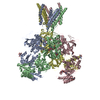
Journal: Nature / Year: 2025 Title: Mechanism of conductance control and neurosteroid binding in NMDA receptors. Authors: Hyunook Kang / Ruben Steigerwald / Elijah Z Ullman / Max Epstein / Srinu Paladugu / Dennis C Liotta / Stephen F Traynelis / Hiro Furukawa / Abstract: Ion-channel activity reflects a combination of open probability and unitary conductance. Many channels display subconductance states that modulate signalling strength, yet the structural mechanisms ...Ion-channel activity reflects a combination of open probability and unitary conductance. Many channels display subconductance states that modulate signalling strength, yet the structural mechanisms governing conductance levels remain incompletely understood. Here we report that conductance levels are controlled by the bending patterns of pore-forming transmembrane helices in the heterotetrameric neuronal channel GluN1a-2B N-methyl-D-aspartate receptor (NMDAR). Our single-particle electron cryomicroscopy (cryo-EM) analyses demonstrate that an endogenous neurosteroid and synthetic positive allosteric modulator (PAM), 24S-hydroxycholesterol (24S-HC), binds to a juxtamembrane pocket in the GluN2B subunit and stabilizes the fully open-gate conformation, where GluN1a M3 and GluN2B M3' pore-forming helices are bent to dilate the channel pore. By contrast, EU1622-240 binds to the same GluN2B juxtamembrane pocket and a distinct juxtamembrane pocket in GluN1a to stabilize a sub-open state whereby only the GluN2B M3' helix is bent. Consistent with the varying extents of gate opening, the single-channel recordings predominantly show full-conductance and subconductance states in the presence of 24S-HC and EU1622-240, respectively. Another class of neurosteroid, pregnenolone sulfate, engages a similar GluN2B pocket, but two molecules bind simultaneously, revealing a diverse neurosteroid recognition pattern. Our study identifies that the juxtamembrane pockets are critical structural hubs for modulating conductance levels in NMDAR.
In the structure databanks used in Yorodumi, some data are registered as the other names, "COVID-19 virus" and "2019-nCoV". Here are the details of the virus and the list of structure data.
Jan 31, 2019. EMDB accession codes are about to change! (news from PDBe EMDB page)
EMDB accession codes are about to change! (news from PDBe EMDB page)
The allocation of 4 digits for EMDB accession codes will soon come to an end. Whilst these codes will remain in use, new EMDB accession codes will include an additional digit and will expand incrementally as the available range of codes is exhausted. The current 4-digit format prefixed with “EMD-” (i.e. EMD-XXXX) will advance to a 5-digit format (i.e. EMD-XXXXX), and so on. It is currently estimated that the 4-digit codes will be depleted around Spring 2019, at which point the 5-digit format will come into force.
The EM Navigator/Yorodumi systems omit the EMD- prefix.
Related info.:Q: What is EMD? / ID/Accession-code notation in Yorodumi/EM Navigator
Yorodumi is a browser for structure data from EMDB, PDB, SASBDB, etc.
This page is also the successor to EM Navigator detail page, and also detail information page/front-end page for Omokage search.
The word "yorodu" (or yorozu) is an old Japanese word meaning "ten thousand". "mi" (miru) is to see.
Related info.:EMDB / PDB / SASBDB / Comparison of 3 databanks / Yorodumi Search / Aug 31, 2016. New EM Navigator & Yorodumi / Yorodumi Papers / Jmol/JSmol / Function and homology information / Changes in new EM Navigator and Yorodumi
 Movie
Movie Controller

 Yorodumi
 Open data
 Basic information
 Map data
 Sample
 Keywords
 Homo sapiens (human)
 Authors
 United States, 2 items
  Citation
 Structure visualization
 Downloads & links
 EMDB map data format
 emd_70649.png
 https://data.pdbj.org/pub/emdb/structures/EMD-70649


 Z (Sec.)
 Y (Row.)
 X (Col.)


 Sample components
 Processing
 Electron microscopy
 FIELD EMISSION GUN