 Movie
Movie Controller


+ Open data

- Basic information
| Entry |  | |||||||||
|---|---|---|---|---|---|---|---|---|---|---|
| Title | In situ mitoribosome focused on the mtSSU | |||||||||
 Map data Map data | ||||||||||
 Sample Sample |
| |||||||||
 Keywords Keywords | mitochondria / mitoribosome / inner membrane / RIBOSOME | |||||||||
| Biological species |  Homo sapiens (human) Homo sapiens (human) | |||||||||
| Method | single particle reconstruction / cryo EM / Resolution: 2.65 Å | |||||||||
 Authors Authors | Wang S / Xiong Y / Zhang Y | |||||||||
| Funding support |  United States, 1 items United States, 1 items
| |||||||||
 Citation Citation | Journal: Nat Commun / Year: 2026 Title: Structural basis of TACO1-mediated efficient mitochondrial translation. Authors: Shuhui Wang / Michele Brischigliaro / Yuekang Zhang / Chunxiang Wu / Wei Zheng / Antoni Barrientos / Yong Xiong / Abstract: Translation elongation is a universally conserved step in protein synthesis, relying on elongation factors that engage the ribosomal L7/L12 stalk to mediate aminoacyl-tRNA delivery, accommodation, ...Translation elongation is a universally conserved step in protein synthesis, relying on elongation factors that engage the ribosomal L7/L12 stalk to mediate aminoacyl-tRNA delivery, accommodation, and ribosomal translocation. Using in organello cryo-electron microscopy, we reveal how the mitochondrial translation accelerator TACO1 promotes efficient elongation on human mitoribosomes. TACO1 binds the mitoribosomal region typically bound by elongation factor Tu (mtEF-Tu), bridging the large and small subunits via contacts with 16S rRNA, bL12m, A-site tRNA, and uS12m. While active throughout elongation, TACO1 is especially critical when translating polyproline motifs. Its absence prolongs mtEF-Tu residence in A/T states, causes persistent mitoribosomal stalling and premature subunit dissociation. Structural analyses indicate that TACO1 competes with mtEF-Tu for mitoribosome binding, stabilizes A-site tRNA, and enhances peptidyl transfer through a mechanism distinct from EF-P and eIF5A. These findings suggest that bacterial TACO1 orthologs may serve analogous roles, highlighting an evolutionarily conserved strategy for maintaining elongation efficiency during challenging translation events. | |||||||||
| History |
|
- Structure visualization
| Supplemental images |
|---|

- Downloads & links
-EMDB archive
| Map data | emd_70620.map.gz | 213.1 MB |  EMDB map data format EMDB map data format | |
|---|---|---|---|---|
| Header (meta data) | emd-70620-v30.xmlemd-70620.xml | 16.5 KB 16.5 KB | Display Display | EMDB header |
| FSC (resolution estimation) | emd_70620_fsc.xml | 15.8 KB | Display | FSC data file |
| Images |  emd_70620.png emd_70620.png | 62.1 KB | ||
| Masks | emd_70620_msk_1.map | 421.9 MB | Mask map | |
| Filedesc metadata | emd-70620.cif.gz | 4.1 KB | ||
| Others | emd_70620_additional_1.map.gzemd_70620_half_map_1.map.gzemd_70620_half_map_2.map.gz | 398.9 MB 391.9 MB 391.9 MB | ||
| Archive directory |  https://data.pdbj.org/pub/emdb/structures/EMD-70620ftp://data.pdbj.org/pub/emdb/structures/EMD-70620 https://data.pdbj.org/pub/emdb/structures/EMD-70620ftp://data.pdbj.org/pub/emdb/structures/EMD-70620 | HTTPS FTP |
-Related structure data
| Related structure data |  9olfC  9pg8C  9pgfC 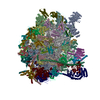 9pgiC  9pglC  9pgmC 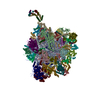 9pr4C  9praC  9prdC  9prqC  9prxC  9ps0C  9ps7C  9psiC  9psmC C: citing same article ( |
|---|


-Links
| EMDB pages | EMDB (EBI/PDBe) / EMDataResource |
|---|
-Map
| File | Download / File: emd_70620.map.gz / Format: CCP4 / Size: 421.9 MB / Type: IMAGE STORED AS FLOATING POINT NUMBER (4 BYTES) | ||||||||||||||||||||||||||||||||||||
|---|---|---|---|---|---|---|---|---|---|---|---|---|---|---|---|---|---|---|---|---|---|---|---|---|---|---|---|---|---|---|---|---|---|---|---|---|---|
| Projections & slices | Image control
Images are generated by Spider. | ||||||||||||||||||||||||||||||||||||
| Voxel size | X=Y=Z: 1.068 Å | ||||||||||||||||||||||||||||||||||||
| Density |
| ||||||||||||||||||||||||||||||||||||
| Symmetry | Space group: 1 | ||||||||||||||||||||||||||||||||||||
| Details | EMDB XML:
|
 Z (Sec.)
 Y (Row.)
 X (Col.)


-Supplemental data
-Mask #1
| File | emd_70620_msk_1.map | ||||||||||||
|---|---|---|---|---|---|---|---|---|---|---|---|---|---|
| Projections & Slices |
| ||||||||||||
| Density Histograms |


-Additional map: #1
| File | emd_70620_additional_1.map | ||||||||||||
|---|---|---|---|---|---|---|---|---|---|---|---|---|---|
| Projections & Slices |
| ||||||||||||
| Density Histograms |


-Half map: #1
| File | emd_70620_half_map_1.map | ||||||||||||
|---|---|---|---|---|---|---|---|---|---|---|---|---|---|
| Projections & Slices |
| ||||||||||||
| Density Histograms |


-Half map: #2
| File | emd_70620_half_map_2.map | ||||||||||||
|---|---|---|---|---|---|---|---|---|---|---|---|---|---|
| Projections & Slices |
| ||||||||||||
| Density Histograms |


- Sample components
-Entire : In situ mitoribosome focused on mtSSU
| Entire | Name: In situ mitoribosome focused on mtSSU |
|---|---|
| Components |
|
-Supramolecule #1: In situ mitoribosome focused on mtSSU
| Supramolecule | Name: In situ mitoribosome focused on mtSSU / type: complex / ID: 1 / Parent: 0 |
|---|---|
| Source (natural) | Organism: Homo sapiens (human) |
-Experimental details
-Structure determination
| Method | cryo EM |
|---|---|
 Processing Processing | single particle reconstruction |
| Aggregation state | particle |
-Sample preparation
| Buffer | pH: 7.4 |
|---|---|
| Vitrification | Cryogen name: ETHANE |
- Electron microscopy
| Microscope | TFS KRIOS |
|---|---|
| Image recording | Film or detector model: GATAN K3 (6k x 4k) / Average electron dose: 55.0 e/Å2 |
| Electron beam | Acceleration voltage: 300 kV / Electron source:  FIELD EMISSION GUN FIELD EMISSION GUN |
| Electron optics | Illumination mode: FLOOD BEAM / Imaging mode: BRIGHT FIELD / Nominal defocus max: 5.0 µm / Nominal defocus min: 1.2 µm |
| Experimental equipment |  Model: Titan Krios / Image courtesy: FEI Company |


