negative regulation of monoatomic ion transmembrane transport / positive regulation by virus of viral protein levels in host cell / spindle assembly involved in female meiosis / epigenetic programming in the zygotic pronuclei / UV-damage excision repair / cyclin A1-CDK2 complex / cyclin E2-CDK2 complex / cyclin E1-CDK2 complex / cyclin A2-CDK2 complex / G2 Phase ...negative regulation of monoatomic ion transmembrane transport / positive regulation by virus of viral protein levels in host cell / spindle assembly involved in female meiosis / epigenetic programming in the zygotic pronuclei / UV-damage excision repair / cyclin A1-CDK2 complex / cyclin E2-CDK2 complex / cyclin E1-CDK2 complex / cyclin A2-CDK2 complex / G2 Phase / Y chromosome / cyclin-dependent protein kinase activity / regulation of heterochromatin organization / biological process involved in interaction with symbiont / Phosphorylation of proteins involved in G1/S transition by active Cyclin E:Cdk2 complexes / positive regulation of heterochromatin formation / p53-Dependent G1 DNA Damage Response / regulation of mitotic cytokinesis / X chromosome / regulation of mitotic cell cycle phase transition / PTK6 Regulates Cell Cycle / regulation of miRNA-mediated gene silencing / regulation of natural killer cell activation / WD40-repeat domain binding / regulation of anaphase-promoting complex-dependent catabolic process / Defective binding of RB1 mutants to E2F1,(E2F2, E2F3) / locomotory exploration behavior / regulation of cell cycle phase transition / Cul4A-RING E3 ubiquitin ligase complex / Cul4-RING E3 ubiquitin ligase complex / regulation of stem cell population maintenance / centriole replication / Cul4B-RING E3 ubiquitin ligase complex / telomere maintenance in response to DNA damage / Regulation of APC/C activators between G1/S and early anaphase / ubiquitin ligase complex scaffold activity / negative regulation of adipose tissue development / G0 and Early G1 / regulation of cellular response to stress / limb development / viral release from host cell / Activation of the pre-replicative complex / Telomere Extension By Telomerase / cyclin-dependent protein kinase holoenzyme complex / cyclin-dependent kinase / cullin family protein binding / cyclin-dependent protein serine/threonine kinase activity / TP53 Regulates Transcription of Genes Involved in G1 Cell Cycle Arrest / Regulation of MITF-M-dependent genes involved in cell cycle and proliferation / Cajal body / Activation of ATR in response to replication stress / positive regulation of Wnt signaling pathway / Cyclin E associated events during G1/S transition / negative regulation of protein-containing complex assembly / regulation of DNA-templated DNA replication initiation / centrosome duplication / Cyclin A:Cdk2-associated events at S phase entry / positive regulation of viral genome replication / positive regulation of gluconeogenesis / Cyclin A/B1/B2 associated events during G2/M transition / condensed chromosome / mitotic G1 DNA damage checkpoint signaling / cellular response to nitric oxide / post-translational protein modification / regulation of embryonic development / cyclin binding / positive regulation of DNA replication / replication fork processing / negative regulation of protein localization to chromatin / regulation of mitotic cell cycle / G1/S transition of mitotic cell cycle / G2/M transition of mitotic cell cycle / proteasomal protein catabolic process / epigenetic regulation of gene expression / positive regulation of protein-containing complex assembly / nucleotide-excision repair / meiotic cell cycle / peptidyl-serine phosphorylation / cellular senescence / regulation of autophagy / Recognition of DNA damage by PCNA-containing replication complex / DNA Damage/Telomere Stress Induced Senescence / regulation of circadian rhythm / Meiotic recombination / cell population proliferation / DNA Damage Recognition in GG-NER / CDK-mediated phosphorylation and removal of Cdc6 / Dual Incision in GG-NER / SCF(Skp2)-mediated degradation of p27/p21 / Transcription-Coupled Nucleotide Excision Repair (TC-NER) / Transcriptional regulation of granulopoiesis / Formation of TC-NER Pre-Incision Complex / Formation of Incision Complex in GG-NER / Orc1 removal from chromatin / positive regulation of protein catabolic process / cellular response to UV / Cyclin D associated events in G1 / Dual incision in TC-NER / Gap-filling DNA repair synthesis and ligation in TC-NER / Regulation of TP53 Degradation Similarity search - Function
Yippee/Mis18/Cereblon / Yippee zinc-binding/DNA-binding /Mis18, centromere assembly / CULT domain / CULT domain profile. / Lon N-terminal domain profile. / Lon protease, N-terminal domain / Lon protease, N-terminal domain superfamily / ATP-dependent protease La (LON) substrate-binding domain / Found in ATP-dependent protease La (LON) / : ...Yippee/Mis18/Cereblon / Yippee zinc-binding/DNA-binding /Mis18, centromere assembly / CULT domain / CULT domain profile. / Lon N-terminal domain profile. / Lon protease, N-terminal domain / Lon protease, N-terminal domain superfamily / ATP-dependent protease La (LON) substrate-binding domain / Found in ATP-dependent protease La (LON) / : / RSE1/DDB1/CPSF1 second beta-propeller / Cleavage/polyadenylation specificity factor, A subunit, C-terminal / Cleavage/polyadenylation specificity factor, A subunit, N-terminal / : / CPSF A subunit region / RSE1/DDB1/CPSF1 first beta-propeller / PUA-like superfamily / : / Serine/threonine-protein kinase, active site / Serine/Threonine protein kinases active-site signature. / Protein kinase domain / Serine/Threonine protein kinases, catalytic domain / WD40-repeat-containing domain superfamily / WD40/YVTN repeat-like-containing domain superfamily / Protein kinase, ATP binding site / Protein kinases ATP-binding region signature. / Protein kinase domain profile. / Protein kinase domain / Protein kinase-like domain superfamily Similarity search - Domain/homology
National Natural Science Foundation of China (NSFC)
China
Citation
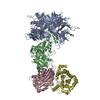
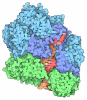
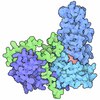
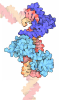
Journal: J Med Chem / Year: 2026 Title: Selective CDK2 Degradation via Noncanonical Recruitment. Authors: Yuanyuan Pei / Weiye Lin / Xinzhu Li / Yuhang Meng / Yuling Yin / Benxun Pan / Lixin Zhou / Linhui Cao / Yong Cang / Yi Jiang / Wenchao Lu / Zhanchao Meng / Abstract: Cyclin-dependent kinase 2 (CDK2) represents a critical therapeutic target in tumors resistant to CDK4/6 inhibitors or with amplification. However, selective inhibition of CDK2 remains challenging ...Cyclin-dependent kinase 2 (CDK2) represents a critical therapeutic target in tumors resistant to CDK4/6 inhibitors or with amplification. However, selective inhibition of CDK2 remains challenging owing to the high structural homology among CDKs. In this study, we identify and as cereblon (CRBN)-based molecular glue degraders that selectively degrade CDK2. Ternary complex structures reveal a noncanonical recruitment mode centered on CDK2 Glu57, which bypasses the canonical G-loop/β-hairpin and kinase glycine-rich loop interactions and is stabilized by an extended CRBN-CDK2 interface. Mechanistically, these degraders inhibit retinoblastoma (Rb) phosphorylation and induce G1/S-phase arrest, suppressing CDK2-dependent cell proliferation. further exhibits improved pharmacokinetics, measurable oral bioavailability, and target engagement, achieving intratumoral CDK2 degradation following intraperitoneal administration. Collectively, this study provides a structural blueprint for designing selective kinase degraders and establishes B12 as a chemically tractable probe for targeting CDK2-driven malignancies.
In the structure databanks used in Yorodumi, some data are registered as the other names, "COVID-19 virus" and "2019-nCoV". Here are the details of the virus and the list of structure data.
Jan 31, 2019. EMDB accession codes are about to change! (news from PDBe EMDB page)
EMDB accession codes are about to change! (news from PDBe EMDB page)
The allocation of 4 digits for EMDB accession codes will soon come to an end. Whilst these codes will remain in use, new EMDB accession codes will include an additional digit and will expand incrementally as the available range of codes is exhausted. The current 4-digit format prefixed with “EMD-” (i.e. EMD-XXXX) will advance to a 5-digit format (i.e. EMD-XXXXX), and so on. It is currently estimated that the 4-digit codes will be depleted around Spring 2019, at which point the 5-digit format will come into force.
The EM Navigator/Yorodumi systems omit the EMD- prefix.
Related info.:Q: What is EMD? / ID/Accession-code notation in Yorodumi/EM Navigator
Yorodumi is a browser for structure data from EMDB, PDB, SASBDB, etc.
This page is also the successor to EM Navigator detail page, and also detail information page/front-end page for Omokage search.
The word "yorodu" (or yorozu) is an old Japanese word meaning "ten thousand". "mi" (miru) is to see.
Related info.:EMDB / PDB / SASBDB / Comparison of 3 databanks / Yorodumi Search / Aug 31, 2016. New EM Navigator & Yorodumi / Yorodumi Papers / Jmol/JSmol / Function and homology information / Changes in new EM Navigator and Yorodumi
 Movie
Movie Controller

 Yorodumi
 Open data
 Basic information
 Map data
 Sample
 Keywords
 Function and homology information
 Homo sapiens (human)
 Authors
 China, 1 items
  Citation
 Structure visualization
 Downloads & links
 emd_69484.png
 http://ftp.pdbj.org/pub/emdb/structures/EMD-69484




 Z (Sec.)
 Y (Row.)
 X (Col.)


 Sample components
 Spodoptera frugiperda (fall armyworm)
 Processing
 Electron microscopy
 FIELD EMISSION GUN