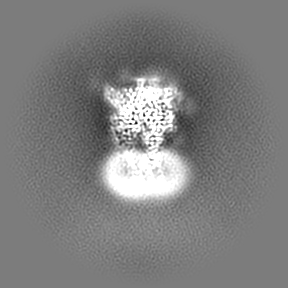
- EMDB-67603: Cryo-EM structure of the human P2X3 receptor in the ATP-bound, de... -
+
Open data
ID or keywords:
Loading...
-
Basic information
Entry
Database: EMDB / ID: EMD-67603
Title
Cryo-EM structure of the human P2X3 receptor in the ATP-bound, desensitized state
Map data
Sample
Complex: human P2X3 trimer
Protein or peptide: P2X purinoceptor 3
Ligand: ADENOSINE-5'-TRIPHOSPHATE
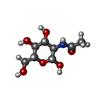
Ligand: 2-acetamido-2-deoxy-beta-D-glucopyranose
Keywords
P2X3 / TRANSPORT PROTEIN
Function / homology
Function and homology information
Platelet homeostasis / extracellularly ATP-gated monoatomic cation channel activity / purinergic nucleotide receptor activity / Elevation of cytosolic Ca2+ levels / protein homotrimerization / cellular response to ATP / positive regulation of calcium ion transport into cytosol / positive regulation of calcium-mediated signaling / hippocampal mossy fiber to CA3 synapse / modulation of chemical synaptic transmission ...Platelet homeostasis / extracellularly ATP-gated monoatomic cation channel activity / purinergic nucleotide receptor activity / Elevation of cytosolic Ca2+ levels / protein homotrimerization / cellular response to ATP / positive regulation of calcium ion transport into cytosol / positive regulation of calcium-mediated signaling / hippocampal mossy fiber to CA3 synapse / modulation of chemical synaptic transmission / Schaffer collateral - CA1 synapse / calcium ion transmembrane transport / transmembrane transport / signaling receptor complex / postsynapse / axon / signal transduction / ATP binding / metal ion binding / plasma membrane Similarity search - Function
National Natural Science Foundation of China (NSFC)
China
Citation
Journal: PLoS Biol / Year: 2026 Title: Structure of the human P2X3 receptor reveals the basis for subtype-selective inhibition by sivopixant. Authors: Zhixuan Zhao / Dong-Ping Wang / Xin Zhang / Yuan Gao / Hexin Xu / Xinyu Teng / Cheng Shen / Jirui Chen / Jinru Zhang / Chang-Run Guo / Motoyuki Hattori / Abstract: P2X receptors are ATP-gated cation channels, and the P2X3 subtype plays crucial roles in peripheral sensory neurons, including in chronic pain and chronic cough. Accordingly, P2X3 receptors have ...P2X receptors are ATP-gated cation channels, and the P2X3 subtype plays crucial roles in peripheral sensory neurons, including in chronic pain and chronic cough. Accordingly, P2X3 receptors have attracted substantial interest as a therapeutic target. Gefapixant, a negative allosteric modulator (NAM) of P2X3 receptors, has been approved in some countries for the treatment of chronic cough; however, its limited selectivity for P2X3 homomers over P2X2/P2X3 heteromers is associated with taste disturbance as a prominent adverse effect. These limitations have motivated the development of next-generation NAMs with improved subtype selectivity, but their subtype-specific allosteric inhibition mechanisms are unclear. Here, we report the cryo-EM structure of the human P2X3 receptor in complex with ATP and the P2X3-selective next-generation NAM sivopixant, an investigational drug. Sivopixant binds to an allosteric site at the portal of the central pocket in the extracellular domain, and structure-based mutational analysis by electrophysiology identifies key residues required for sivopixant-dependent inhibition of human P2X3 receptors. Structural comparisons across P2X subtypes, together with patch-clamp analyses of gain-of-function mutants that confer sensitivity to two investigational drugs, sivopixant and camlipixant, provided a broadly applicable structural framework for subtype selectivity. Furthermore, structural comparisons with apo and ATP-bound open states of P2X3 receptors, together with molecular dynamics simulations, revealed that sivopixant expands the upper-body domain to suppress the lower-body movements required for channel activation, thereby preventing channel opening even in the presence of ATP.
In the structure databanks used in Yorodumi, some data are registered as the other names, "COVID-19 virus" and "2019-nCoV". Here are the details of the virus and the list of structure data.
Jan 31, 2019. EMDB accession codes are about to change! (news from PDBe EMDB page)
EMDB accession codes are about to change! (news from PDBe EMDB page)
The allocation of 4 digits for EMDB accession codes will soon come to an end. Whilst these codes will remain in use, new EMDB accession codes will include an additional digit and will expand incrementally as the available range of codes is exhausted. The current 4-digit format prefixed with “EMD-” (i.e. EMD-XXXX) will advance to a 5-digit format (i.e. EMD-XXXXX), and so on. It is currently estimated that the 4-digit codes will be depleted around Spring 2019, at which point the 5-digit format will come into force.
The EM Navigator/Yorodumi systems omit the EMD- prefix.
Related info.:Q: What is EMD? / ID/Accession-code notation in Yorodumi/EM Navigator
Yorodumi is a browser for structure data from EMDB, PDB, SASBDB, etc.
This page is also the successor to EM Navigator detail page, and also detail information page/front-end page for Omokage search.
The word "yorodu" (or yorozu) is an old Japanese word meaning "ten thousand". "mi" (miru) is to see.
Related info.:EMDB / PDB / SASBDB / Comparison of 3 databanks / Yorodumi Search / Aug 31, 2016. New EM Navigator & Yorodumi / Yorodumi Papers / Jmol/JSmol / Function and homology information / Changes in new EM Navigator and Yorodumi
 Movie
Movie Controller

 Yorodumi
 Open data
 Basic information
 Map data
 Sample
 Keywords
 Function and homology information
 Homo sapiens (human)
 Authors
 China, 1 items
  Citation
 Structure visualization
 Downloads & links
 emd_67603.png
 http://ftp.pdbj.org/pub/emdb/structures/EMD-67603


 Z (Sec.)
 Y (Row.)
 X (Col.)




 Sample components
 Spodoptera frugiperda (fall armyworm)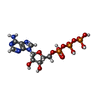
 Processing
 Electron microscopy
 FIELD EMISSION GUN


