 Movie
Movie Controller
 Structure viewers
 About Yorodumi Papers


+Search query
-Structure paper
| Title | Structure of the human P2X3 receptor reveals the basis for subtype-selective inhibition by sivopixant. |
|---|---|
| Journal, issue, pages | PLoS Biol, Vol. 24, Issue 4, Page e3003777, Year 2026 |
| Publish date | Apr 22, 2026 |
 Authors Authors | Zhixuan Zhao / Dong-Ping Wang / Xin Zhang / Yuan Gao / Hexin Xu / Xinyu Teng / Cheng Shen / Jirui Chen / Jinru Zhang / Chang-Run Guo / Motoyuki Hattori /  |
| PubMed Abstract | P2X receptors are ATP-gated cation channels, and the P2X3 subtype plays crucial roles in peripheral sensory neurons, including in chronic pain and chronic cough. Accordingly, P2X3 receptors have ...P2X receptors are ATP-gated cation channels, and the P2X3 subtype plays crucial roles in peripheral sensory neurons, including in chronic pain and chronic cough. Accordingly, P2X3 receptors have attracted substantial interest as a therapeutic target. Gefapixant, a negative allosteric modulator (NAM) of P2X3 receptors, has been approved in some countries for the treatment of chronic cough; however, its limited selectivity for P2X3 homomers over P2X2/P2X3 heteromers is associated with taste disturbance as a prominent adverse effect. These limitations have motivated the development of next-generation NAMs with improved subtype selectivity, but their subtype-specific allosteric inhibition mechanisms are unclear. Here, we report the cryo-EM structure of the human P2X3 receptor in complex with ATP and the P2X3-selective next-generation NAM sivopixant, an investigational drug. Sivopixant binds to an allosteric site at the portal of the central pocket in the extracellular domain, and structure-based mutational analysis by electrophysiology identifies key residues required for sivopixant-dependent inhibition of human P2X3 receptors. Structural comparisons across P2X subtypes, together with patch-clamp analyses of gain-of-function mutants that confer sensitivity to two investigational drugs, sivopixant and camlipixant, provided a broadly applicable structural framework for subtype selectivity. Furthermore, structural comparisons with apo and ATP-bound open states of P2X3 receptors, together with molecular dynamics simulations, revealed that sivopixant expands the upper-body domain to suppress the lower-body movements required for channel activation, thereby preventing channel opening even in the presence of ATP. |
 External links External links | PLoS Biol / PubMed:42018567 / PubMed Central |
| Methods | EM (single particle) |
| Resolution | 2.95 - 3.34 Å |
| Structure data | EMDB-67603, PDB-21dx: EMDB-67624, PDB-21fg: |
| Chemicals | 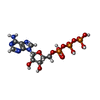 ChemComp-ATP: 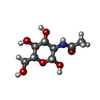 ChemComp-NAG:  PDB-1e2n: |
| Source |
|
 Keywords Keywords | TRANSPORT PROTEIN / P2X3 |


 homo sapiens (human)