ornithine decarboxylase inhibitor activity / misfolded RNA binding / Group I intron splicing / RNA folding / four-way junction DNA binding / regulation of mRNA stability / negative regulation of translational initiation / mRNA regulatory element binding translation repressor activity / positive regulation of RNA splicing / transcription antitermination ...ornithine decarboxylase inhibitor activity / misfolded RNA binding / Group I intron splicing / RNA folding / four-way junction DNA binding / regulation of mRNA stability / negative regulation of translational initiation / mRNA regulatory element binding translation repressor activity / positive regulation of RNA splicing / transcription antitermination / DNA endonuclease activity / DNA-templated transcription termination / maintenance of translational fidelity / mRNA 5'-UTR binding / regulation of translation / ribosomal small subunit assembly / ribosomal small subunit biogenesis / small ribosomal subunit / small ribosomal subunit rRNA binding / cytosolic small ribosomal subunit / cytoplasmic translation / tRNA binding / rRNA binding / structural constituent of ribosome / ribosome / translation / response to antibiotic / hydrolase activity / zinc ion binding / cytosol / cytoplasm Similarity search - Function
Ribosomal protein S16, conserved site / Ribosomal protein S16 signature. / Ribosomal protein S6, conserved site / Ribosomal protein S6 signature. / Ribosomal protein S11, bacterial-type / Ribosomal protein S20 / Ribosomal protein S20 superfamily / Ribosomal protein S20 / Ribosomal protein S4, bacterial-type / Ribosomal protein S5, bacterial-type ...Ribosomal protein S16, conserved site / Ribosomal protein S16 signature. / Ribosomal protein S6, conserved site / Ribosomal protein S6 signature. / Ribosomal protein S11, bacterial-type / Ribosomal protein S20 / Ribosomal protein S20 superfamily / Ribosomal protein S20 / Ribosomal protein S4, bacterial-type / Ribosomal protein S5, bacterial-type / 30S ribosomal protein S17 / Ribosomal protein S6, plastid/chloroplast / Ribosomal protein S2, bacteria/mitochondria/plastid / Ribosomal protein S18, conserved site / Ribosomal protein S18 signature. / Ribosomal protein S16 / Ribosomal protein S16 domain superfamily / Ribosomal protein S16 / Ribosomal protein S15, bacterial-type / Ribosomal protein S6 / Ribosomal protein S6 / Ribosomal protein S6 superfamily / Ribosomal protein S12, bacterial-type / Translation elongation factor EF1B/ribosomal protein S6 / Ribosomal protein S18 / Ribosomal protein S18 / Ribosomal protein S18 superfamily / Ribosomal protein S2 signature 2. / Ribosomal protein S2 signature 1. / Ribosomal protein S5, N-terminal, conserved site / Ribosomal protein S5 signature. / Ribosomal protein S2, conserved site / : / Ribosomal protein S2 / Ribosomal protein S2, flavodoxin-like domain superfamily / Ribosomal protein S2 / Ribosomal protein S17, conserved site / Ribosomal protein S17 signature. / Ribosomal protein S5 / S5 double stranded RNA-binding domain profile. / Ribosomal protein S5, N-terminal / Ribosomal protein S5, C-terminal / Ribosomal protein S5, N-terminal domain / Ribosomal protein S5, C-terminal domain / Ribosomal protein S8 signature. / Ribosomal protein S4/S9 N-terminal domain / Ribosomal protein S4, conserved site / Ribosomal protein S4 signature. / Ribosomal protein S15 signature. / Ribosomal protein S4/S9 N-terminal domain / Ribosomal protein S4/S9, N-terminal / Ribosomal protein S4/S9 / Ribosomal protein S8 / Ribosomal protein S8 superfamily / Ribosomal protein S8 / S4 RNA-binding domain profile. / S4 RNA-binding domain / S4 domain / RNA-binding S4 domain / Ribosomal S11, conserved site / Ribosomal protein S11 signature. / RNA-binding S4 domain superfamily / Ribosomal protein S11 / Ribosomal protein S12 signature. / Ribosomal protein S11 / Ribosomal protein S12/S23 / Ribosomal protein S12/S23 / Ribosomal protein S17/S11 / Ribosomal protein S17 / Ribosomal protein S15 / Ribosomal_S15 / Ribosomal protein S15 / Ribosomal protein S11 superfamily / S15/NS1, RNA-binding / Ribosomal protein S5 domain 2-type fold, subgroup / Ribosomal protein S5 domain 2-type fold / Nucleic acid-binding, OB-fold Similarity search - Domain/homology
Small ribosomal subunit protein bS6 / Small ribosomal subunit protein uS11 / Small ribosomal subunit protein uS12 / Small ribosomal subunit protein bS16 / Small ribosomal subunit protein bS18 / Small ribosomal subunit protein bS20 / Small ribosomal subunit protein uS2 / Small ribosomal subunit protein uS4 / Small ribosomal subunit protein uS5 / Small ribosomal subunit protein uS8 ...Small ribosomal subunit protein bS6 / Small ribosomal subunit protein uS11 / Small ribosomal subunit protein uS12 / Small ribosomal subunit protein bS16 / Small ribosomal subunit protein bS18 / Small ribosomal subunit protein bS20 / Small ribosomal subunit protein uS2 / Small ribosomal subunit protein uS4 / Small ribosomal subunit protein uS5 / Small ribosomal subunit protein uS8 / Small ribosomal subunit protein uS15 / Small ribosomal subunit protein uS17 Similarity search - Component
Biological species
Escherichia coli (E. coli)
Method
single particle reconstruction / cryo EM / Resolution: 2.1 Å
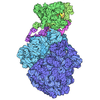
Journal: Int J Mol Sci / Year: 2026 Title: The Conserved GTPase LepA May Contribute to the Final Proper Stabilization of the 3' Domain of the 30S Subunit During Ribosome Assembly. Authors: Olesya Kravchenko / Elena Maksimova / Timur Baymukhametov / Irina Eliseeva / Elena Stolboushkina / Abstract: The function of the highly conserved GTPase LepA, a homolog of elongation factor EF-G, remains unknown in translation. However, there is biochemical data that it implicates in the 30S ribosomal ...The function of the highly conserved GTPase LepA, a homolog of elongation factor EF-G, remains unknown in translation. However, there is biochemical data that it implicates in the 30S ribosomal subunit biogenesis. Here, using cryo-electron microscopy, we characterized 30S subunits isolated from an strain with a deleted gene. The cryo-EM maps for ∆ 30S particles were divided into classes corresponding to consecutive assembly intermediates: from particles characterized by unformed helices h44/h45 of the central decoding center (CDR) and highly flexible head, through intermediates with a distorted CDR and a partial stabilization of the head, to near-mature 30S subunits with correctly docked h44 in the CDR, accessible 3' end of 16S rRNA for translation but significant flexibility in head domain. Cryo-EM analysis of Δ 30S intermediates revealed that they predominantly proceed to nearly mature functional state and exhibit suboptimal flexibility in the head domain. This finding suggests that LepA likely contributes to the final proper stabilization of the 3' domain of the 30S subunit during ribosome assembly.
Name: 30S ribosomal protein S12 / type: protein_or_peptide / ID: 8 Details: D2T - (3R)-3-(methylsulfanyl)-L-aspartic acid post-translational modification in the protein Number of copies: 1 / Enantiomer: LEVO
In the structure databanks used in Yorodumi, some data are registered as the other names, "COVID-19 virus" and "2019-nCoV". Here are the details of the virus and the list of structure data.
Jan 31, 2019. EMDB accession codes are about to change! (news from PDBe EMDB page)
EMDB accession codes are about to change! (news from PDBe EMDB page)
The allocation of 4 digits for EMDB accession codes will soon come to an end. Whilst these codes will remain in use, new EMDB accession codes will include an additional digit and will expand incrementally as the available range of codes is exhausted. The current 4-digit format prefixed with “EMD-” (i.e. EMD-XXXX) will advance to a 5-digit format (i.e. EMD-XXXXX), and so on. It is currently estimated that the 4-digit codes will be depleted around Spring 2019, at which point the 5-digit format will come into force.
The EM Navigator/Yorodumi systems omit the EMD- prefix.
Related info.:Q: What is EMD? / ID/Accession-code notation in Yorodumi/EM Navigator
Yorodumi is a browser for structure data from EMDB, PDB, SASBDB, etc.
This page is also the successor to EM Navigator detail page, and also detail information page/front-end page for Omokage search.
The word "yorodu" (or yorozu) is an old Japanese word meaning "ten thousand". "mi" (miru) is to see.
Related info.:EMDB / PDB / SASBDB / Comparison of 3 databanks / Yorodumi Search / Aug 31, 2016. New EM Navigator & Yorodumi / Yorodumi Papers / Jmol/JSmol / Function and homology information / Changes in new EM Navigator and Yorodumi
 Movie
Movie Controller


 Open data
 Basic information
 Map data
 Sample
 Keywords
 Function and homology information
 Escherichia coli (E. coli)
 Authors
 Russian Federation, 1 items
  Citation
 Structure visualization
 Downloads & links
 emd_67201.png
 http://ftp.pdbj.org/pub/emdb/structures/EMD-67201


 Z (Sec.)
 Y (Row.)
 X (Col.)


 Sample components
 Processing
 Electron microscopy
 FIELD EMISSION GUN

