[English] 日本語
Yorodumi
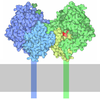
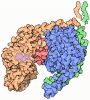
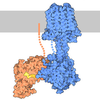
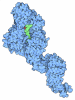
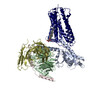
- EMDB-66875: Structure of the CCL21-CCR7-Gi-scFv16 complex -

+
Open data


ID or keywords:

Loading...

-
Basic information

Entry
Database: EMDB / ID: EMD-66875
TitleStructure of the CCL21-CCR7-Gi-scFv16 complex
Map dataSharpened map for model refinement
Sample
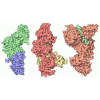
  • Complex: CCL21-CCR7-Gi-scFv16
    • Complex: CCL21
      • Protein or peptide: C-C motif chemokine 21
    • Complex: CCR7-Gi
      • Protein or peptide: C-C chemokine receptor type 7,Non structural polyprotein
      • Protein or peptide: Guanine nucleotide-binding protein G(I)/G(S)/G(O) subunit gamma-2,Guanine nucleotide-binding protein G(i) subunit alpha-1
      • Protein or peptide: Guanine nucleotide-binding protein G(I)/G(S)/G(T) subunit beta-1
    • Complex: scFv16
      • Protein or peptide: Antibody fragment scFv16
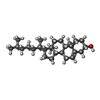
  • Ligand: CHOLESTEROL
Keywordschemokine / chemokine receptor / GPCR / MEMBRANE PROTEIN
Function / homology
Function and homology information


mesangial cell-matrix adhesion / dendritic cell dendrite assembly / negative regulation of dendritic cell dendrite assembly / positive regulation of hypersensitivity / chemokine (C-C motif) ligand 19 binding / chemokine (C-C motif) ligand 21 binding / C-C motif chemokine 19 receptor activity / C-C motif chemokine 21 receptor activity / : / regulation of dendritic cell dendrite assembly ...mesangial cell-matrix adhesion / dendritic cell dendrite assembly / negative regulation of dendritic cell dendrite assembly / positive regulation of hypersensitivity / chemokine (C-C motif) ligand 19 binding / chemokine (C-C motif) ligand 21 binding / C-C motif chemokine 19 receptor activity / C-C motif chemokine 21 receptor activity / : / regulation of dendritic cell dendrite assembly / myeloid dendritic cell chemotaxis / CCL19-activated CCR7 signaling pathway / CCL21-activated CCR7 signaling pathway / CCR7 chemokine receptor binding / positive regulation of immunological synapse formation / positive regulation of T cell costimulation / positive regulation of humoral immune response / chemokine (C-C motif) ligand 21 signaling pathway / lymphocyte migration into lymph node / mature conventional dendritic cell differentiation / positive regulation of dendritic cell antigen processing and presentation / Adenylate cyclase inhibitory pathway / positive regulation of myeloid dendritic cell chemotaxis / negative regulation of leukocyte tethering or rolling / establishment of T cell polarity / positive regulation of dendritic cell chemotaxis / regulation of interleukin-1 beta production / chemokine receptor binding / positive regulation of phospholipase C/protein kinase C signal transduction / immunological synapse formation / positive regulation of T cell chemotaxis / CCR chemokine receptor binding / regulation of type II interferon production / positive regulation of glycoprotein biosynthetic process / positive regulation of pseudopodium assembly / negative regulation of interleukin-12 production / negative thymic T cell selection / negative regulation of dendritic cell apoptotic process / positive regulation of chemotaxis / ruffle organization / cellular response to chemokine / C-C chemokine receptor activity / eosinophil chemotaxis / positive regulation of T cell receptor signaling pathway / positive regulation of cell adhesion mediated by integrin / regulation of Cdc42 protein signal transduction / positive regulation of neutrophil chemotaxis / chemokine activity / positive regulation of filopodium assembly / Chemokine receptors bind chemokines / positive regulation of cell motility / ADP signalling through P2Y purinoceptor 12 / Adrenaline,noradrenaline inhibits insulin secretion / dendritic cell chemotaxis / Extra-nuclear estrogen signaling / response to nitric oxide / positive regulation of cell-matrix adhesion / G alpha (i) signalling events / cellular response to cytokine stimulus / positive regulation of actin filament polymerization / homeostasis of number of cells / positive regulation of T cell migration / positive regulation of Rac protein signal transduction / T cell costimulation / release of sequestered calcium ion into cytosol / positive regulation of interleukin-12 production / cell maturation / positive regulation of protein localization to cell cortex / positive regulation of cell adhesion / G protein-coupled serotonin receptor binding / cellular response to forskolin / regulation of mitotic spindle organization / chemokine-mediated signaling pathway / cell chemotaxis / calcium-mediated signaling / positive regulation of receptor-mediated endocytosis / positive regulation of JNK cascade / G protein-coupled receptor binding / G protein-coupled receptor activity / G-protein beta/gamma-subunit complex binding / adenylate cyclase-modulating G protein-coupled receptor signaling pathway / Olfactory Signaling Pathway / Activation of the phototransduction cascade / G protein-coupled acetylcholine receptor signaling pathway / G beta:gamma signalling through PLC beta / Presynaptic function of Kainate receptors / Thromboxane signalling through TP receptor / Activation of G protein gated Potassium channels / Inhibition of voltage gated Ca2+ channels via Gbeta/gamma subunits / G-protein activation / Glucagon signaling in metabolic regulation / Prostacyclin signalling through prostacyclin receptor / G beta:gamma signalling through CDC42 / Synthesis, secretion, and inactivation of Glucagon-like Peptide-1 (GLP-1) / G beta:gamma signalling through BTK / photoreceptor disc membrane / ADP signalling through P2Y purinoceptor 12 / Sensory perception of sweet, bitter, and umami (glutamate) taste / Glucagon-type ligand receptors / GDP binding
Similarity search - Function
CC chemokine receptor 7 / Chemokine CC, DCCL motif-cointaining domain / Chemokine receptor family / Chemokine beta/gamma/delta / Intercrine alpha family (small cytokine C-X-C) (chemokine CXC). / Chemokine interleukin-8-like domain / Chemokine interleukin-8-like superfamily / Small cytokines (intecrine/chemokine), interleukin-8 like / : / Calycin ...CC chemokine receptor 7 / Chemokine CC, DCCL motif-cointaining domain / Chemokine receptor family / Chemokine beta/gamma/delta / Intercrine alpha family (small cytokine C-X-C) (chemokine CXC). / Chemokine interleukin-8-like domain / Chemokine interleukin-8-like superfamily / Small cytokines (intecrine/chemokine), interleukin-8 like / : / Calycin / G-protein alpha subunit, group I / G protein alpha subunit, helical insertion / G protein alpha subunit / Guanine nucleotide binding protein (G-protein), alpha subunit / G-protein alpha subunit / G-alpha domain profile. / G-protein, gamma subunit / G-protein gamma subunit domain profile. / G-protein gamma-like domain / G-protein gamma-like domain superfamily / GGL domain / G protein gamma subunit-like motifs / GGL domain / G protein beta WD-40 repeat protein / Guanine nucleotide-binding protein, beta subunit / G-protein, beta subunit / G-protein coupled receptors family 1 signature. / 7 transmembrane receptor (rhodopsin family) / G protein-coupled receptor, rhodopsin-like / GPCR, rhodopsin-like, 7TM / G-protein coupled receptors family 1 profile. / G-protein beta WD-40 repeat / WD40 repeat, conserved site / Trp-Asp (WD) repeats signature. / Trp-Asp (WD) repeats profile. / Trp-Asp (WD) repeats circular profile. / WD40 repeats / WD40 repeat / WD40-repeat-containing domain superfamily / WD40/YVTN repeat-like-containing domain superfamily / P-loop containing nucleoside triphosphate hydrolase
Similarity search - Domain/homology
Non structural polyprotein / C-C motif chemokine 21 / C-C chemokine receptor type 7 / Guanine nucleotide-binding protein G(I)/G(S)/G(O) subunit gamma-2 / Guanine nucleotide-binding protein G(I)/G(S)/G(T) subunit beta-1 / Guanine nucleotide-binding protein G(i) subunit alpha-1
Similarity search - Component
Biological speciesHomo sapiens (human) / Mus musculus (house mouse)
Methodsingle particle reconstruction / cryo EM / Resolution: 3.2 Å
AuthorsTsutsumi N / Nishikawa K / Fujiyoshi Y
Funding support Japan, 3 items
OrganizationGrant numberCountry
Japan Society for the Promotion of Science (JSPS)24K01965 Japan
Japan Society for the Promotion of Science (JSPS)24K21935 Japan
Japan Society for the Promotion of Science (JSPS)22K20632 Japan
CitationJournal: Proc Natl Acad Sci U S A / Year: 2026
Title: Structural insights into biased signaling at chemokine receptor CCR7.
Authors: Kotaro Tanaka / Kouki Nishikawa / Yuki Shiimura / Yoshinori Fujiyoshi / Naotaka Tsutsumi /
Abstract: CC chemokine receptor 7 (CCR7), which orchestrates adaptive immunity, exhibits a phenomenon known as biased agonism. CCL19 induces robust G-protein signaling and β-arrestin recruitment, leading to ...CC chemokine receptor 7 (CCR7), which orchestrates adaptive immunity, exhibits a phenomenon known as biased agonism. CCL19 induces robust G-protein signaling and β-arrestin recruitment, leading to transient signaling. In contrast, CCL21 preferentially activates G-protein pathways with minimal arrestin engagement, resulting in sustained signaling and differential functional outcomes. Here, we present the cryo-EM structures of the human CCR7-G complex with either CCL19 or CCL21. The structures reveal that while both engage a conserved orthosteric pocket, they adopt markedly distinct binding poses. Notably, the compact 30s loop of CCL21 inserts deeply into the receptor's extracellular vestibule, whereas the corresponding loop of CCL19 rests atop extracellular loop 2. Molecular dynamics simulations further reveal that these distinct binding modes induce differential intracellular dynamics, linked to the rotameric state of Y83 at the intracellular end of transmembrane helix 1. We demonstrate that CCL19 stabilizes a flexible conformational ensemble with a highly dynamic helix 8, creating a lateral opening favorable for GPCR kinase engagement. Conversely, CCL21 restricts this flexibility, locking the receptor in a state that precludes kinase interaction while maintaining G-protein coupling. Corroborated by functional data, these findings provide key insights into the structural basis of biased agonism at CCR7 and establish a foundation for rational design of pathway-selective immunomodulators.
History
DepositionNov 1, 2025-
Header (metadata) releaseApr 22, 2026-
Map releaseApr 22, 2026-
UpdateMay 6, 2026-
Current statusMay 6, 2026Processing site: PDBj / Status: Released

-
Structure visualization

Supplemental images

Downloads & links

-
Map

FileDownload / File: emd_66875.map.gz / Format: CCP4 / Size: 64 MB / Type: IMAGE STORED AS FLOATING POINT NUMBER (4 BYTES)
AnnotationSharpened map for model refinement
Projections & slices

Image control

Size
Brightness
Contrast
Others
AxesZ (Sec.)Y (Row.)X (Col.)
0.99 Å/pix.
x 256 pix.
= 252.8 Å
0.99 Å/pix.
x 256 pix.
= 252.8 Å
0.99 Å/pix.
x 256 pix.
= 252.8 Å

Surface

Projections

Slices (1/3)

Slices (1/2)

Slices (2/3)

Images are generated by Spider.

Voxel sizeX=Y=Z: 0.9875 Å
Density
Contour LevelBy AUTHOR: 0.05
Minimum - Maximum-0.4450464 - 0.56440735
Average (Standard dev.)0.000037512746 (±0.010279355)
SymmetrySpace group: 1
Details

EMDB XML:

Map geometry
Axis orderXYZ
Origin000
Dimensions256256256
Spacing256256256
CellA=B=C: 252.8 Å
α=β=γ: 90.0 °

-
Supplemental data

-
Mask #1

Fileemd_66875_msk_1.map
Projections & Slices
AxesZYX

Projections

Slices (1/2)
Density Histograms

-
Mask #2

Fileemd_66875_msk_2.map
Projections & Slices
AxesZYX

Projections

Slices (1/2)
Density Histograms

-
Additional map: Unsharpened map

Fileemd_66875_additional_1.map
AnnotationUnsharpened map
Projections & Slices
AxesZYX

Projections

Slices (1/2)
Density Histograms

-
Additional map: deepEMhancer sharpened map

Fileemd_66875_additional_2.map
AnnotationdeepEMhancer sharpened map
Projections & Slices
AxesZYX

Projections

Slices (1/2)
Density Histograms

-
Half map: Half map A

Fileemd_66875_half_map_1.map
AnnotationHalf map A
Projections & Slices
AxesZYX

Projections

Slices (1/2)
Density Histograms

-
Half map: Half map B

Fileemd_66875_half_map_2.map
AnnotationHalf map B
Projections & Slices
AxesZYX

Projections

Slices (1/2)
Density Histograms

-
Sample components

+
Entire : CCL21-CCR7-Gi-scFv16

EntireName: CCL21-CCR7-Gi-scFv16
Components
  • Complex: CCL21-CCR7-Gi-scFv16
    • Complex: CCL21
      • Protein or peptide: C-C motif chemokine 21
    • Complex: CCR7-Gi
      • Protein or peptide: C-C chemokine receptor type 7,Non structural polyprotein
      • Protein or peptide: Guanine nucleotide-binding protein G(I)/G(S)/G(O) subunit gamma-2,Guanine nucleotide-binding protein G(i) subunit alpha-1
      • Protein or peptide: Guanine nucleotide-binding protein G(I)/G(S)/G(T) subunit beta-1
    • Complex: scFv16
      • Protein or peptide: Antibody fragment scFv16
  • Ligand: CHOLESTEROL

+
Supramolecule #1: CCL21-CCR7-Gi-scFv16

SupramoleculeName: CCL21-CCR7-Gi-scFv16 / type: complex / ID: 1 / Parent: 0 / Macromolecule list: #1-#5
Source (natural)Organism: Homo sapiens (human)
Molecular weightTheoretical: 30 KDa

+
Supramolecule #2: CCL21

SupramoleculeName: CCL21 / type: complex / ID: 2 / Parent: 1 / Macromolecule list: #1
Source (natural)Organism: Homo sapiens (human)

+
Supramolecule #3: CCR7-Gi

SupramoleculeName: CCR7-Gi / type: complex / ID: 3 / Parent: 1 / Macromolecule list: #2-#4
Source (natural)Organism: Homo sapiens (human)

+
Supramolecule #4: scFv16

SupramoleculeName: scFv16 / type: complex / ID: 4 / Parent: 1 / Macromolecule list: #5
Source (natural)Organism: Mus musculus (house mouse)

+
Macromolecule #1: C-C motif chemokine 21

MacromoleculeName: C-C motif chemokine 21 / type: protein_or_peptide / ID: 1
Details: CCL21 with a C-terminal linker to an expression/purification tag and the 3C protease scar
Number of copies: 1 / Enantiomer: LEVO
Source (natural)Organism: Homo sapiens (human)
Molecular weightTheoretical: 13.652765 KDa
Recombinant expressionOrganism: Homo sapiens (human)
SequenceString:
SDGGAQDCCL KYSQRKIPAK VVRSYRKQEP SLGCSIPAIL FLPRKRSQAE LCADPKELWV QQLMQHLDKT PSPQKPAQGC RKDRGASKT GKKGKGSKGC KRTERSQTPK GPGSGSGSAA ALEVLFQ

UniProtKB: C-C motif chemokine 21

+
Macromolecule #2: C-C chemokine receptor type 7,Non structural polyprotein

MacromoleculeName: C-C chemokine receptor type 7,Non structural polyprotein
type: protein_or_peptide / ID: 2
Details: CCR7 with a C-terminal LgBit-His tag. CLR is a bound small molecule, not a part of the polypeptide.,CCR7 with a C-terminal LgBit-His tag. CLR is a bound small molecule, not a part of the polypeptide.
Number of copies: 1 / Enantiomer: LEVO
Source (natural)Organism: Homo sapiens (human)
Molecular weightTheoretical: 61.585 KDa
Recombinant expressionOrganism: Homo sapiens (human)
SequenceString: DYKDDDDGSQ DEVTDDYIGD NTTVDYTLFE SLCSKKDVRN FKAWFLPIMY SIICFVGLLG NGLVVLTYIY FKRLKTMTDT YLLNLAVAD ILFLLTLPFW AYSAAKSWVF GVHFCKLIFA IYKMSFFSGM LLLLCISIDR YVAIVQAVSA HRHRARVLLI S KLSCVGIW ...String:
DYKDDDDGSQ DEVTDDYIGD NTTVDYTLFE SLCSKKDVRN FKAWFLPIMY SIICFVGLLG NGLVVLTYIY FKRLKTMTDT YLLNLAVAD ILFLLTLPFW AYSAAKSWVF GVHFCKLIFA IYKMSFFSGM LLLLCISIDR YVAIVQAVSA HRHRARVLLI S KLSCVGIW ILATVLSIPE LLYSDLQRSS SEQAMRCSLI TEHVEAFITI QVAQMVIGFL VPLLAMSFCY LVIIRTLLQA RN FERNKAI KVIIAVVVVF IVFQLPYNGV VLAQTVANFN ITSSTCELSK QLNIAYDVTY SLACVRCCVN PFLYAFIGVK FRN DLFKLF KDLGCLSQEQ LRQWSSCRHI RRSSMSVEAE TTTTFSPSRG SSGGGGSGGG GSSGVFTLED FVGDWEQTAA YNLD QVLEQ GGVSSLLQNL AVSVTPIQRI VRSGENALKI DIHVIIPYEG LSADQMAQIE EVFKVVYPVD DHHFKVILPY GTLVI DGVT PNMLNYFGRP YEGIAVFDGK KITVTGTLWN GNKIIDERLI TPDGSMLFRV TINSGGGGSH HHHHHHH

UniProtKB: C-C chemokine receptor type 7, Non structural polyprotein

+
Macromolecule #3: Guanine nucleotide-binding protein G(I)/G(S)/G(O) subunit gamma-2...

MacromoleculeName: Guanine nucleotide-binding protein G(I)/G(S)/G(O) subunit gamma-2,Guanine nucleotide-binding protein G(i) subunit alpha-1
type: protein_or_peptide / ID: 3
Details: chimeric protein with molecule 5 Gg2-Galpha(i)1 single chain fusion assigned a different chain ID for residue numbering,chimeric protein with molecule 5 Gg2-Galpha(i)1 single chain fusion ...Details: chimeric protein with molecule 5 Gg2-Galpha(i)1 single chain fusion assigned a different chain ID for residue numbering,chimeric protein with molecule 5 Gg2-Galpha(i)1 single chain fusion assigned a different chain ID for residue numbering
Number of copies: 2 / Enantiomer: LEVO
EC number: Hydrolases; Acting on acid anhydrides; Acting on GTP to facilitate cellular and subcellular movement
Source (natural)Organism: Homo sapiens (human)
Molecular weightTheoretical: 48.640371 KDa
Recombinant expressionOrganism: Homo sapiens (human)
SequenceString: ASNNTASIAQ ARKLVEQLKM EANIDRIKVS KAAADLMAYC EAHAKEDPLL TPVPASENPF REKKFFCAIL GSAGSAGSAG CTLSAEDKA AVERSKMIDR NLREDGEKAA REVKLLLLGA GESGKNTIVK QMKIIHEAGY SEEECKQYKA VVYSNTIQSI I AIIRAMGR ...String:
ASNNTASIAQ ARKLVEQLKM EANIDRIKVS KAAADLMAYC EAHAKEDPLL TPVPASENPF REKKFFCAIL GSAGSAGSAG CTLSAEDKA AVERSKMIDR NLREDGEKAA REVKLLLLGA GESGKNTIVK QMKIIHEAGY SEEECKQYKA VVYSNTIQSI I AIIRAMGR LKIDFGDSAR ADDARQLFVL AGAAEEGFMT AELAGVIKRL WKDSGVQACF NRSREYQLND SAAYYLNDLD RI AQPNYIP TQQDVLRTRV KTTGIVETHF TFKDLHFKMF DVGAQRSERK KWIHCFEGVT AIIFCVALSD YDLVLAEDEE MNR MHASMK LFDSICNNKW FTDTSIILFL NKKDLFEEKI KKSPLTICYP EYAGSNTYEE AAAYIQCQFE DLNKRKDTKE IYTH FTCST DTKNVQFVFD AVTDVIIKNN LKDCGLF

UniProtKB: Guanine nucleotide-binding protein G(I)/G(S)/G(O) subunit gamma-2, Guanine nucleotide-binding protein G(i) subunit alpha-1

+
Macromolecule #4: Guanine nucleotide-binding protein G(I)/G(S)/G(T) subunit beta-1

MacromoleculeName: Guanine nucleotide-binding protein G(I)/G(S)/G(T) subunit beta-1
type: protein_or_peptide / ID: 4
Details: Gb1 with a C-terminal HiBit tag. The 3C protease scar and a short linker at the N-terminus.
Number of copies: 1 / Enantiomer: LEVO
Source (natural)Organism: Homo sapiens (human)
Molecular weightTheoretical: 40.039648 KDa
Recombinant expressionOrganism: Homo sapiens (human)
SequenceString: GPGSSGSELD QLRQEAEQLK NQIRDARKAC ADATLSQITN NIDPVGRIQM RTRRTLRGHL AKIYAMHWGT DSRLLVSASQ DGKLIIWDS YTTNKVHAIP LRSSWVMTCA YAPSGNYVAC GGLDNICSIY NLKTREGNVR VSRELAGHTG YLSCCRFLDD N QIVTSSGD ...String:
GPGSSGSELD QLRQEAEQLK NQIRDARKAC ADATLSQITN NIDPVGRIQM RTRRTLRGHL AKIYAMHWGT DSRLLVSASQ DGKLIIWDS YTTNKVHAIP LRSSWVMTCA YAPSGNYVAC GGLDNICSIY NLKTREGNVR VSRELAGHTG YLSCCRFLDD N QIVTSSGD TTCALWDIET GQQTTTFTGH TGDVMSLSLA PDTRLFVSGA CDASAKLWDV REGMCRQTFT GHESDINAIC FF PNGNAFA TGSDDATCRL FDLRADQELM TYSHDNIICG ITSVSFSKSG RLLLAGYDDF NCNVWDALKA DRAGVLAGHD NRV SCLGVT DDGMAVATGS WDSFLKIWNG SSGGGGSGGG GSSGVSGWRL FKKIS

UniProtKB: Guanine nucleotide-binding protein G(I)/G(S)/G(T) subunit beta-1

+
Macromolecule #5: Antibody fragment scFv16

MacromoleculeName: Antibody fragment scFv16 / type: protein_or_peptide / ID: 5 / Number of copies: 1 / Enantiomer: LEVO
Source (natural)Organism: Mus musculus (house mouse)
Molecular weightTheoretical: 27.340482 KDa
Recombinant expressionOrganism: Trichoplusia ni (cabbage looper)
SequenceString: DVQLVESGGG LVQPGGSRKL SCSASGFAFS SFGMHWVRQA PEKGLEWVAY ISSGSGTIYY ADTVKGRFTI SRDDPKNTLF LQMTSLRSE DTAMYYCVRS IYYYGSSPFD FWGQGTTLTV SSGGGGSGGG GSGGGGSDIV MTQATSSVPV TPGESVSISC R SSKSLLHS ...String:
DVQLVESGGG LVQPGGSRKL SCSASGFAFS SFGMHWVRQA PEKGLEWVAY ISSGSGTIYY ADTVKGRFTI SRDDPKNTLF LQMTSLRSE DTAMYYCVRS IYYYGSSPFD FWGQGTTLTV SSGGGGSGGG GSGGGGSDIV MTQATSSVPV TPGESVSISC R SSKSLLHS NGNTYLYWFL QRPGQSPQLL IYRMSNLASG VPDRFSGSGS GTAFTLTISR LEAEDVGVYY CMQHLEYPLT FG AGTKLEL KGSLEVLFQ

+
Macromolecule #6: CHOLESTEROL

MacromoleculeName: CHOLESTEROL / type: ligand / ID: 6 / Number of copies: 1 / Formula: CLR
Molecular weightTheoretical: 386.654 Da
Chemical component information

ChemComp-CLR:
CHOLESTEROL

-
Experimental details

-
Structure determination

Methodcryo EM
Processingsingle particle reconstruction
Aggregation stateparticle

-
Sample preparation

Concentration4.5 mg/mL
BufferpH: 7.2
Component:
ConcentrationName
10.0 mMHepes-Na
150.0 mMNaCl
0.001 % (w/v)LMNG
0.001 % (w/v)GDN
0.0001 % (w/v)CHS
GridModel: Quantifoil R1.2/1.3 / Material: GOLD / Mesh: 300 / Pretreatment - Type: GLOW DISCHARGE / Pretreatment - Time: 60 sec. / Pretreatment - Atmosphere: AIR
VitrificationCryogen name: ETHANE / Chamber humidity: 100 % / Chamber temperature: 277 K / Instrument: FEI VITROBOT MARK IV

-
Electron microscopy

MicroscopeJEOL CRYO ARM 300
Specialist opticsEnergy filter - Name: In-column Omega Filter / Energy filter - Slit width: 20 eV
DetailsThe microscope model is the JEOL's "JEM-Z320FHC", a custom-built model of JEOL CRYO ARM 300.
Image recordingFilm or detector model: GATAN K3 (6k x 4k) / Number grids imaged: 2 / Number real images: 5968 / Average electron dose: 50.0 e/Å2
Electron beamAcceleration voltage: 300 kV / Electron source: FIELD EMISSION GUN
Electron opticsCalibrated magnification: 63291 / Illumination mode: FLOOD BEAM / Imaging mode: BRIGHT FIELD / Cs: 3.4 mm / Nominal defocus max: 1.8 µm / Nominal defocus min: 1.0 µm
Sample stageCooling holder cryogen: NITROGEN

+
Image processing

Particle selectionNumber selected: 1537777 / Details: initial particles that appeared to be protein
CTF correctionSoftware - Name: cryoSPARC (ver. 4.7)
Details: CryoSPARC patch CTF estimation and global/local CTF refinements
Type: PHASE FLIPPING AND AMPLITUDE CORRECTION
Startup modelType of model: OTHER / Details: CryoSPARC ab-initio reconstruction model
Final reconstructionApplied symmetry - Point group: C1 (asymmetric) / Algorithm: FOURIER SPACE / Resolution.type: BY AUTHOR / Resolution: 3.2 Å / Resolution method: FSC 0.143 CUT-OFF / Software - Name: cryoSPARC (ver. 4.7) / Number images used: 195011
Initial angle assignmentType: MAXIMUM LIKELIHOOD / Software - Name: cryoSPARC (ver. 4.7) / Details: CryoSPARC ab-initio reconstruction
Final angle assignmentType: MAXIMUM LIKELIHOOD / Software - Name: cryoSPARC (ver. 4.7) / Details: CryoSPARC non-uniform refinement
Final 3D classificationNumber classes: 3 / Software - Name: cryoSPARC (ver. 4.7) / Details: CryoSPARC heterogeneous 3D refinement
FSC plot (resolution estimation)

-
Atomic model buiding 1

Initial model
ChainDetailsPDB ID
source_name: AlphaFold, initial_model_type: in silico modelCCL21-CCR7-Gi
source_name: PDB, initial_model_type: experimental modelscFv16
RefinementSpace: REAL / Protocol: FLEXIBLE FIT / Overall B value: 60
Output model

PDB-9xhi:
Structure of the CCL21-CCR7-Gi-scFv16 complex

+
About Yorodumi

-
News

-
Feb 9, 2022. New format data for meta-information of EMDB entries

New format data for meta-information of EMDB entries

  • Version 3 of the EMDB header file is now the official format.
  • The previous official version 1.9 will be removed from the archive.

Related info.:EMDB header

External links:wwPDB to switch to version 3 of the EMDB data model

-
Aug 12, 2020. Covid-19 info

Covid-19 info

URL: https://pdbj.org/emnavi/covid19.php

New page: Covid-19 featured information page in EM Navigator.

Related info.:Covid-19 info / Mar 5, 2020. Novel coronavirus structure data

+
Mar 5, 2020. Novel coronavirus structure data

Novel coronavirus structure data

Related info.:Yorodumi Speices / Aug 12, 2020. Covid-19 info

External links:COVID-19 featured content - PDBj / Molecule of the Month (242):Coronavirus Proteases

+
Jan 31, 2019. EMDB accession codes are about to change! (news from PDBe EMDB page)

EMDB accession codes are about to change! (news from PDBe EMDB page)

  • The allocation of 4 digits for EMDB accession codes will soon come to an end. Whilst these codes will remain in use, new EMDB accession codes will include an additional digit and will expand incrementally as the available range of codes is exhausted. The current 4-digit format prefixed with “EMD-” (i.e. EMD-XXXX) will advance to a 5-digit format (i.e. EMD-XXXXX), and so on. It is currently estimated that the 4-digit codes will be depleted around Spring 2019, at which point the 5-digit format will come into force.
  • The EM Navigator/Yorodumi systems omit the EMD- prefix.

Related info.:Q: What is EMD? / ID/Accession-code notation in Yorodumi/EM Navigator

External links:EMDB Accession Codes are Changing Soon! / Contact to PDBj

+
Jul 12, 2017. Major update of PDB

Major update of PDB

  • wwPDB released updated PDB data conforming to the new PDBx/mmCIF dictionary.
  • This is a major update changing the version number from 4 to 5, and with Remediation, in which all the entries are updated.
  • In this update, many items about electron microscopy experimental information are reorganized (e.g. em_software).
  • Now, EM Navigator and Yorodumi are based on the updated data.

External links:wwPDB Remediation / Enriched Model Files Conforming to OneDep Data Standards Now Available in the PDB FTP Archive

-
Yorodumi

Thousand views of thousand structures

  • Yorodumi is a browser for structure data from EMDB, PDB, SASBDB, etc.
  • This page is also the successor to EM Navigator detail page, and also detail information page/front-end page for Omokage search.
  • The word "yorodu" (or yorozu) is an old Japanese word meaning "ten thousand". "mi" (miru) is to see.

Related info.:EMDB / PDB / SASBDB / Comparison of 3 databanks / Yorodumi Search / Aug 31, 2016. New EM Navigator & Yorodumi / Yorodumi Papers / Jmol/JSmol / Function and homology information / Changes in new EM Navigator and Yorodumi

Read more