phycobilisome / photosystem I reaction center / photosystem I / photosynthetic electron transport in photosystem I / photosystem I / plasma membrane-derived thylakoid membrane / photosynthesis / 4 iron, 4 sulfur cluster binding / electron transfer activity / magnesium ion binding Similarity search - Function
Photosystem I PsaX / Photosystem I PsaX superfamily / PsaX family / Phycobilisome linker protein / Phycobilisome linker domain / Phycobilisome linker domain superfamily / Phycobilisome Linker polypeptide / Phycobilisome (PBS) linker domain profile. / Photosystem I reaction center subunit PsaK / Photosystem I reaction centre subunit PsaK ...Photosystem I PsaX / Photosystem I PsaX superfamily / PsaX family / Phycobilisome linker protein / Phycobilisome linker domain / Phycobilisome linker domain superfamily / Phycobilisome Linker polypeptide / Phycobilisome (PBS) linker domain profile. / Photosystem I reaction center subunit PsaK / Photosystem I reaction centre subunit PsaK / Photosystem I reaction centre subunit PsaK superfamily / Photosystem I PsaM, reaction centre superfamily / Photosystem I PsaM, reaction centre / Photosystem I protein M (PsaM) / Photosystem I reaction center subunit V/PsaK / Photosystem I psaG / psaK / Photosystem I PsaL, reaction centre subunit XI / Photosystem I, reaction centre subunit XI / Photosystem I PsaL, reaction centre subunit XI superfamily / Photosystem I reaction centre subunit XI / Photosystem I reaction centre subunit VIII / Photosystem I reaction centre subunit VIII / Photosystem I reaction centre subunit VIII superfamily / Photosystem I PsaF, reaction centre subunit III / Photosystem I PsaF, reaction centre subunit III superfamily / Photosystem I reaction centre subunit III / Photosystem I PsaD / Photosystem I, reaction centre subunit PsaD superfamily / PsaD / Photosystem I PsaE, reaction centre subunit IV / Photosystem I reaction centre subunit IV / PsaE / Photosystem I PsaJ, reaction centre subunit IX superfamily / Photosystem I PsaJ, reaction centre subunit IX / Photosystem I reaction centre subunit IX / PsaJ / Photosystem I protein PsaC / Photosystem I PsaA / Photosystem I PsaB / Photosystem I PsaA/PsaB, conserved site / Photosystem I psaA and psaB proteins signature. / : / Photosystem I PsaA/PsaB / Photosystem I PsaA/PsaB superfamily / Photosystem I psaA/psaB protein / Electron transport accessory-like domain superfamily / 4Fe-4S dicluster domain / 4Fe-4S ferredoxin, iron-sulphur binding, conserved site / 4Fe-4S ferredoxin-type iron-sulfur binding region signature. / 4Fe-4S ferredoxin-type iron-sulfur binding domain profile. / 4Fe-4S ferredoxin-type, iron-sulphur binding domain Similarity search - Domain/homology
Photosystem I iron-sulfur center / Photosystem I-associated linker protein CpcL / Photosystem I reaction center subunit VIII / Photosystem I reaction center subunit III / Photosystem I P700 chlorophyll a apoprotein A2 1 / Photosystem I 4.8 kDa protein / Photosystem I reaction center subunit IX / Photosystem I reaction center subunit II / Photosystem I reaction center subunit IV / Photosystem I P700 chlorophyll a apoprotein A1 ...Photosystem I iron-sulfur center / Photosystem I-associated linker protein CpcL / Photosystem I reaction center subunit VIII / Photosystem I reaction center subunit III / Photosystem I P700 chlorophyll a apoprotein A2 1 / Photosystem I 4.8 kDa protein / Photosystem I reaction center subunit IX / Photosystem I reaction center subunit II / Photosystem I reaction center subunit IV / Photosystem I P700 chlorophyll a apoprotein A1 / Photosystem I reaction center subunit XI / Photosystem I reaction center subunit PsaK 1 / Photosystem I reaction center subunit XII Similarity search - Component
Biological species
Nostoc sp. PCC 7120 = FACHB-418 (bacteria)
Method
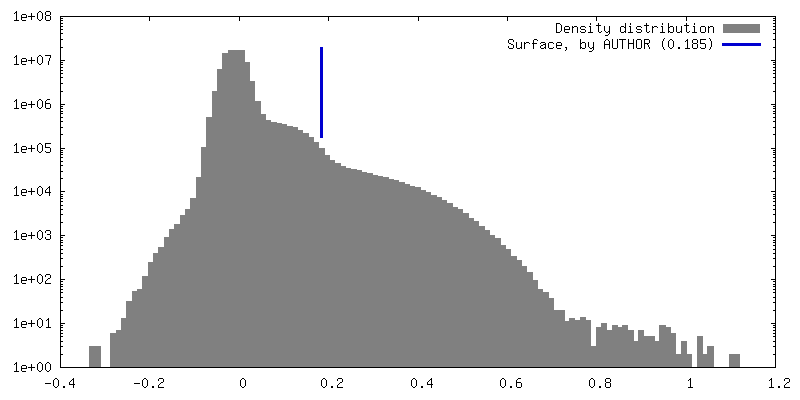
single particle reconstruction / cryo EM / Resolution: 2.98 Å
National Natural Science Foundation of China (NSFC)
China
Citation
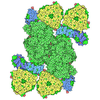
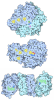
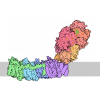
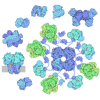
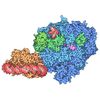
Journal: Proc Natl Acad Sci U S A / Year: 2026 Title: Structural insight of a photosystem I-CpcL-phycobilisome supercomplex from a cyanobacterium sp. PCC 7120. Authors: Zhiyuan Mao / Zhenhua Li / Xingyue Li / Liangliang Shen / Tingyun Kuang / Wenda Wang / Jian-Ren Shen / Guangye Han / Abstract: Phycobilisomes (PBSs) are supramolecular pigment-protein complexes composed of phycobiliproteins and linker proteins, serving as the major light-harvesting complexes that capture and transfer light ...Phycobilisomes (PBSs) are supramolecular pigment-protein complexes composed of phycobiliproteins and linker proteins, serving as the major light-harvesting complexes that capture and transfer light energy to photosystem II (PSII) and photosystem I (PSI) in cyanobacteria and eukaryotic red algae. In cyanobacteria, a rod-type PBS that does not have a core is specifically connected to PSI by a linker protein CpcL to form a PSI-CpcL-PBS supercomplex. However, the mechanism of CpcL-PBS association to PSI remains unclear. Here, we report the cryoelectron microscopic structures of PSI-CpcL-PBS at 2.98 Å and CpcL-PBS at 2.93 Å resolution from a cyanobacterium sp. PCC 7120, respectively. CpcL-PBS is located on the stromal side of a PSI tetramer and exhibits a structure of three-layered PBS consisting of four linkers (CpcL, CpcC1, CpcC2, PecC) and 18 pairs of phycocyanin αβ monomers. The C-terminal transmembrane helix of CpcL inserts to the membrane and interacts with PsaA, PsaB, and PsaM of PSI at an interface I between two PSI monomers, enabling the formation of the PSI-CpcL-PBS supercomplex. The exact structure of protein subunits and arrangement of bilin and chlorophyll pigments are revealed, which provide a structural basis for the assembly of PSI-CpcL-PBS and possible excitation energy transfer pathways from antennas to PSI within this supercomplex, shedding light on the organization and attachment of CpcL-PBS in cyanobacterial thylakoids.
In the structure databanks used in Yorodumi, some data are registered as the other names, "COVID-19 virus" and "2019-nCoV". Here are the details of the virus and the list of structure data.
Jan 31, 2019. EMDB accession codes are about to change! (news from PDBe EMDB page)
EMDB accession codes are about to change! (news from PDBe EMDB page)
The allocation of 4 digits for EMDB accession codes will soon come to an end. Whilst these codes will remain in use, new EMDB accession codes will include an additional digit and will expand incrementally as the available range of codes is exhausted. The current 4-digit format prefixed with “EMD-” (i.e. EMD-XXXX) will advance to a 5-digit format (i.e. EMD-XXXXX), and so on. It is currently estimated that the 4-digit codes will be depleted around Spring 2019, at which point the 5-digit format will come into force.
The EM Navigator/Yorodumi systems omit the EMD- prefix.
Related info.:Q: What is EMD? / ID/Accession-code notation in Yorodumi/EM Navigator
Yorodumi is a browser for structure data from EMDB, PDB, SASBDB, etc.
This page is also the successor to EM Navigator detail page, and also detail information page/front-end page for Omokage search.
The word "yorodu" (or yorozu) is an old Japanese word meaning "ten thousand". "mi" (miru) is to see.
Related info.:EMDB / PDB / SASBDB / Comparison of 3 databanks / Yorodumi Search / Aug 31, 2016. New EM Navigator & Yorodumi / Yorodumi Papers / Jmol/JSmol / Function and homology information / Changes in new EM Navigator and Yorodumi
 Movie
Movie Controller


 Open data
 Basic information
 Map data
 Sample
 Keywords
 Function and homology information
 Nostoc sp. PCC 7120 = FACHB-418 (bacteria)
 Authors
 China, 1 items
  Citation
 Structure visualization
 Downloads & links
 emd_65883.png
 https://data.pdbj.org/pub/emdb/structures/EMD-65883


 Z (Sec.)
 Y (Row.)
 X (Col.)




 Sample components
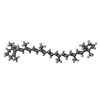
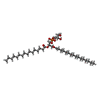
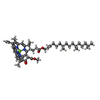
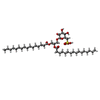
 Processing
 Electron microscopy
 FIELD EMISSION GUN

