[English] 日本語
Yorodumi
- EMDB-65226: Cryo-EM Structure of GPR158 in Complex with RGS7-Gbeta5 and Nanob... -

+
Open data


ID or keywords:

Loading...

-
Basic information

Entry
Database: EMDB / ID: EMD-65226
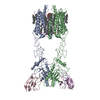
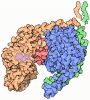
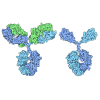
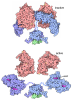
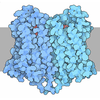
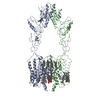
TitleCryo-EM Structure of GPR158 in Complex with RGS7-Gbeta5 and Nanobody Nb20
Map data
Sample
  • Complex: GPR158 complexed with Nb20
    • Complex: GRP158-RGS7
      • Protein or peptide: Metabotropic glycine receptor
      • Protein or peptide: Isoform 2 of Regulator of G-protein signaling 7
    • Complex: Gbeta5
      • Protein or peptide: Guanine nucleotide-binding protein subunit beta-5
    • Complex: nanobody
      • Protein or peptide: Nb20
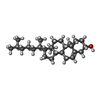
  • Ligand: CHOLESTEROL
  • Ligand: 1,2-dioleoyl-sn-glycero-3-phosphoethanolamine
  • Ligand: 2-[(HYDROXY{[(2R,3R,5S,6R)-2,3,4,5,6-PENTAHYDROXYCYCLOHEXYL]OXY}PHOSPHORYL)OXY]-1-[(PALMITOYLOXY)METHYL]ETHYL HEPTADECANOATE
KeywordsGPCR / orphan receptor / nanobody / RGS proteins / signalling receptor / MEMBRANE PROTEIN / MEMBRANE PROTEIN-IMMUNE SYSTEM complex
Function / homology
Function and homology information


G protein-coupled glycine receptor activity / dendrite terminus / Inactivation, recovery and regulation of the phototransduction cascade / G beta:gamma signalling through PLC beta / Presynaptic function of Kainate receptors / Prostacyclin signalling through prostacyclin receptor / G alpha (z) signalling events / Glucagon-type ligand receptors / G beta:gamma signalling through PI3Kgamma / G beta:gamma signalling through CDC42 ...G protein-coupled glycine receptor activity / dendrite terminus / Inactivation, recovery and regulation of the phototransduction cascade / G beta:gamma signalling through PLC beta / Presynaptic function of Kainate receptors / Prostacyclin signalling through prostacyclin receptor / G alpha (z) signalling events / Glucagon-type ligand receptors / G beta:gamma signalling through PI3Kgamma / G beta:gamma signalling through CDC42 / Adrenaline,noradrenaline inhibits insulin secretion / ADP signalling through P2Y purinoceptor 12 / Cooperation of PDCL (PhLP1) and TRiC/CCT in G-protein beta folding / Thromboxane signalling through TP receptor / G beta:gamma signalling through BTK / Thrombin signalling through proteinase activated receptors (PARs) / Activation of G protein gated Potassium channels / Inhibition of voltage gated Ca2+ channels via Gbeta/gamma subunits / light adaption / dark adaptation / G-protein gamma-subunit binding / G alpha (s) signalling events / Ca2+ pathway / G-protein activation / Extra-nuclear estrogen signaling / G alpha (12/13) signalling events / G alpha (q) signalling events / Vasopressin regulates renal water homeostasis via Aquaporins / GPER1 signaling / Glucagon-like Peptide-1 (GLP1) regulates insulin secretion / positive regulation of neurotransmitter secretion / ADP signalling through P2Y purinoceptor 1 / High laminar flow shear stress activates signaling by PIEZO1 and PECAM1:CDH5:KDR in endothelial cells / cell tip / G alpha (i) signalling events / regulation of G protein-coupled receptor signaling pathway / GTPase activating protein binding / G protein-coupled dopamine receptor signaling pathway / negative regulation of G protein-coupled receptor signaling pathway / regulation of synapse organization / parallel fiber to Purkinje cell synapse / regulation of postsynaptic membrane potential / positive regulation of GTPase activity / photoreceptor outer segment / G-protein alpha-subunit binding / photoreceptor inner segment / protein localization to plasma membrane / GTPase activator activity / brain development / postsynaptic density membrane / cognition / enzyme activator activity / transmembrane signaling receptor activity / myelin sheath / Cooperation of PDCL (PhLP1) and TRiC/CCT in G-protein beta folding / heterotrimeric G-protein complex / G-protein beta-subunit binding / presynapse / protein-folding chaperone binding / signaling receptor complex adaptor activity / cell body / presynaptic membrane / G alpha (i) signalling events / postsynaptic membrane / intracellular signal transduction / neuron projection / G protein-coupled receptor signaling pathway / GTPase activity / synapse / dendrite / glutamatergic synapse / protein-containing complex / nucleus / plasma membrane / cytosol / cytoplasm
Similarity search - Function
Regulator of G-protein signalling, DHEX domain / : / : / Regulator of G-protein signalling DHEX domain / G-protein coupled receptor 158/179 / : / GPR158/179 extracellular domain / Regulator of G protein signaling domain / Domain found in Dishevelled, Egl-10, and Pleckstrin (DEP) / DEP domain profile. ...Regulator of G-protein signalling, DHEX domain / : / : / Regulator of G-protein signalling DHEX domain / G-protein coupled receptor 158/179 / : / GPR158/179 extracellular domain / Regulator of G protein signaling domain / Domain found in Dishevelled, Egl-10, and Pleckstrin (DEP) / DEP domain profile. / Domain found in Dishevelled, Egl-10, and Pleckstrin / DEP domain / RGS domain / RGS domain profile. / Regulator of G protein signalling domain / RGS, subdomain 2 / RGS domain superfamily / G-protein coupled receptors family 3 profile. / GPCR family 3, C-terminal / 7 transmembrane sweet-taste receptor of 3 GCPR / G-protein gamma-like domain / G-protein gamma-like domain superfamily / GGL domain / G protein gamma subunit-like motifs / GGL domain / G protein beta WD-40 repeat protein / Guanine nucleotide-binding protein, beta subunit / G-protein, beta subunit / Winged helix DNA-binding domain superfamily / G-protein beta WD-40 repeat / WD40 repeat, conserved site / Trp-Asp (WD) repeats signature. / Trp-Asp (WD) repeats profile. / Trp-Asp (WD) repeats circular profile. / WD40 repeats / WD40 repeat / Winged helix-like DNA-binding domain superfamily / WD40-repeat-containing domain superfamily / WD40/YVTN repeat-like-containing domain superfamily
Similarity search - Domain/homology
Regulator of G-protein signaling 7 / Guanine nucleotide-binding protein subunit beta-5 / Metabotropic glycine receptor
Similarity search - Component
Biological speciesHomo sapiens (human) / Mus musculus (house mouse) / Lama glama (llama)
Methodsingle particle reconstruction / cryo EM / Resolution: 4.3 Å
AuthorsLaboute T / Zucca S / Sial M / Sharma M / Brunori G / Singh S / Singh A / Martemyanov K
Funding support United States, India, 4 items
OrganizationGrant numberCountry
National Institutes of Health/National Eye Institute (NIH/NEI)MH105482 United States
National Institutes of Health/National Eye Institute (NIH/NEI)EY034339 United States
Indian Council of Medical ResearchNeuro/2022-NCD-I India
Department of Biotechnology (DBT, India)Neuro/2022-NCD-I India
CitationJournal: Nat Commun / Year: 2026
Title: Targeting mGlyR with nanobodies for depression.
Authors: Thibaut Laboute / Stefano Zucca / Omar K Sial / Mansi Sharma / Gloria Brunori / Shikha Singh / K V Nageswar / Haiyong Peng / Christoph Rader / Jérôme Aj Becker / Julie Le Merrer / Appu K ...Authors: Thibaut Laboute / Stefano Zucca / Omar K Sial / Mansi Sharma / Gloria Brunori / Shikha Singh / K V Nageswar / Haiyong Peng / Christoph Rader / Jérôme Aj Becker / Julie Le Merrer / Appu K Singh / Kirill A Martemyanov /
Abstract: Development of therapies for neuropsychiatric conditions is one of the greatest challenges of modern medicine. Common limitations of traditional small molecule drugs include poor efficacy, off-target ...Development of therapies for neuropsychiatric conditions is one of the greatest challenges of modern medicine. Common limitations of traditional small molecule drugs include poor efficacy, off-target side effects and difficult druggability of many targets. In this study, we report a different approach deploying small engineered single domain antibodies, known as nanobodies, for the treatment of depression, a prevalent neuropsychiatric condition. We develop highly selective nanobodies for a recently discovered glycine receptor mGlyR crucially linked to pathophysiology of depression. Using a mouse model of stress-induced depression, we show that non-invasive intranasal delivery of nanobody produces rapid and lasting anti-depressant effect. We solve an atomic structure of mGlyR bound to nanobody and use a variety of cell-based approaches to reveal the mechanism of mGlyR modulation and its impact on neural circuitry. These findings support development of biologics for the treatment of intractable brain disorders.
History
DepositionJul 2, 2025-
Header (metadata) releaseJul 22, 2026-
Map releaseJul 22, 2026-
UpdateJul 22, 2026-
Current statusJul 22, 2026Processing site: PDBj / Status: Released

-
Structure visualization

Supplemental images

Downloads & links

-
Map

FileReleased
Projections & slices

Image control

Size
Brightness
Contrast
Others
AxesZ (Sec.)Y (Row.)X (Col.)
0.87 Å/pix.
x 340 pix.
= 296.82 Å
0.87 Å/pix.
x 340 pix.
= 296.82 Å
0.87 Å/pix.
x 340 pix.
= 296.82 Å

Surface

Projections

Slices (1/3)

Slices (1/2)

Slices (2/3)

Images are generated by Spider.

Voxel sizeX=Y=Z: 0.873 Å
Density
Contour LevelBy AUTHOR: 0.0457
Minimum - Maximum-0.3108229 - 0.47406012
Average (Standard dev.)0.00050860766 (±0.012611415)
SymmetrySpace group: 1
Details

EMDB XML:

Map geometry
Axis orderXYZ
Origin000
Dimensions340340340
Spacing340340340
CellA=B=C: 296.82 Å
α=β=γ: 90.0 °

-
Supplemental data

-
Half map: #2

Fileemd_65226_half_map_1.map
Projections & Slices
AxesZYX

Projections

Slices (1/2)
Density Histograms

-
Half map: #1

Fileemd_65226_half_map_2.map
Projections & Slices
AxesZYX

Projections

Slices (1/2)
Density Histograms

-
Sample components

+
Entire : GPR158 complexed with Nb20

EntireName: GPR158 complexed with Nb20
Components
  • Complex: GPR158 complexed with Nb20
    • Complex: GRP158-RGS7
      • Protein or peptide: Metabotropic glycine receptor
      • Protein or peptide: Isoform 2 of Regulator of G-protein signaling 7
    • Complex: Gbeta5
      • Protein or peptide: Guanine nucleotide-binding protein subunit beta-5
    • Complex: nanobody
      • Protein or peptide: Nb20
  • Ligand: CHOLESTEROL
  • Ligand: 1,2-dioleoyl-sn-glycero-3-phosphoethanolamine
  • Ligand: 2-[(HYDROXY{[(2R,3R,5S,6R)-2,3,4,5,6-PENTAHYDROXYCYCLOHEXYL]OXY}PHOSPHORYL)OXY]-1-[(PALMITOYLOXY)METHYL]ETHYL HEPTADECANOATE

+
Supramolecule #1: GPR158 complexed with Nb20

SupramoleculeName: GPR158 complexed with Nb20 / type: complex / ID: 1 / Parent: 0 / Macromolecule list: #1-#4

+
Supramolecule #2: GRP158-RGS7

SupramoleculeName: GRP158-RGS7 / type: complex / ID: 2 / Parent: 1 / Macromolecule list: #1-#2
Source (natural)Organism: Homo sapiens (human)

+
Supramolecule #3: Gbeta5

SupramoleculeName: Gbeta5 / type: complex / ID: 3 / Parent: 1 / Macromolecule list: #3
Source (natural)Organism: Mus musculus (house mouse)

+
Supramolecule #4: nanobody

SupramoleculeName: nanobody / type: complex / ID: 4 / Parent: 1 / Macromolecule list: #4
Source (natural)Organism: Lama glama (llama)

+
Macromolecule #1: Metabotropic glycine receptor

MacromoleculeName: Metabotropic glycine receptor / type: protein_or_peptide / ID: 1 / Number of copies: 2 / Enantiomer: LEVO
Source (natural)Organism: Homo sapiens (human)
Molecular weightTheoretical: 88.251633 KDa
Recombinant expressionOrganism: Homo sapiens (human)
SequenceString: MGAMAYPLLL CLLLAQLGLG AVGASRDPQG RPDSPRERTP KGKPHAQQPG RASASDSSAP WSRSTDGTIL AQKLAEEVPM DVASYLYTG DSHQLKRANC SGRYELAGLP GKWPALASAH PSLHRALDTL THATNFLNVM LQSNKSREQN LQDDLDWYQA L VWSLLEGE ...String:
MGAMAYPLLL CLLLAQLGLG AVGASRDPQG RPDSPRERTP KGKPHAQQPG RASASDSSAP WSRSTDGTIL AQKLAEEVPM DVASYLYTG DSHQLKRANC SGRYELAGLP GKWPALASAH PSLHRALDTL THATNFLNVM LQSNKSREQN LQDDLDWYQA L VWSLLEGE PSISRAAITF STDSLSAPAP QVFLQATREE SRILLQDLSS SAPHLANATL ETEWFHGLRR KWRPHLHRRG PN QGPRGLG HSWRRKDGLG GDKSHFKWSP PYLECENGSY KPGWLVTLSS AIYGLQPNLV PEFRGVMKVD INLQKVDIDQ CSS DGWFSG THKCHLNNSE CMPIKGLGFV LGAYECICKA GFYHPGVLPV NNFRRRGPDQ HISGSTKDVS EEAYVCLPCR EGCP FCADD SPCFVQEDKY LRLAIISFQA LCMLLDFVSM LVVYHFRKAK SIRASGLILL ETILFGSLLL YFPVVILYFE PSTFR CILL RWARLLGFAT VYGTVTLKLH RVLKVFLSRT AQRIPYMTGG RVMRMLAVIL LVVFWFLIGW TSSVCQNLEK QISLIG QGK TSDHLIFNMC LIDRWDYMTA VAEFLFLLWG VYLCYAVRTV PSAFHEPRYM AVAVHNELII SAIFHTIRFV LASRLQS DW MLMLYFAHTH LTVTVTIGLL LIPKFSHSSN NPRDDIATEA YEDELDMGRS GSYLNSSINS AWSEHSLDPE DIRDELKK L YAQLEIYKRK KMITNNPHLQ KKRCSKKGLG RSIMRRITEI PETVSRQCSK EDKELEVLFQ

UniProtKB: Metabotropic glycine receptor

+
Macromolecule #2: Isoform 2 of Regulator of G-protein signaling 7

MacromoleculeName: Isoform 2 of Regulator of G-protein signaling 7 / type: protein_or_peptide / ID: 2 / Number of copies: 1 / Enantiomer: LEVO
Source (natural)Organism: Homo sapiens (human)
Molecular weightTheoretical: 54.761859 KDa
Recombinant expressionOrganism: Homo sapiens (human)
SequenceString: MAQGNNYGQT SNGVADESPN MLVYRKMEDV IARMQDEKNG IPIRTVKSFL SKIPSVFSGS DIVQWLIKNL TIEDPVEALH LGTLMAAHG YFFPISDHVL TLKDDGTFYR FQTPYFWPSN CWEPENTDYA VYLCKRTMQN KARLELADYE AESLARLQRA F ARKWEFIF ...String:
MAQGNNYGQT SNGVADESPN MLVYRKMEDV IARMQDEKNG IPIRTVKSFL SKIPSVFSGS DIVQWLIKNL TIEDPVEALH LGTLMAAHG YFFPISDHVL TLKDDGTFYR FQTPYFWPSN CWEPENTDYA VYLCKRTMQN KARLELADYE AESLARLQRA F ARKWEFIF MQAEAQAKVD KKRDKIERKI LDSQERAFWD VHRPVPGCVN TTEVDIKKSS RMRNPHKTRK SVYGLQNDIR SH SPTHTPT PETKPPTEDE LQQQIKYWQI QLDRHRLKMS KVADSLLSYT EQYLEYDPFL LPPDPSNPWL SDDTTFWELE ASK EPSQQR VKRWGFGMDE ALKDPVGREQ FLKFLESEFS SENLRFWLAV EDLKKRPIKE VPSRVQEIWQ EFLAPGAPSA INLD SKSYD KTTQNVKEPG RYTFEDAQEH IYKLMKSDSY PRFIRSSAYQ ELLQAKKKGK SLTSKRLTSL AQSY

UniProtKB: Regulator of G-protein signaling 7

+
Macromolecule #3: Guanine nucleotide-binding protein subunit beta-5

MacromoleculeName: Guanine nucleotide-binding protein subunit beta-5 / type: protein_or_peptide / ID: 3 / Number of copies: 1 / Enantiomer: LEVO
Source (natural)Organism: Mus musculus (house mouse)
Molecular weightTheoretical: 38.778602 KDa
Recombinant expressionOrganism: Homo sapiens (human)
SequenceString: MATDGLHENE TLASLKSEAE SLKGKLEEER AKLHDVELHQ VAERVEALGQ FVMKTRRTLK GHGNKVLCMD WCKDKRRIVS SSQDGKVIV WDSFTTNKEH AVTMPCTWVM ACAYAPSGCA IACGGLDNKC SVYPLTFDKN ENMAAKKKSV AMHTNYLSAC S FTNSDMQI ...String:
MATDGLHENE TLASLKSEAE SLKGKLEEER AKLHDVELHQ VAERVEALGQ FVMKTRRTLK GHGNKVLCMD WCKDKRRIVS SSQDGKVIV WDSFTTNKEH AVTMPCTWVM ACAYAPSGCA IACGGLDNKC SVYPLTFDKN ENMAAKKKSV AMHTNYLSAC S FTNSDMQI LTASGDGTCA LWDVESGQLL QSFHGHGADV LCLDLAPSET GNTFVSGGCD KKAMVWDMRS GQCVQAFETH ES DVNSVRY YPSGDAFASG SDDATCRLYD LRADREVAIY SKESIIFGAS SVDFSLSGRL LFAGYNDYTI NVWDVLKGSR VSI LFGHEN RVSTLRVSPD GTAFCSGSWD HTLRVWA

UniProtKB: Guanine nucleotide-binding protein subunit beta-5

+
Macromolecule #4: Nb20

MacromoleculeName: Nb20 / type: protein_or_peptide / ID: 4 / Number of copies: 2 / Enantiomer: LEVO
Source (natural)Organism: Lama glama (llama)
Molecular weightTheoretical: 16.722469 KDa
Recombinant expressionOrganism: Escherichia coli 'BL21-Gold(DE3)pLysS AG' (bacteria)
SequenceString:
MGSSHHHHHH HHLEVLFQGP AEVQLQESGG GLVQAGGSLR LSCAASGSIG NIYIMGWYRQ TPGPQRELVA TIRTVRWTKY EDYADSVKG RFTISDDDAK NTVYLQMNSL KPEDTAVYYC NYKDYNAPSD GYWGQGTQVT VSSEPKTPKP Q

+
Macromolecule #5: CHOLESTEROL

MacromoleculeName: CHOLESTEROL / type: ligand / ID: 5 / Number of copies: 22 / Formula: CLR
Molecular weightTheoretical: 386.654 Da
Chemical component information

ChemComp-CLR:
CHOLESTEROL

+
Macromolecule #6: 1,2-dioleoyl-sn-glycero-3-phosphoethanolamine

MacromoleculeName: 1,2-dioleoyl-sn-glycero-3-phosphoethanolamine / type: ligand / ID: 6 / Number of copies: 1 / Formula: PEE
Molecular weightTheoretical: 744.034 Da
Chemical component information

ChemComp-PEE:
1,2-dioleoyl-sn-glycero-3-phosphoethanolamine / DOPE, phospholipid*YM

+
Macromolecule #7: 2-[(HYDROXY{[(2R,3R,5S,6R)-2,3,4,5,6-PENTAHYDROXYCYCLOHEXYL]OXY}P...

MacromoleculeName: 2-[(HYDROXY{[(2R,3R,5S,6R)-2,3,4,5,6-PENTAHYDROXYCYCLOHEXYL]OXY}PHOSPHORYL)OXY]-1-[(PALMITOYLOXY)METHYL]ETHYL HEPTADECANOATE
type: ligand / ID: 7 / Number of copies: 1 / Formula: PII
Molecular weightTheoretical: 825.059 Da
Chemical component information

ChemComp-PII:
2-[(HYDROXY{[(2R,3R,5S,6R)-2,3,4,5,6-PENTAHYDROXYCYCLOHEXYL]OXY}PHOSPHORYL)OXY]-1-[(PALMITOYLOXY)METHYL]ETHYL HEPTADECANOATE

-
Experimental details

-
Structure determination

Methodcryo EM
Processingsingle particle reconstruction
Aggregation stateparticle

-
Sample preparation

Concentration0.8 mg/mL
BufferpH: 8
GridModel: C-flat-1.2/1.3 / Material: GOLD / Mesh: 200 / Support film - Material: CARBON / Support film - topology: HOLEY
VitrificationCryogen name: ETHANE / Chamber humidity: 100 % / Chamber temperature: 277 K / Instrument: FEI VITROBOT MARK IV

-
Electron microscopy

MicroscopeTFS KRIOS
Image recordingFilm or detector model: GATAN K3 BIOQUANTUM (6k x 4k) / Number grids imaged: 4 / Number real images: 40 / Average electron dose: 48.0 e/Å2
Electron beamAcceleration voltage: 300 kV / Electron source: FIELD EMISSION GUN
Electron opticsIllumination mode: SPOT SCAN / Imaging mode: OTHER / Nominal defocus max: 2.0 µm / Nominal defocus min: 1.2 µm
Experimental equipment
Model: Titan Krios / Image courtesy: FEI Company

+
Image processing

CTF correctionType: PHASE FLIPPING AND AMPLITUDE CORRECTION
Startup modelType of model: PDB ENTRY
PDB model - PDB ID:
Final reconstructionResolution.type: BY AUTHOR / Resolution: 4.3 Å / Resolution method: FSC 0.143 CUT-OFF / Software - Name: cryoSPARC / Number images used: 91859
Initial angle assignmentType: ANGULAR RECONSTITUTION
Final angle assignmentType: NOT APPLICABLE

-
Atomic model buiding 1

RefinementProtocol: AB INITIO MODEL
Output model

PDB-9vos:
Cryo-EM Structure of GPR158 in Complex with RGS7-Gbeta5 and Nanobody Nb20

+
About Yorodumi

-
News

-
Feb 9, 2022. New format data for meta-information of EMDB entries

New format data for meta-information of EMDB entries

  • Version 3 of the EMDB header file is now the official format.
  • The previous official version 1.9 will be removed from the archive.

Related info.:EMDB header

External links:wwPDB to switch to version 3 of the EMDB data model

-
Aug 12, 2020. Covid-19 info

Covid-19 info

URL: https://pdbj.org/emnavi/covid19.php

New page: Covid-19 featured information page in EM Navigator.

Related info.:Covid-19 info / Mar 5, 2020. Novel coronavirus structure data

+
Mar 5, 2020. Novel coronavirus structure data

Novel coronavirus structure data

Related info.:Yorodumi Speices / Aug 12, 2020. Covid-19 info

External links:COVID-19 featured content - PDBj / Molecule of the Month (242):Coronavirus Proteases

+
Jan 31, 2019. EMDB accession codes are about to change! (news from PDBe EMDB page)

EMDB accession codes are about to change! (news from PDBe EMDB page)

  • The allocation of 4 digits for EMDB accession codes will soon come to an end. Whilst these codes will remain in use, new EMDB accession codes will include an additional digit and will expand incrementally as the available range of codes is exhausted. The current 4-digit format prefixed with “EMD-” (i.e. EMD-XXXX) will advance to a 5-digit format (i.e. EMD-XXXXX), and so on. It is currently estimated that the 4-digit codes will be depleted around Spring 2019, at which point the 5-digit format will come into force.
  • The EM Navigator/Yorodumi systems omit the EMD- prefix.

Related info.:Q: What is EMD? / ID/Accession-code notation in Yorodumi/EM Navigator

External links:EMDB Accession Codes are Changing Soon! / Contact to PDBj

+
Jul 12, 2017. Major update of PDB

Major update of PDB

  • wwPDB released updated PDB data conforming to the new PDBx/mmCIF dictionary.
  • This is a major update changing the version number from 4 to 5, and with Remediation, in which all the entries are updated.
  • In this update, many items about electron microscopy experimental information are reorganized (e.g. em_software).
  • Now, EM Navigator and Yorodumi are based on the updated data.

External links:wwPDB Remediation / Enriched Model Files Conforming to OneDep Data Standards Now Available in the PDB FTP Archive

-
Yorodumi

Thousand views of thousand structures

  • Yorodumi is a browser for structure data from EMDB, PDB, SASBDB, etc.
  • This page is also the successor to EM Navigator detail page, and also detail information page/front-end page for Omokage search.
  • The word "yorodu" (or yorozu) is an old Japanese word meaning "ten thousand". "mi" (miru) is to see.

Related info.:EMDB / PDB / SASBDB / Comparison of 3 databanks / Yorodumi Search / Aug 31, 2016. New EM Navigator & Yorodumi / Yorodumi Papers / Jmol/JSmol / Function and homology information / Changes in new EM Navigator and Yorodumi

Read more