[English] 日本語
Yorodumi
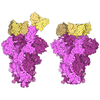
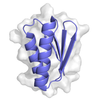
- EMDB-65041: SARS-CoV-2 spike di-trimer of RBD and NTD -

+
Open data


ID or keywords:

Loading...

-
Basic information

Entry
Database: EMDB / ID: EMD-65041
TitleSARS-CoV-2 spike di-trimer of RBD and NTD
Map data
Sample
  • Cell: SARS-CoV-2 spike di-trimer of RBD and NTD
    • Protein or peptide: Spike protein S1
    • Protein or peptide: Spike protein S1
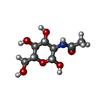
  • Ligand: 2-acetamido-2-deoxy-beta-D-glucopyranose
KeywordsSARS-CoV-2 / cryo-EM structure / VIRAL PROTEIN
Function / homology
Function and homology information


symbiont-mediated disruption of host tissue / Maturation of spike protein / Translation of Structural Proteins / Virion Assembly and Release / host cell surface / Lectin pathway of complement activation / host extracellular region / symbiont-mediated-mediated suppression of host tetherin activity / Induction of Cell-Cell Fusion / structural constituent of virion ...symbiont-mediated disruption of host tissue / Maturation of spike protein / Translation of Structural Proteins / Virion Assembly and Release / host cell surface / Lectin pathway of complement activation / host extracellular region / symbiont-mediated-mediated suppression of host tetherin activity / Induction of Cell-Cell Fusion / structural constituent of virion / positive regulation of viral entry into host cell / Initial triggering of complement / membrane fusion / host cell endoplasmic reticulum-Golgi intermediate compartment membrane / Attachment and Entry / entry receptor-mediated virion attachment to host cell / receptor-mediated virion attachment to host cell / host cell surface receptor binding / symbiont-mediated suppression of host innate immune response / endocytosis involved in viral entry into host cell / receptor ligand activity / fusion of virus membrane with host plasma membrane / fusion of virus membrane with host endosome membrane / viral envelope / symbiont entry into host cell / virion attachment to host cell / host cell plasma membrane / SARS-CoV-2 activates/modulates innate and adaptive immune responses / virion membrane / membrane / identical protein binding / plasma membrane
Similarity search - Function
Spike (S) protein S1 subunit, receptor-binding domain, SARS-CoV-2 / Spike (S) protein S1 subunit, N-terminal domain, SARS-CoV-like / Coronavirus spike glycoprotein S1, C-terminal / Coronavirus spike glycoprotein S1, C-terminal / Spike glycoprotein, N-terminal domain superfamily / Spike S1 subunit, receptor binding domain superfamily, betacoronavirus / Spike glycoprotein, betacoronavirus / Betacoronavirus spike (S) glycoprotein S1 subunit N-terminal (NTD) domain profile. / Spike glycoprotein S1, N-terminal domain, betacoronavirus-like / Betacoronavirus-like spike glycoprotein S1, N-terminal ...Spike (S) protein S1 subunit, receptor-binding domain, SARS-CoV-2 / Spike (S) protein S1 subunit, N-terminal domain, SARS-CoV-like / Coronavirus spike glycoprotein S1, C-terminal / Coronavirus spike glycoprotein S1, C-terminal / Spike glycoprotein, N-terminal domain superfamily / Spike S1 subunit, receptor binding domain superfamily, betacoronavirus / Spike glycoprotein, betacoronavirus / Betacoronavirus spike (S) glycoprotein S1 subunit N-terminal (NTD) domain profile. / Spike glycoprotein S1, N-terminal domain, betacoronavirus-like / Betacoronavirus-like spike glycoprotein S1, N-terminal / Betacoronavirus spike (S) glycoprotein S1 subunit C-terminal (CTD) domain profile. / Spike (S) protein S1 subunit, receptor-binding domain, betacoronavirus / Betacoronavirus spike glycoprotein S1, receptor binding / Spike glycoprotein S2 superfamily, coronavirus / Spike glycoprotein S2, coronavirus, heptad repeat 1 / Spike glycoprotein S2, coronavirus, heptad repeat 2 / Coronavirus spike (S) glycoprotein S2 subunit heptad repeat 1 (HR1) region profile. / Coronavirus spike (S) glycoprotein S2 subunit heptad repeat 2 (HR2) region profile. / Spike glycoprotein S2, coronavirus / Coronavirus spike glycoprotein S2
Similarity search - Domain/homology
Biological speciesSARS-CoV-2 pseudovirus / Severe acute respiratory syndrome coronavirus 2
Methodsingle particle reconstruction / cryo EM / Resolution: 2.8 Å
AuthorsYang QX / Yang YL
Funding support China, 2 items
OrganizationGrant numberCountry
National Natural Science Foundation of China (NSFC)31970146 China
National Natural Science Foundation of China (NSFC)82030062 China
CitationJournal: Mucosal Immunol / Year: 2026
Title: Enteric α-defensins contribute to intestinal mucosal immunity against SARS-CoV-2 infection.
Authors: Yilin Yang / Qianxi Yang / Xin Huang / Chongbing Liao / Zhenguo Chen / Wuyuan Lu /
Abstract: SARS-CoV-2 primarily targets epithelial cells in the respiratory and intestinal tracts where its cognate receptor ACE2 and obligate processing enzymes furin and TMPRSS2 are richly expressed. However, ...SARS-CoV-2 primarily targets epithelial cells in the respiratory and intestinal tracts where its cognate receptor ACE2 and obligate processing enzymes furin and TMPRSS2 are richly expressed. However, compared with severe inflammation and tissue damage in the lungs of a COVID-19 patient, clinical lesions in the intestine are rare, suggesting an effective intestinal mucosal immunity against SARS-CoV-2 infection. Here, we report that MMP7/hACE2 hybrid mice lacking mature enteric α-defensins or cryptdins were more susceptible to SARS-CoV-2 infection in the intestine than K18-hACE2 transgenic mice. The mouse α-defensin cryptdin-5 (Crp5) displayed potent and broad antiviral activity in vitro and in vivo by two distinct mechanisms, (1) directly targeting the RBD of the spike (S) protein to antagonize its interactions with ACE2, thus blocking viral attachment, membrane fusion and cell-to-cell transmission, and (2) binding to the 630 loop of the S protein to induce its multimerization, thereby impairing proteolytic processing, membrane fusion and, ultimately, viral infectivity. Our findings imply that enteric α-defensins help alleviate, as host protective factors, Covid-19 symptoms in the intestine despite higher ACE2 expression in the gut than in the lungs, and that Crp5 may be developed as a broad-spectrum antiviral for the treatment of coronavirus infection irrespective of virus type and variant.
History
DepositionJun 11, 2025-
Header (metadata) releaseAug 12, 2026-
Map releaseAug 12, 2026-
UpdateAug 12, 2026-
Current statusAug 12, 2026Processing site: PDBc / Status: Released

-
Structure visualization

Supplemental images

Downloads & links

-
Map

FileDownload / File: emd_65041.map.gz / Format: CCP4 / Size: 244.1 MB / Type: IMAGE STORED AS FLOATING POINT NUMBER (4 BYTES)
Projections & slices

Image control

Size
Brightness
Contrast
Others
AxesZ (Sec.)Y (Row.)X (Col.)
0.93 Å/pix.
x 400 pix.
= 372.8 Å
0.93 Å/pix.
x 400 pix.
= 372.8 Å
0.93 Å/pix.
x 400 pix.
= 372.8 Å

Surface

Projections

Slices (1/3)

Slices (1/2)

Slices (2/3)

Images are generated by Spider.

Voxel sizeX=Y=Z: 0.932 Å
Density
Contour LevelBy AUTHOR: 0.1
Minimum - Maximum0.0 - 16.035910000000001
Average (Standard dev.)0.015346993 (±0.3035419)
SymmetrySpace group: 1
Details

EMDB XML:

Map geometry
Axis orderXYZ
Origin000
Dimensions400400400
Spacing400400400
CellA=B=C: 372.8 Å
α=β=γ: 90.0 °

-
Supplemental data

-
Half map: #2

Fileemd_65041_half_map_1.map
Projections & Slices
AxesZYX

Projections

Slices (1/2)
Density Histograms

-
Half map: #1

Fileemd_65041_half_map_2.map
Projections & Slices
AxesZYX

Projections

Slices (1/2)
Density Histograms

-
Sample components

-
Entire : SARS-CoV-2 spike di-trimer of RBD and NTD

EntireName: SARS-CoV-2 spike di-trimer of RBD and NTD
Components
  • Cell: SARS-CoV-2 spike di-trimer of RBD and NTD
    • Protein or peptide: Spike protein S1
    • Protein or peptide: Spike protein S1
  • Ligand: 2-acetamido-2-deoxy-beta-D-glucopyranose

-
Supramolecule #1: SARS-CoV-2 spike di-trimer of RBD and NTD

SupramoleculeName: SARS-CoV-2 spike di-trimer of RBD and NTD / type: cell / ID: 1 / Parent: 0 / Macromolecule list: #1-#2
Source (natural)Organism: SARS-CoV-2 pseudovirus

-
Macromolecule #1: Spike protein S1

MacromoleculeName: Spike protein S1 / type: protein_or_peptide / ID: 1 / Number of copies: 2 / Enantiomer: LEVO
Source (natural)Organism: Severe acute respiratory syndrome coronavirus 2
Molecular weightTheoretical: 35.784562 KDa
Recombinant expressionOrganism: Homo sapiens (human)
SequenceString: MFVFLVLLPL VSSQCVNLTT RTQLPPAYTN SFTRGVYYPD KVFRSSVLHS TQDLFLPFFS NVTWFHAIHV SGTNGTKRFD NPVLPFNDG VYFASTEKSN IIRGWIFGTT LDSKTQSLLI VNNATNVVIK VCEFQFCNDP FLGVYYHKNN KSWMESEFRV Y SSANNCTF ...String:
MFVFLVLLPL VSSQCVNLTT RTQLPPAYTN SFTRGVYYPD KVFRSSVLHS TQDLFLPFFS NVTWFHAIHV SGTNGTKRFD NPVLPFNDG VYFASTEKSN IIRGWIFGTT LDSKTQSLLI VNNATNVVIK VCEFQFCNDP FLGVYYHKNN KSWMESEFRV Y SSANNCTF EYVSQPFLMD LEGKQGNFKN LREFVFKNID GYFKIYSKHT PINLVRDLPQ GFSALEPLVD LPIGINITRF QT LLALHRS YLTPGDSSSG WTAGAAAYYV GYLQPRTFLL KYNENGTITD AVDCALDPLS ETKCTLKSFT VEKGIYQT

UniProtKB: Spike glycoprotein

-
Macromolecule #2: Spike protein S1

MacromoleculeName: Spike protein S1 / type: protein_or_peptide / ID: 2 / Number of copies: 2 / Enantiomer: LEVO
Source (natural)Organism: Severe acute respiratory syndrome coronavirus 2
Molecular weightTheoretical: 44.76502 KDa
Recombinant expressionOrganism: Homo sapiens (human)
SequenceString: CALDPLSETK CTLKSFTVEK GIYQTSNFRV QPTESIVRFP NITNLCPFGE VFNATRFASV YAWNRKRISN CVADYSVLYN SASFSTFKC YGVSPTKLND LCFTNVYADS FVIRGDEVRQ IAPGQTGKIA DYNYKLPDDF TGCVIAWNSN NLDSKVGGNY N YLYRLFRK ...String:
CALDPLSETK CTLKSFTVEK GIYQTSNFRV QPTESIVRFP NITNLCPFGE VFNATRFASV YAWNRKRISN CVADYSVLYN SASFSTFKC YGVSPTKLND LCFTNVYADS FVIRGDEVRQ IAPGQTGKIA DYNYKLPDDF TGCVIAWNSN NLDSKVGGNY N YLYRLFRK SNLKPFERDI STEIYQAGST PCNGVEGFNC YFPLQSYGFQ PTNGVGYQPY RVVVLSFELL HAPATVCGPK KS TNLVKNK CVNFNFNGLT GTGVLTESNK KFLPFQQFGR DIADTTDAVR DPQTLEILDI TPCSFGGVSV ITPGTNTSNQ VAV LYQDVN CTEVPVAIHA DQLTPTWRVY STGSNVFQTR AGCLIGAEHV NNSYECDIPI GAGICASYQT QTNSPGSASS VASQ SIIAY TM

UniProtKB: Spike glycoprotein

-
Macromolecule #3: 2-acetamido-2-deoxy-beta-D-glucopyranose

MacromoleculeName: 2-acetamido-2-deoxy-beta-D-glucopyranose / type: ligand / ID: 3 / Number of copies: 14 / Formula: NAG
Molecular weightTheoretical: 221.208 Da
Chemical component information

ChemComp-NAG:
2-acetamido-2-deoxy-beta-D-glucopyranose

-
Experimental details

-
Structure determination

Methodcryo EM
Processingsingle particle reconstruction
Aggregation stateparticle

-
Sample preparation

BufferpH: 8
VitrificationCryogen name: ETHANE

-
Electron microscopy

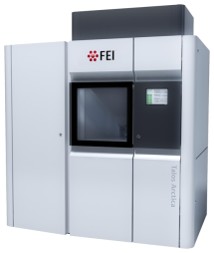
MicroscopeFEI TALOS ARCTICA
Image recordingFilm or detector model: FEI FALCON IV (4k x 4k) / Average electron dose: 50.0 e/Å2
Electron beamAcceleration voltage: 300 kV / Electron source: FIELD EMISSION GUN
Electron opticsIllumination mode: FLOOD BEAM / Imaging mode: BRIGHT FIELD / Nominal defocus max: 3.0 µm / Nominal defocus min: 1.0 µm
Experimental equipment
Model: Talos Arctica / Image courtesy: FEI Company

+
Image processing

CTF correctionType: PHASE FLIPPING AND AMPLITUDE CORRECTION
Startup modelType of model: OTHER
Final reconstructionResolution.type: BY AUTHOR / Resolution: 2.8 Å / Resolution method: FSC 0.143 CUT-OFF / Software - Name: cryoSPARC / Number images used: 94002
Initial angle assignmentType: PROJECTION MATCHING
Final angle assignmentType: PROJECTION MATCHING

+
About Yorodumi

-
News

-
Feb 9, 2022. New format data for meta-information of EMDB entries

New format data for meta-information of EMDB entries

  • Version 3 of the EMDB header file is now the official format.
  • The previous official version 1.9 will be removed from the archive.

Related info.:EMDB header

External links:wwPDB to switch to version 3 of the EMDB data model

-
Aug 12, 2020. Covid-19 info

Covid-19 info

URL: https://pdbj.org/emnavi/covid19.php

New page: Covid-19 featured information page in EM Navigator.

Related info.:Covid-19 info / Mar 5, 2020. Novel coronavirus structure data

+
Mar 5, 2020. Novel coronavirus structure data

Novel coronavirus structure data

Related info.:Yorodumi Speices / Aug 12, 2020. Covid-19 info

External links:COVID-19 featured content - PDBj / Molecule of the Month (242):Coronavirus Proteases

+
Jan 31, 2019. EMDB accession codes are about to change! (news from PDBe EMDB page)

EMDB accession codes are about to change! (news from PDBe EMDB page)

  • The allocation of 4 digits for EMDB accession codes will soon come to an end. Whilst these codes will remain in use, new EMDB accession codes will include an additional digit and will expand incrementally as the available range of codes is exhausted. The current 4-digit format prefixed with “EMD-” (i.e. EMD-XXXX) will advance to a 5-digit format (i.e. EMD-XXXXX), and so on. It is currently estimated that the 4-digit codes will be depleted around Spring 2019, at which point the 5-digit format will come into force.
  • The EM Navigator/Yorodumi systems omit the EMD- prefix.

Related info.:Q: What is EMD? / ID/Accession-code notation in Yorodumi/EM Navigator

External links:EMDB Accession Codes are Changing Soon! / Contact to PDBj

+
Jul 12, 2017. Major update of PDB

Major update of PDB

  • wwPDB released updated PDB data conforming to the new PDBx/mmCIF dictionary.
  • This is a major update changing the version number from 4 to 5, and with Remediation, in which all the entries are updated.
  • In this update, many items about electron microscopy experimental information are reorganized (e.g. em_software).
  • Now, EM Navigator and Yorodumi are based on the updated data.

External links:wwPDB Remediation / Enriched Model Files Conforming to OneDep Data Standards Now Available in the PDB FTP Archive

-
Yorodumi

Thousand views of thousand structures

  • Yorodumi is a browser for structure data from EMDB, PDB, SASBDB, etc.
  • This page is also the successor to EM Navigator detail page, and also detail information page/front-end page for Omokage search.
  • The word "yorodu" (or yorozu) is an old Japanese word meaning "ten thousand". "mi" (miru) is to see.

Related info.:EMDB / PDB / SASBDB / Comparison of 3 databanks / Yorodumi Search / Aug 31, 2016. New EM Navigator & Yorodumi / Yorodumi Papers / Jmol/JSmol / Function and homology information / Changes in new EM Navigator and Yorodumi

Read more