 Movie
Movie Controller

[English] 日本語
 Yorodumi
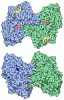
- EMDB-65039: Glycogen phosphorylase tetramer from E. coli in complex with AMP -
+ Open data

- Basic information
| Entry |  | |||||||||
|---|---|---|---|---|---|---|---|---|---|---|
| Title | Glycogen phosphorylase tetramer from E. coli in complex with AMP | |||||||||
 Map data Map data | ||||||||||
 Sample Sample |
| |||||||||
 Keywords Keywords | glycogen metabolism / cryo-EM / gut bacteria / STRUCTURAL PROTEIN | |||||||||
| Function / homology | :  Function and homology information Function and homology information | |||||||||
| Biological species |   Escherichia coli BL21(DE3) (bacteria) Escherichia coli BL21(DE3) (bacteria) | |||||||||
| Method | single particle reconstruction / cryo EM / Resolution: 3.14 Å | |||||||||
 Authors Authors | Takai M / Fukuda Y / Inoue T | |||||||||
| Funding support |  Japan, 1 items Japan, 1 items
| |||||||||
 Citation Citation | Journal: Proc Natl Acad Sci U S A / Year: 2026 Title: Structural and mechanistic diversity of glycogen phosphorylases from gut bacteria. Authors: Keigo Shobu / Mayu Takai / Hiroki Tanino / Yohta Fukuda / Tsuyoshi Inoue / Abstract: Glycogen phosphorylase (GP) plays a central role in glycogen metabolism. While the structure and regulation of mammalian GPs have been extensively studied, the corresponding mechanisms in gut ...Glycogen phosphorylase (GP) plays a central role in glycogen metabolism. While the structure and regulation of mammalian GPs have been extensively studied, the corresponding mechanisms in gut bacterial GPs remain poorly understood. Here, we investigate GPs from (GP), (GP), and (GP), which represent three phylogenetic clades of GPs, using enzymatic assays, cryo-electron microscopy (cryo-EM), and X-ray crystallography. We find that GP forms a unique pentamer that undergoes adenosine monophosphate (AMP)-dependent assembly into a dimer-of-pentamer, which inhibits activity by restricting substrate access to the catalytic site. GP exists in equilibrium among monomers, dimers, and tetramers, with AMP promoting tetramer dissociation and enhancing catalytic efficiency. In contrast, GP remains predominantly monomeric and is unresponsive to AMP. These findings uncover structural and regulatory diversity among gut bacterial GPs. Notably, the oligomeric states of GPs modulate substrate accessibility and enzyme activation, suggesting a distinct mode of allosteric regulation beyond the canonical T-to-R transition model. Because bacterial GPs contribute to the generation of glucose, their regulation may influence the composition of gut-derived metabolites that affect host glucose homeostasis and insulin sensitivity. Our study provides mechanistic insight into the structural and functional diversity of gut bacterial GPs and lays a foundation for future exploration of microbiome-mediated metabolic interactions. | |||||||||
| History |
|
- Structure visualization
| Supplemental images |
|---|

- Downloads & links
-EMDB archive
| Map data | emd_65039.map.gz | 397.8 MB | EMDB map data format | |
|---|---|---|---|---|
| Header (meta data) | emd-65039-v30.xmlemd-65039.xml | 17.6 KB 17.6 KB | Display Display | EMDB header |
| FSC (resolution estimation) | emd_65039_fsc.xml | 15.9 KB | Display | FSC data file |
| Images |  emd_65039.png emd_65039.png | 151.8 KB | ||
| Filedesc metadata | emd-65039.cif.gz | 6.3 KB | ||
| Others | emd_65039_half_map_1.map.gzemd_65039_half_map_2.map.gz | 390.9 MB 390.9 MB | ||
| Archive directory |  http://ftp.pdbj.org/pub/emdb/structures/EMD-65039ftp://ftp.pdbj.org/pub/emdb/structures/EMD-65039 http://ftp.pdbj.org/pub/emdb/structures/EMD-65039ftp://ftp.pdbj.org/pub/emdb/structures/EMD-65039 | HTTPS FTP |
-Related structure data
| Related structure data |  9vfvMC  20yrC  20ysC  9l6iC  9m9pC  9ma8C  9maqC  9u3aC  9u3kC  9ukqC  9ukrC  9uoeC  9upeC  9utgC  9uupC  9v16C  9v17C  9vblC  9vbmC M: atomic model generated by this map C: citing same article ( |
|---|---|
| Similar structure data |


-Links
| EMDB pages | EMDB (EBI/PDBe) / EMDataResource |
|---|---|
| Related items in Molecule of the Month |
-Map
| File | Download / File: emd_65039.map.gz / Format: CCP4 / Size: 421.9 MB / Type: IMAGE STORED AS FLOATING POINT NUMBER (4 BYTES) | ||||||||||||||||||||||||||||||||||||
|---|---|---|---|---|---|---|---|---|---|---|---|---|---|---|---|---|---|---|---|---|---|---|---|---|---|---|---|---|---|---|---|---|---|---|---|---|---|
| Projections & slices | Image control
Images are generated by Spider. | ||||||||||||||||||||||||||||||||||||
| Voxel size | X=Y=Z: 0.83 Å | ||||||||||||||||||||||||||||||||||||
| Density |
| ||||||||||||||||||||||||||||||||||||
| Symmetry | Space group: 1 | ||||||||||||||||||||||||||||||||||||
| Details | EMDB XML:
|
 Z (Sec.)
 Y (Row.)
 X (Col.)


-Supplemental data
-Half map: #2
| File | emd_65039_half_map_1.map | ||||||||||||
|---|---|---|---|---|---|---|---|---|---|---|---|---|---|
| Projections & Slices |
| ||||||||||||
| Density Histograms |


-Half map: #1
| File | emd_65039_half_map_2.map | ||||||||||||
|---|---|---|---|---|---|---|---|---|---|---|---|---|---|
| Projections & Slices |
| ||||||||||||
| Density Histograms |


- Sample components
-Entire : glycogen phosphorylase
| Entire | Name: glycogen phosphorylase |
|---|---|
| Components |
|
-Supramolecule #1: glycogen phosphorylase
| Supramolecule | Name: glycogen phosphorylase / type: complex / ID: 1 / Parent: 0 / Macromolecule list: #1 |
|---|---|
| Source (natural) | Organism: Escherichia coli BL21(DE3) (bacteria) |
-Macromolecule #1: Alpha-1,4 glucan phosphorylase
| Macromolecule | Name: Alpha-1,4 glucan phosphorylase / type: protein_or_peptide / ID: 1 / Number of copies: 2 / Enantiomer: LEVO / EC number: glycogen phosphorylase |
|---|---|
| Source (natural) | Organism: Escherichia coli BL21(DE3) (bacteria) |
| Molecular weight | Theoretical: 95.552625 KDa |
| Recombinant expression | Organism: Escherichia coli BL21(DE3) (bacteria) |
| Sequence | String: MGSSHHHHHH ENLYFQGMNA PFTYSSPTLS VEALKHSIAY KLMFTIGKDP VVANKHEWLN ATLFAVRDRL VERWLRSNRA QLSQETRQV YYLSMEFLIG RTLSNAMLSL GIYEDVQGAL EAMGLNLEEL IDEENDPGLG NGGLGRLAAC FLDSLATLGL P GRGYGIRY ...String: MGSSHHHHHH ENLYFQGMNA PFTYSSPTLS VEALKHSIAY KLMFTIGKDP VVANKHEWLN ATLFAVRDRL VERWLRSNRA QLSQETRQV YYLSMEFLIG RTLSNAMLSL GIYEDVQGAL EAMGLNLEEL IDEENDPGLG NGGLGRLAAC FLDSLATLGL P GRGYGIRY DYGMFKQNIV NGSQKESPDY WLEYGNPWEF KRHNTRYKVR FGGRIQQEGK KTRWIETEEI LGVAYDQIIP GY DTDATNT LRLWSAQASS EINLGKFNQG DYFAAVEDKN HSENVSRVLY PDDSTYSGRE LRLRQEYFLV SSTIQDILSR HYQ LHKTYD NLADKIAIHL NDTHPVLSIP EMMRLLIDEH QFSWDDAFEV CCQVFSYTNH TLMSEALETW PVDMLGKILP RHLQ IIFEI NDYFLKTLQE QYPNDTDLLG RASIIDESNG RRVRMAWLAV VVSHKVNGVS ELHSNLMVQS LFADFAKIFP GRFTN VTNG VTPRRWLAVA NPSLSAVLDE HLGRNWRTDL SLLNELQQHC DFPMVNHAVH QAKLENKKRL AEYIAQQLNV VVNPKA LFD VQIKRIHEYK RQLMNVLHVI TRYNRIKADP DAKWVPRVNI FGGKAASAYY MAKHIIHLIN DVAKVINNDP QIGDKLK VV FIPNYSVSLA QLIIPAADLS EQISLAGTEA SGTSNM(LLP)FAL NGALTIGTLD GANVEMLDHV GADNIFIFGN TAEE VEELR RQGYKPREYY EKDEELHQVL TQIGSGVFSP EDPGRYRDLV DSLINFGDHY QVLADYRSYV DCQDKVDELY ELQEE WTAK AMLNIANMGY FSSDRTIKEY ADHIWHIDPV RL UniProtKB: UNIPROTKB: A0A140N6M9 |
-Macromolecule #2: ADENOSINE MONOPHOSPHATE
| Macromolecule | Name: ADENOSINE MONOPHOSPHATE / type: ligand / ID: 2 / Number of copies: 2 / Formula: AMP |
|---|---|
| Molecular weight | Theoretical: 347.221 Da |
| Chemical component information | 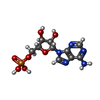 ChemComp-AMP: |
-Experimental details
-Structure determination
| Method | cryo EM |
|---|---|
 Processing Processing | single particle reconstruction |
| Aggregation state | particle |
-Sample preparation
| Concentration | 1.00 mg/mL | |||||||||
|---|---|---|---|---|---|---|---|---|---|---|
| Buffer | pH: 8 Component:
| |||||||||
| Vitrification | Cryogen name: ETHANE / Chamber humidity: 100 % / Chamber temperature: 277 K / Instrument: FEI VITROBOT MARK IV Details: 3 microliters droplet, 20 seconds delay before blotting, 3 seconds blot, 0 second delay before plunging.. |
- Electron microscopy
| Microscope | JEOL CRYO ARM 200 |
|---|---|
| Image recording | Film or detector model: GATAN K3 (6k x 4k) / Number grids imaged: 1 / Number real images: 7656 / Average electron dose: 40.0 e/Å2 |
| Electron beam | Acceleration voltage: 200 kV / Electron source:  FIELD EMISSION GUN FIELD EMISSION GUN |
| Electron optics | Illumination mode: FLOOD BEAM / Imaging mode: BRIGHT FIELD / Nominal defocus max: 2.2 µm / Nominal defocus min: 0.7000000000000001 µm |

