 Movie
Movie Controller


+ Open data

- Basic information
| Entry |  | |||||||||
|---|---|---|---|---|---|---|---|---|---|---|
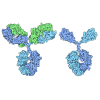
| Title | Cryo-EM structure of the GLPG1205-bound GPR84 receptor | |||||||||
 Map data Map data | GPR84 inactive form Cryo-EM map complex with GLPG1205 | |||||||||
 Sample Sample |
| |||||||||
 Keywords Keywords | GPCR / MCFA / complex / antagonist / MEMBRANE PROTEIN | |||||||||
| Function / homology |  Function and homology information Function and homology informationurotensin II receptor activity / tertiary granule membrane / specific granule membrane / neuropeptide signaling pathway / electron transport chain / G alpha (s) signalling events / electron transfer activity / signaling receptor complex / periplasmic space / iron ion binding ...urotensin II receptor activity / tertiary granule membrane / specific granule membrane / neuropeptide signaling pathway / electron transport chain / G alpha (s) signalling events / electron transfer activity / signaling receptor complex / periplasmic space / iron ion binding / heme binding / Neutrophil degranulation / plasma membrane Similarity search - Function | |||||||||
| Biological species |  Homo sapiens (human) Homo sapiens (human) | |||||||||
| Method | single particle reconstruction / cryo EM / Resolution: 3.5 Å | |||||||||
 Authors Authors | Choi MK / Cho HS | |||||||||
| Funding support | 1 items
| |||||||||
 Citation Citation | Journal: Exp Mol Med / Year: 2026 Title: Pharmacological modulation of GPR84 revealed by dual states structures and immune functional assays. Authors: Myung Kyung Choi / Dong Jin Park / Pankyung Kim / Hee Seong Choi / Sorin Myung / Youngki Yoo / Nienping Chang / Ga-Yeon Yoon / Hye Jin Kang / Sang-Jun Ha / Hyun-Soo Cho /   Abstract: G-protein-coupled receptor 84 (GPR84) is an orphan class A GPCR selectively activated by medium chain fatty acids and highly expressed in immune cells, where it modulates pro-inflammatory signaling. ...G-protein-coupled receptor 84 (GPR84) is an orphan class A GPCR selectively activated by medium chain fatty acids and highly expressed in immune cells, where it modulates pro-inflammatory signaling. The structural basis of GPR84 inactivation and antagonism has remained unclear, limiting the rational design of pathway-selective modulators despite its clinical relevance in metabolic inflammation and fibrotic diseases. Here, we report cryo-electron microscopy structures of human GPR84 in inactive and active states. The 3.5 Å inactive structure bound to the antagonist GLPG1205 reveals a lid-like conformation of extracellular loop 2 and an inward reorientation of Arg172, with the antagonist head group blocking the allosteric sodium-binding site. Molecular dynamics simulations further support these findings, identifying an aberrant TM5, TM6 lateral entry gate. By contrast, the 3.17 Å agonist ZQ-16, Gαi complex, shows a rearranged toggle switch and comparative analyses highlight extracellular loop 2 conformational plasticity. Immune functional assays in THP-1 cells demonstrated that ZQ-16 elicited GPR84-dependent activation and cytokine production, which were effectively abrogated by GLPG1205. Mutagenesis combined with functional assays validates key ligand interactions, providing a framework for the rational design of pathway selective GPR84 modulators. | |||||||||
| History |
|
- Structure visualization
| Supplemental images |
|---|

- Downloads & links
-EMDB archive
| Map data | emd_64807.map.gz | 328.4 MB | EMDB map data format | |
|---|---|---|---|---|
| Header (meta data) | emd-64807-v30.xmlemd-64807.xml | 21.8 KB 21.8 KB | Display Display | EMDB header |
| FSC (resolution estimation) | emd_64807_fsc.xml | 14.9 KB | Display | FSC data file |
| Images |  emd_64807.png emd_64807.png | 52.4 KB | ||
| Filedesc metadata | emd-64807.cif.gz | 6.7 KB | ||
| Others | emd_64807_half_map_1.map.gzemd_64807_half_map_2.map.gz | 322.9 MB 322.9 MB | ||
| Archive directory |  https://data.pdbj.org/pub/emdb/structures/EMD-64807ftp://data.pdbj.org/pub/emdb/structures/EMD-64807 https://data.pdbj.org/pub/emdb/structures/EMD-64807ftp://data.pdbj.org/pub/emdb/structures/EMD-64807 | HTTPS FTP |
-Related structure data
| Related structure data |  9v6tMC  9upyC C: citing same article ( M: atomic model generated by this map |
|---|---|
| Similar structure data |

-Links
| EMDB pages | EMDB (EBI/PDBe) / EMDataResource |
|---|---|
| Related items in Molecule of the Month |
-Map
| File | Download / File: emd_64807.map.gz / Format: CCP4 / Size: 347.6 MB / Type: IMAGE STORED AS FLOATING POINT NUMBER (4 BYTES) | ||||||||||||||||||||||||||||||||||||
|---|---|---|---|---|---|---|---|---|---|---|---|---|---|---|---|---|---|---|---|---|---|---|---|---|---|---|---|---|---|---|---|---|---|---|---|---|---|
| Annotation | GPR84 inactive form Cryo-EM map complex with GLPG1205 | ||||||||||||||||||||||||||||||||||||
| Projections & slices | Image control
Images are generated by Spider. | ||||||||||||||||||||||||||||||||||||
| Voxel size | X=Y=Z: 0.664 Å | ||||||||||||||||||||||||||||||||||||
| Density |
| ||||||||||||||||||||||||||||||||||||
| Symmetry | Space group: 1 | ||||||||||||||||||||||||||||||||||||
| Details | EMDB XML:
|
 Z (Sec.)
 Y (Row.)
 X (Col.)


-Supplemental data
-Half map: GPR84 inactive form Cryo-EM map(half B) complex with GLPG1205
| File | emd_64807_half_map_1.map | ||||||||||||
|---|---|---|---|---|---|---|---|---|---|---|---|---|---|
| Annotation | GPR84 inactive form Cryo-EM map(half B) complex with GLPG1205 | ||||||||||||
| Projections & Slices |
| ||||||||||||
| Density Histograms |


-Half map: GPR84 inactive form Cryo-EM map(half A) complex with GLPG1205
| File | emd_64807_half_map_2.map | ||||||||||||
|---|---|---|---|---|---|---|---|---|---|---|---|---|---|
| Annotation | GPR84 inactive form Cryo-EM map(half A) complex with GLPG1205 | ||||||||||||
| Projections & Slices |
| ||||||||||||
| Density Histograms |


- Sample components
-Entire : GLPG1205-bound GPR84 receptor complex
| Entire | Name: GLPG1205-bound GPR84 receptor complex |
|---|---|
| Components |
|
-Supramolecule #1: GLPG1205-bound GPR84 receptor complex
| Supramolecule | Name: GLPG1205-bound GPR84 receptor complex / type: complex / ID: 1 / Parent: 0 / Macromolecule list: #1-#3 |
|---|---|
| Source (natural) | Organism: Homo sapiens (human) |
| Molecular weight | Theoretical: 107 KDa |
-Macromolecule #1: Soluble cytochrome b562
| Macromolecule | Name: Soluble cytochrome b562 / type: protein_or_peptide / ID: 1 / Number of copies: 1 / Enantiomer: LEVO |
|---|---|
| Source (natural) | Organism: Homo sapiens (human) |
| Molecular weight | Theoretical: 12.885483 KDa |
| Recombinant expression | Organism:   Spodoptera frugiperda (fall armyworm) Spodoptera frugiperda (fall armyworm) |
| Sequence | String: ADLEDNMETL NDNLKVIEKA DNAAQVKDAL TKMRAAALDA QKATPPKLED KSPDSPEMKD FRHGFDILVG QIDDALKLAN EGKVKEAQA AAEQLKTTRN AYHQKYLGER ARSTLQK UniProtKB: Soluble cytochrome b562 |
-Macromolecule #2: anti-BRIL Fab Heavy chain
| Macromolecule | Name: anti-BRIL Fab Heavy chain / type: protein_or_peptide / ID: 2 / Number of copies: 1 / Enantiomer: LEVO |
|---|---|
| Source (natural) | Organism: Homo sapiens (human) |
| Molecular weight | Theoretical: 13.769205 KDa |
| Recombinant expression | Organism: Spodoptera frugiperda (fall armyworm) |
| Sequence | String: EISEVQLVES GGGLVQPGGS LRLSCAASGF NVVDFSLHWV RQAPGKGLEW VAYISSSSGS TSYADSVKGR FTISADTSKN TAYLQMNSL RAEDTAVYYC ARWGYWPGEP WWKAFDYWGQ GTLVTVS |
-Macromolecule #3: anti-BRIL Fab Light chain
| Macromolecule | Name: anti-BRIL Fab Light chain / type: protein_or_peptide / ID: 3 / Number of copies: 1 / Enantiomer: LEVO |
|---|---|
| Source (natural) | Organism: Homo sapiens (human) |
| Molecular weight | Theoretical: 12.025412 KDa |
| Recombinant expression | Organism:   Escherichia coli (E. coli) Escherichia coli (E. coli) |
| Sequence | String: SDIQMTQSPS SLSASVGDRV TITCRASQSV SSAVAWYQQK PGKAPKLLIY SASSLYSGVP SRFSGSRSGT DFTLTISSLQ PEDFATYYC QQYLYYSLVT FGQGTKVEIK R |
-Macromolecule #4: G-protein coupled receptor 84
| Macromolecule | Name: G-protein coupled receptor 84 / type: protein_or_peptide / ID: 4 / Number of copies: 1 / Enantiomer: LEVO |
|---|---|
| Source (natural) | Organism: Homo sapiens (human) |
| Molecular weight | Theoretical: 43.752965 KDa |
| Recombinant expression | Organism: Spodoptera frugiperda (fall armyworm) |
| Sequence | String: MWNSSDANFS CYHESVLGYR YVAVSWGVVV AVTGTVGNVL TLLALAIQPK LRTRFNLLIA NLTLADLLYC TLLQPFSVDT YLHLHWRTG ATFCRVFGLL LFASNSVSIL TLCLIALGRY LLIAHPKLFP QVFSAKGIVL ALVSTWVVGV ASFAPLWPIY I LVPVVCTC ...String: MWNSSDANFS CYHESVLGYR YVAVSWGVVV AVTGTVGNVL TLLALAIQPK LRTRFNLLIA NLTLADLLYC TLLQPFSVDT YLHLHWRTG ATFCRVFGLL LFASNSVSIL TLCLIALGRY LLIAHPKLFP QVFSAKGIVL ALVSTWVVGV ASFAPLWPIY I LVPVVCTC SFDRIRGRPY TTILMGIYFV LGLSSVGIFY CLIHRQVKRA AQALDQYKLR QASIHSNHVA RTDEAMPGRF QE LDSRLAS GGPSEGISSE PVSAATTQTL EGDSSEVGDQ INSKRAKQMA EKSPPEASAK AQPIKGARRA PDSSSEFGKV TRM CFAVFL CFALSYIPFL LLNILDARVQ APRVVHMLAA NLTWLNGCIN PVLYAAMNRQ FRQAYGSILK RGPRSFHRLH UniProtKB: G protein-coupled receptor 84 |
-Macromolecule #5: 9-(2-cyclopropylethynyl)-2-[[(2~{S})-1,4-dioxan-2-yl]methoxy]-6,7...
| Macromolecule | Name: 9-(2-cyclopropylethynyl)-2-[[(2~{S})-1,4-dioxan-2-yl]methoxy]-6,7-dihydropyrimido[6,1-a]isoquinolin-4-one type: ligand / ID: 5 / Number of copies: 1 / Formula: A1L93 |
|---|---|
| Molecular weight | Theoretical: 378.421 Da |
-Experimental details
-Structure determination
| Method | cryo EM |
|---|---|
 Processing Processing | single particle reconstruction |
| Aggregation state | particle |
-Sample preparation
| Concentration | 12 mg/mL | ||||||||||||||||||
|---|---|---|---|---|---|---|---|---|---|---|---|---|---|---|---|---|---|---|---|
| Buffer | pH: 7.5 Component:
| ||||||||||||||||||
| Grid | Model: Quantifoil R1.2/1.3 / Material: COPPER / Mesh: 300 / Support film - Material: CARBON / Support film - topology: HOLEY / Pretreatment - Type: GLOW DISCHARGE | ||||||||||||||||||
| Vitrification | Cryogen name: ETHANE / Chamber humidity: 100 % / Chamber temperature: 277.15 K / Instrument: FEI VITROBOT MARK IV |
- Electron microscopy
| Microscope | TFS KRIOS |
|---|---|
| Image recording | Film or detector model: GATAN K3 BIOQUANTUM (6k x 4k) / Average electron dose: 69.0 e/Å2 |
| Electron beam | Acceleration voltage: 300 kV / Electron source:  FIELD EMISSION GUN FIELD EMISSION GUN |
| Electron optics | Illumination mode: FLOOD BEAM / Imaging mode: BRIGHT FIELD / Nominal defocus max: 2.0 µm / Nominal defocus min: 0.7000000000000001 µm |
| Sample stage | Specimen holder model: FEI TITAN KRIOS AUTOGRID HOLDER / Cooling holder cryogen: NITROGEN |
| Experimental equipment |  Model: Titan Krios / Image courtesy: FEI Company |

