National Natural Science Foundation of China (NSFC)
China
Citation
Journal: Proc Natl Acad Sci U S A / Year: 2025 Title: Binding of autotransporter adhesin CbpF to human CEACAM1 and CEACAM5: A Velcro model for bacterium adhesion. Authors: Fan Shen / Linjie Li / Dongchun Yang / Zhexiao Tang / Lu Zhang / Kefang Liu / Wenzhe Hou / Zhuozhuang Lu / Jing-Yuan Fang / Jianxun Qi / Xin Zhao / George F Gao / Abstract: In eukaryotic systems, three major types of cell junctions have been well characterized. While bacterial adhesion mechanisms also exhibit remarkable diversity, the molecular processes that regulate ...In eukaryotic systems, three major types of cell junctions have been well characterized. While bacterial adhesion mechanisms also exhibit remarkable diversity, the molecular processes that regulate the dynamic modulation of binding strength between elongated bacterial cells and host cells remain poorly understood. () utilizes the surface adhesin CbpF to interact with the highly expressed host receptors CEACAM1 and CEACAM5 on cancer cells to facilitate tumor colonization. By elucidating the structural details of CbpF binding to human CEACAM1/CEACAM5 receptors, and through mechanistic investigations, we identified that the prominent EFNGQYQ loop on CbpF and the key Q78 residue of CEACAM1/CEACAM5 constitute the molecular linchpin of this pathogen-host interface. Furthermore, we found a distinct type of binding particle and proposed a Velcro-like adhesion model. In this model, CbpF mediates robust attachment through the simultaneous interaction of multiple binding sites, akin to the interlocking mechanism of Velcro. This multivalent interaction allows to dynamically switch between firm anchoring and easy detachment, adapting to varying physiological microenvironments. Our study elucidates the dynamic modulation of bacterial adhesion strength and lays the foundation for developing therapeutic interventions to disrupt the bacterium-host interface.
In the structure databanks used in Yorodumi, some data are registered as the other names, "COVID-19 virus" and "2019-nCoV". Here are the details of the virus and the list of structure data.
Jan 31, 2019. EMDB accession codes are about to change! (news from PDBe EMDB page)
EMDB accession codes are about to change! (news from PDBe EMDB page)
The allocation of 4 digits for EMDB accession codes will soon come to an end. Whilst these codes will remain in use, new EMDB accession codes will include an additional digit and will expand incrementally as the available range of codes is exhausted. The current 4-digit format prefixed with “EMD-” (i.e. EMD-XXXX) will advance to a 5-digit format (i.e. EMD-XXXXX), and so on. It is currently estimated that the 4-digit codes will be depleted around Spring 2019, at which point the 5-digit format will come into force.
The EM Navigator/Yorodumi systems omit the EMD- prefix.
Related info.:Q: What is EMD? / ID/Accession-code notation in Yorodumi/EM Navigator
Yorodumi is a browser for structure data from EMDB, PDB, SASBDB, etc.
This page is also the successor to EM Navigator detail page, and also detail information page/front-end page for Omokage search.
The word "yorodu" (or yorozu) is an old Japanese word meaning "ten thousand". "mi" (miru) is to see.
Related info.:EMDB / PDB / SASBDB / Comparison of 3 databanks / Yorodumi Search / Aug 31, 2016. New EM Navigator & Yorodumi / Yorodumi Papers / Jmol/JSmol / Function and homology information / Changes in new EM Navigator and Yorodumi
 Movie
Movie Controller

 Yorodumi
 Open data
 Basic information
 Map data
 Sample
 Keywords
 Function and homology information
 Fusobacterium nucleatum (bacteria) /
  Homo sapiens (human)
 Authors
 China, 1 items
  Citation
 Structure visualization
 Downloads & links
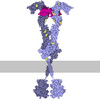
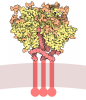
 emd_63959.png
 http://ftp.pdbj.org/pub/emdb/structures/EMD-63959



 Z (Sec.)
 Y (Row.)
 X (Col.)


 Sample components
 Escherichia coli (E. coli)
 Processing
 Electron microscopy
 FIELD EMISSION GUN
