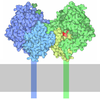
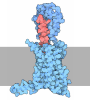
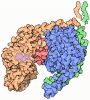
Journal: PNAS Nexus / Year: 2025 Title: Structural insights into endogenous agonist selectivity of aminergic receptors from the octopamine β receptor. Authors: Tetsuya Hori / Kazushige Katsura / Sayako Miyamoto-Kohno / Tomomi Uchikubo-Kamo / Mayumi Yonemochi / Mikako Shirouzu / Abstract: Tyrosine-derived amines (TDAs), such as octopamine, noradrenaline, dopamine, and tyramine, are essential neurotransmitters that play diverse roles in various physiological processes. The distinct ...Tyrosine-derived amines (TDAs), such as octopamine, noradrenaline, dopamine, and tyramine, are essential neurotransmitters that play diverse roles in various physiological processes. The distinct receptor selectivity of these structurally similar molecules is vital for their specific functions. However, all these receptors belong to the same subfamily of G-protein-coupled receptors and share high sequence homology within their orthosteric binding sites. The molecular basis of this selectivity remains unclear because of the absence of structural data on octopamine and tyramine receptors. In this study, we present cryo-electron microscopy structures of the deer tick octopamine β receptor (octβR) bound to octopamine or -2,4-dimethylphenyl-'-methylformamidine (DPMF), an acaricidal amitraz metabolite. Octopamine and DPMF formed aromatic interactions with Y307 and F328, residues crucial for octβR activation. The lower potency of other TDAs for octβR stems from the subtle effect of functional groups on both interactions, i.e. the meta-hydroxyl group of noradrenaline and dopamine hinders edge-to-edge interaction with Y307, and the absence of a 1-hydroxyl group in dopamine and tyramine prevents π-hydrogen bonding with F328. These structural insights into octβR selectivity are likely applicable across other TDA receptors, highlighting the pivotal role of residues 6.55 and 7.39. Consequently, the elucidated selection mechanism provides fundamental knowledge of aminergic ligand recognition, a process crucial for neurotransmission and overall organismal function.
In the structure databanks used in Yorodumi, some data are registered as the other names, "COVID-19 virus" and "2019-nCoV". Here are the details of the virus and the list of structure data.
Jan 31, 2019. EMDB accession codes are about to change! (news from PDBe EMDB page)
EMDB accession codes are about to change! (news from PDBe EMDB page)
The allocation of 4 digits for EMDB accession codes will soon come to an end. Whilst these codes will remain in use, new EMDB accession codes will include an additional digit and will expand incrementally as the available range of codes is exhausted. The current 4-digit format prefixed with “EMD-” (i.e. EMD-XXXX) will advance to a 5-digit format (i.e. EMD-XXXXX), and so on. It is currently estimated that the 4-digit codes will be depleted around Spring 2019, at which point the 5-digit format will come into force.
The EM Navigator/Yorodumi systems omit the EMD- prefix.
Related info.:Q: What is EMD? / ID/Accession-code notation in Yorodumi/EM Navigator
Yorodumi is a browser for structure data from EMDB, PDB, SASBDB, etc.
This page is also the successor to EM Navigator detail page, and also detail information page/front-end page for Omokage search.
The word "yorodu" (or yorozu) is an old Japanese word meaning "ten thousand". "mi" (miru) is to see.
Related info.:EMDB / PDB / SASBDB / Comparison of 3 databanks / Yorodumi Search / Aug 31, 2016. New EM Navigator & Yorodumi / Yorodumi Papers / Jmol/JSmol / Function and homology information / Changes in new EM Navigator and Yorodumi
 Movie
Movie Controller


 Open data
 Basic information
 Map data
 Sample
 Keywords
 Function and homology information
 Ixodes scapularis (black-legged tick) /
  Homo sapiens (human) /
 Escherichia coli (E. coli)
 Authors
 Japan, 1 items
  Citation
 Structure visualization
 Downloads & links
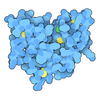
 emd_63636.png
 http://ftp.pdbj.org/pub/emdb/structures/EMD-63636




 X (Sec.)
 Y (Row.)
 Z (Col.)


 Sample components
 Spodoptera frugiperda granulovirus
 Processing
 Electron microscopy
 FIELD EMISSION GUN
