 Movie
Movie Controller

[English] 日本語
 Yorodumi
- EMDB-56471: Structure of the type IV pilus machinery from Thermus thermophilu... -
+ Open data

- Basic information
| Entry |  | |||||||||
|---|---|---|---|---|---|---|---|---|---|---|
| Title | Structure of the type IV pilus machinery from Thermus thermophilus in the closed state (C6 symmetry) | |||||||||
 Map data Map data | ||||||||||
 Sample Sample |
| |||||||||
 Keywords Keywords | Type IV pilus / Thermus / Bacterial motility / STRUCTURAL PROTEIN | |||||||||
| Biological species |   Thermus thermophilus HB27 (bacteria) Thermus thermophilus HB27 (bacteria) | |||||||||
| Method | subtomogram averaging / cryo EM / Resolution: 140.0 Å | |||||||||
 Authors Authors | McLaren MJ / Neuhaus A / Gold VAM | |||||||||
| Funding support |  United Kingdom, 1 items United Kingdom, 1 items
| |||||||||
 Citation Citation | Journal: Commun Biol / Year: 2026 Title: Structural insights into the Thermus thermophilus type IV pilus machinery assembling two distinct pili. Authors: Alexander Neuhaus / Mathew McLaren / Michail N Isupov / Matthew Gaines / Emma Buzzard / Mateusz Sikora / Cyril Hanus / Bertram Daum / Beate Averhoff / Vicki A M Gold /     Abstract: Type IV pili are long, filamentous structures that extend from bacterial cell surfaces, enabling cells to respond to changing environments and facilitating genome plasticity. Thermus thermophilus ...Type IV pili are long, filamentous structures that extend from bacterial cell surfaces, enabling cells to respond to changing environments and facilitating genome plasticity. Thermus thermophilus HB27 produces two different type IV pili, each exhibiting distinct structural and functional properties. Here, we combine cryo-electron tomography, mutagenesis, and AlphaFold predictions to generate hypothetical in situ models of the T. thermophilus type IV pilus assembly machinery. Using single-particle cryo-electron microscopy, we determine structures of both filament types, enabling modelling of their surface glycans. Molecular dynamics simulations further reveal the flexibility of these glycans on extrusion. Integration of the filament structures with our hypothetical model of the assembly machinery offers a framework for further dissecting T4P architecture and biogenesis. | |||||||||
| History |
|
- Structure visualization
| Supplemental images |
|---|

- Downloads & links
-EMDB archive
| Map data | emd_56471.map.gz | 5.7 MB |  EMDB map data format EMDB map data format | |
|---|---|---|---|---|
| Header (meta data) | emd-56471-v30.xmlemd-56471.xml | 15.9 KB 15.9 KB | Display Display | EMDB header |
| Images |  emd_56471.png emd_56471.png | 37.3 KB | ||
| Filedesc metadata | emd-56471.cif.gz | 4.3 KB | ||
| Others | emd_56471_half_map_1.map.gzemd_56471_half_map_2.map.gz | 5.6 MB 5.6 MB | ||
| Archive directory |  https://data.pdbj.org/pub/emdb/structures/EMD-56471ftp://data.pdbj.org/pub/emdb/structures/EMD-56471 https://data.pdbj.org/pub/emdb/structures/EMD-56471ftp://data.pdbj.org/pub/emdb/structures/EMD-56471 | HTTPS FTP |
-Related structure data


-Links
| EMDB pages | EMDB (EBI/PDBe) / EMDataResource |
|---|
-Map
| File | Download / File: emd_56471.map.gz / Format: CCP4 / Size: 12.9 MB / Type: IMAGE STORED AS FLOATING POINT NUMBER (4 BYTES) | ||||||||||||||||||||||||||||||||||||
|---|---|---|---|---|---|---|---|---|---|---|---|---|---|---|---|---|---|---|---|---|---|---|---|---|---|---|---|---|---|---|---|---|---|---|---|---|---|
| Projections & slices | Image control
Images are generated by Spider. | ||||||||||||||||||||||||||||||||||||
| Voxel size | X=Y=Z: 8.4 Å | ||||||||||||||||||||||||||||||||||||
| Density |
| ||||||||||||||||||||||||||||||||||||
| Symmetry | Space group: 1 | ||||||||||||||||||||||||||||||||||||
| Details | EMDB XML:
|
 Z (Sec.)
 Y (Row.)
 X (Col.)


-Supplemental data
-Half map: #2
| File | emd_56471_half_map_1.map | ||||||||||||
|---|---|---|---|---|---|---|---|---|---|---|---|---|---|
| Projections & Slices |
| ||||||||||||
| Density Histograms |


-Half map: #1
| File | emd_56471_half_map_2.map | ||||||||||||
|---|---|---|---|---|---|---|---|---|---|---|---|---|---|
| Projections & Slices |
| ||||||||||||
| Density Histograms |


- Sample components
-Entire : Structure of the type IV pilus machinery from Thermus thermophilu...
| Entire | Name: Structure of the type IV pilus machinery from Thermus thermophilus in the open state (C13 symmetry) |
|---|---|
| Components |
|
-Supramolecule #1: Structure of the type IV pilus machinery from Thermus thermophilu...
| Supramolecule | Name: Structure of the type IV pilus machinery from Thermus thermophilus in the open state (C13 symmetry) type: complex / ID: 1 / Parent: 0 |
|---|---|
| Source (natural) | Organism: Thermus thermophilus HB27 (bacteria) |
-Experimental details
-Structure determination
| Method | cryo EM |
|---|---|
 Processing Processing | subtomogram averaging |
| Aggregation state | cell |
-Sample preparation
| Buffer | pH: 7.4 |
|---|---|
| Vitrification | Cryogen name: ETHANE |
- Electron microscopy
| Microscope | FEI TALOS ARCTICA |
|---|---|
| Image recording | Film or detector model: GATAN K2 SUMMIT (4k x 4k) / Detector mode: SUPER-RESOLUTION / Average electron dose: 1.97 e/Å2 |
| Electron beam | Acceleration voltage: 200 kV / Electron source:  FIELD EMISSION GUN FIELD EMISSION GUN |
| Electron optics | Illumination mode: FLOOD BEAM / Imaging mode: BRIGHT FIELD / Nominal defocus max: 8.0 µm / Nominal defocus min: 2.5 µm |
| Experimental equipment | 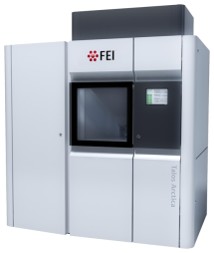 Model: Talos Arctica / Image courtesy: FEI Company |
-Image processing
| Final reconstruction | Applied symmetry - Point group: C6 (6 fold cyclic) / Resolution.type: BY AUTHOR / Resolution: 140.0 Å / Resolution method: FSC 0.143 CUT-OFF / Software: (Name: PEET (ver. 1.17.0), RELION (ver. 4.0.1)) / Number subtomograms used: 33 |
|---|---|
| Extraction | Number tomograms: 32 / Number images used: 33 / Software - Name: PEET (ver. 1.17.0) |
| CTF correction | Type: NONE |
| Final angle assignment | Type: MAXIMUM LIKELIHOOD |
-Atomic model buiding 1
| Initial model | Chain - Source name: PDB / Chain - Initial model type: experimental model |
|---|
