- EMDB-55593: Chlorophyll f-containing dimeric far-red Photosystem II from Chro... -
+
Open data
ID or keywords:
Loading...
-
Basic information
Entry
Database: EMDB / ID: EMD-55593
Title
Chlorophyll f-containing dimeric far-red Photosystem II from Chroococcidiopsis thermalis PCC 7203
Map data
Sample
Complex: Dimeric far-red Photosystem II
Protein or peptide: x 21 types
Ligand: x 18 types
Keywords
Chlorophyll f / photosystem II / ELECTRON TRANSPORT / FaRLiP
Function / homology
Function and homology information
oxidoreductase activity, acting on diphenols and related substances as donors, oxygen as acceptor / response to herbicide / photosystem II oxygen evolving complex / photosystem II assembly / oxygen evolving activity / photosystem II stabilization / photosystem II reaction center / photosystem II / photosynthetic electron transport chain / photosystem II ...oxidoreductase activity, acting on diphenols and related substances as donors, oxygen as acceptor / response to herbicide / photosystem II oxygen evolving complex / photosystem II assembly / oxygen evolving activity / photosystem II stabilization / photosystem II reaction center / photosystem II / photosynthetic electron transport chain / photosystem II / extrinsic component of membrane / chlorophyll binding / photosynthetic electron transport in photosystem II / plasma membrane-derived thylakoid membrane / photosynthesis, light reaction / phosphate ion binding / photosynthesis / respiratory electron transport chain / manganese ion binding / electron transfer activity / protein stabilization / iron ion binding / heme binding / metal ion binding Similarity search - Function
Photosystem II protein Y (PsbY) / Photosystem II PsbY / Photosystem II PsbU, oxygen evolving complex / Photosystem II 12 kDa extrinsic protein (PsbU) / Photosystem II PsbV, cytochrome c-550 precursor / Photosystem II cytochrome c-550 precursor / Cytochrome c-550 domain / Cytochrome c-550 domain / Photosystem II PsbX, type 1 subfamily / Photosystem II PsbJ ...Photosystem II protein Y (PsbY) / Photosystem II PsbY / Photosystem II PsbU, oxygen evolving complex / Photosystem II 12 kDa extrinsic protein (PsbU) / Photosystem II PsbV, cytochrome c-550 precursor / Photosystem II cytochrome c-550 precursor / Cytochrome c-550 domain / Cytochrome c-550 domain / Photosystem II PsbX, type 1 subfamily / Photosystem II PsbJ / Photosystem II PsbJ superfamily / PsbJ / Photosystem II PsbO, manganese-stabilising / Manganese-stabilising protein / photosystem II polypeptide / Photosystem II reaction centre protein Ycf12 / Photosystem II complex subunit Ycf12 / Photosystem II reaction centre M protein (PsbM) / Photosystem II PsbM superfamily / Photosystem II PsbM / Photosystem II PsbZ, reaction centre / Photosystem II PsbZ superfamily / YCF9 / Photosystem II PsbX / Photosystem II reaction centre X protein (PsbX) / Photosystem II PsbT / Photosystem II PsbL / Photosystem II CP43 reaction centre protein / Photosystem II PsbL superfamily / Photosystem II PsbT superfamily / Photosystem II CP43 reaction centre protein superfamily / Photosystem II reaction centre T protein / PsbL protein / Photosystem II PsbK / Photosystem II PsbK superfamily / Photosystem II 4 kDa reaction centre component / Photosystem II PsbI / Photosystem II CP47 reaction centre protein / Photosystem II PsbI superfamily / Photosystem II reaction centre I protein (PSII 4.8 kDa protein) / Photosystem II reaction centre protein H / Photosystem II protein D1 / Photosystem II reaction centre protein H superfamily / Photosystem II 10 kDa phosphoprotein / Photosystem II D2 protein / Photosystem II cytochrome b559, conserved site / Photosystem II cytochrome b559, alpha subunit / Photosystem II cytochrome b559, beta subunit / Photosystem II cytochrome b559, N-terminal / Photosystem II cytochrome b559, alpha subunit, lumenal region / Photosystem II cytochrome b559, alpha subunit superfamily / Cytochrome b559, alpha (gene psbE) and beta (gene psbF)subunits / Lumenal portion of Cytochrome b559, alpha (gene psbE) subunit / Cytochrome b559 subunits heme-binding site signature. / : / Photosystem antenna protein-like / Photosystem antenna protein-like superfamily / Photosystem II protein / Outer membrane protein/outer membrane enzyme PagP, beta-barrel / : / Photosynthetic reaction centre, L/M / Photosystem II protein D1/D2 superfamily / Photosynthetic reaction centre protein / Photosynthetic reaction center proteins signature. / Cytochrome c family profile. / Cytochrome c-like domain / Cytochrome c-like domain superfamily / Prokaryotic membrane lipoprotein lipid attachment site profile. Similarity search - Domain/homology
Photosystem II reaction center protein I / Photosystem II reaction center protein K / Photosystem II extrinsic protein V / Photosystem II CP43 reaction center protein / Photosystem II reaction center protein Psb30 / Photosystem II protein D1 / Photosystem II phosphoprotein PsbH / Photosystem II CP47 reaction center protein / Photosystem II extrinsic protein O / Photosystem II D2 protein ...Photosystem II reaction center protein I / Photosystem II reaction center protein K / Photosystem II extrinsic protein V / Photosystem II CP43 reaction center protein / Photosystem II reaction center protein Psb30 / Photosystem II protein D1 / Photosystem II phosphoprotein PsbH / Photosystem II CP47 reaction center protein / Photosystem II extrinsic protein O / Photosystem II D2 protein / Uncharacterized protein / Photosystem II reaction center protein L / Cytochrome b559 subunit beta / Photosystem II reaction center protein J / Cytochrome b559 subunit alpha / Photosystem II extrinsic protein U / Photosystem II reaction center protein Y / Photosystem II reaction center protein Z / Photosystem II reaction center protein X / Photosystem II reaction center protein M / Photosystem II reaction center protein T Similarity search - Component
Biological species
Chroococcidiopsis thermalis PCC 7203 (bacteria)
Method
single particle reconstruction / cryo EM / Resolution: 2.17 Å
Biotechnology and Biological Sciences Research Council (BBSRC)
BB/M011178/1
United Kingdom
Royal Society
RSRP/S2/242010
United Kingdom
H2020 Marie Curie Actions of the European Commission
955520
European Union
Biotechnology and Biological Sciences Research Council (BBSRC)
BB/R001383/1
United Kingdom
Biotechnology and Biological Sciences Research Council (BBSRC)
BB/V002015/1
United Kingdom
Biotechnology and Biological Sciences Research Council (BBSRC)
BB/R00921X
United Kingdom
Leverhulme Trust
RPG-2022-203
United Kingdom
Biotechnology and Biological Sciences Research Council (BBSRC)
BB/Z516740/1
United Kingdom
Biotechnology and Biological Sciences Research Council (BBSRC)
UKRI2820
United Kingdom
Imperial College London
Presidents PhD Scholarship
United Kingdom
Biotechnology and Biological Sciences Research Council (BBSRC)
BB/X019284/1
United Kingdom
Citation
Journal: Nat Commun / Year: 2026 Title: Mapping the absorption landscape of far-red Photosystem II. Authors: Ho Fong Leong / Giovanni Consoli / Geoffry A Davis / Ben Hancox-Lachman / Kenta Renard / Fiazall Tufail / Lauren E Lee / Lucas Gautier / James W Murray / Andrea Fantuzzi / A William Rutherford / Abstract: Far-red light photoacclimation enables some cyanobacteria to survive in white-light-depleted environments by extending the red limit of photosynthesis. In far-red Photosystem II, paralogous subunits ...Far-red light photoacclimation enables some cyanobacteria to survive in white-light-depleted environments by extending the red limit of photosynthesis. In far-red Photosystem II, paralogous subunits replace their canonical counterparts, allowing the incorporation of some chlorophyll f molecules and one chlorophyll d that are red-shifted and spectrally distinct from the chlorophyll a manifold, and from each other. Here, we present a comparative study of far-red Photosystem II from Chroococcidiopsis thermalis PCC 7203 and Calothrix sp. NIES-3974. In C. thermalis, the cryo-electron microscopy structure reveals the far-red-exclusive subunit, PsbH2', which forms part of a chlorophyll f binding site. We also assign four chlorophyll f sites using sequence comparisons and electrostatic potential analyses. In Calothrix, psbH2' is absent, and the same analyses show that only two of these chlorophyll f sites are present. Comparative phylogenetic, structural, and spectroscopic analyses allow the assignment of specific wavelengths to all the red-shifted chlorophylls. This provides the framework needed to model excitation energy transfer in far-red Photosystem II, and to understand the conserved features that allow survival under far-red light.
In the structure databanks used in Yorodumi, some data are registered as the other names, "COVID-19 virus" and "2019-nCoV". Here are the details of the virus and the list of structure data.
Jan 31, 2019. EMDB accession codes are about to change! (news from PDBe EMDB page)
EMDB accession codes are about to change! (news from PDBe EMDB page)
The allocation of 4 digits for EMDB accession codes will soon come to an end. Whilst these codes will remain in use, new EMDB accession codes will include an additional digit and will expand incrementally as the available range of codes is exhausted. The current 4-digit format prefixed with “EMD-” (i.e. EMD-XXXX) will advance to a 5-digit format (i.e. EMD-XXXXX), and so on. It is currently estimated that the 4-digit codes will be depleted around Spring 2019, at which point the 5-digit format will come into force.
The EM Navigator/Yorodumi systems omit the EMD- prefix.
Related info.:Q: What is EMD? / ID/Accession-code notation in Yorodumi/EM Navigator
Yorodumi is a browser for structure data from EMDB, PDB, SASBDB, etc.
This page is also the successor to EM Navigator detail page, and also detail information page/front-end page for Omokage search.
The word "yorodu" (or yorozu) is an old Japanese word meaning "ten thousand". "mi" (miru) is to see.
Related info.:EMDB / PDB / SASBDB / Comparison of 3 databanks / Yorodumi Search / Aug 31, 2016. New EM Navigator & Yorodumi / Yorodumi Papers / Jmol/JSmol / Function and homology information / Changes in new EM Navigator and Yorodumi
 Movie
Movie Controller

 Yorodumi
 Open data
 Basic information
 Map data
 Sample
 Keywords
 Function and homology information
 Chroococcidiopsis thermalis PCC 7203 (bacteria)
 Authors
 United Kingdom, European Union, 11 items
  Citation
 Structure visualization
 Downloads & links
 emd_55593.png
 https://data.pdbj.org/pub/emdb/structures/EMD-55593


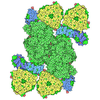
 Z (Sec.)
 Y (Row.)
 X (Col.)


 Sample components




 Processing
 Electron microscopy
 FIELD EMISSION GUN

