- EMDB-54955: Cryo-EM structure of Human Apoferritin at pH 9 -
+
Open data
ID or keywords:
Loading...
-
Basic information
Entry
Database: EMDB / ID: EMD-54955
Title
Cryo-EM structure of Human Apoferritin at pH 9
Map data
Sample
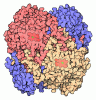
Complex: 24-mer of Human Apoferritin at pH 9
Protein or peptide: Ferritin heavy chain, N-terminally processed
Ligand: FE (III) ION
Ligand: MAGNESIUM ION
Ligand: water
Keywords
Apoferritin / Ferritin / Metal storage / Low pH / METAL BINDING PROTEIN
Function / homology
Function and homology information
iron ion sequestering activity / ferritin complex / Scavenging by Class A Receptors / Golgi Associated Vesicle Biogenesis / ferroxidase / negative regulation of ferroptosis / ferroxidase activity / autolysosome / negative regulation of fibroblast proliferation / ferric iron binding ...iron ion sequestering activity / ferritin complex / Scavenging by Class A Receptors / Golgi Associated Vesicle Biogenesis / ferroxidase / negative regulation of ferroptosis / ferroxidase activity / autolysosome / negative regulation of fibroblast proliferation / ferric iron binding / autophagosome / iron ion transport / erythrocyte differentiation / autophagy / ferrous iron binding / Iron uptake and transport / tertiary granule lumen / ficolin-1-rich granule lumen / intracellular iron ion homeostasis / lysosome / immune response / iron ion binding / negative regulation of cell population proliferation / Neutrophil degranulation / extracellular exosome / extracellular region / identical protein binding / nucleus / cytosol / cytoplasm Similarity search - Function
German Federal Ministry for Education and Research
03Z22HN23
Germany
German Federal Ministry for Education and Research
03Z22HI2
Germany
German Federal Ministry for Education and Research
03COV04
Germany
European Regional Development Fund
ZS/2016/04/78115
European Union
European Regional Development Fund
ZS/2024/05/187255
European Union
German Research Foundation (DFG)
391498659
Germany
German Research Foundation (DFG)
514901783
Germany
Fundacao para a Ciencia e a Tecnologia
UIDB/04612/2020
Portugal
Fundacao para a Ciencia e a Tecnologia
UIDP/04612/2020
Portugal
Fundacao para a Ciencia e a Tecnologia
LA/P/0087/2020
Portugal
H2020 Marie Curie Actions of the European Commission
101207412
European Union
Citation
Journal: Proc Natl Acad Sci U S A / Year: 2026 Title: Direct evidence of acid-driven protein desolvation. Authors: Farzad Hamdi / Ioannis Skalidis / Inken Kaja Schwerin / Jaydeep Belapure / Dmitry A Semchonok / Fotis L Kyrilis / Christian Tüting / Johannes Müller / Georg Künze / Panagiotis L Kastritis / Abstract: Water and its ability to modulate the protonation states of biomolecules govern the physical chemistry of life, dictating their metabolic functions. However, how amino acid protonation alters protein ...Water and its ability to modulate the protonation states of biomolecules govern the physical chemistry of life, dictating their metabolic functions. However, how amino acid protonation alters protein hydration and solubility is an open question since Kuntz and Kauzmann proposed p-driven protein desolvation in 1974. Here, in a series of high-resolution cryoelectron microscopy structures of a protein complex at different p values (from p 9.0 to 3.5), we examined thousands of observable hydration sites. Cryoelectron microscopy data, in agreement with constant-p molecular dynamics simulations, show that nearly half of protein-bound waters exchanged with the bulk solvent upon acidification, with ~100 waters lost per p unit per molecule. The loss of waters was most significant around the side chains of glutamate and aspartate residues while specific polar residues, mostly asparagine, anchored persistent waters. A positionally conserved hydration layer was observed across all p conditions, accounting for 40% of resolved waters. Those waters displayed denser packing than less persistent waters, forming a p-independent solvation shell. Acid-induced water exchange also displaced bound iron, providing a mechanistic link between solvation and metal release. Our findings demonstrate the core principles of acid-driven protein desolvation, resolving a 50-y-old biochemical hypothesis.
In the structure databanks used in Yorodumi, some data are registered as the other names, "COVID-19 virus" and "2019-nCoV". Here are the details of the virus and the list of structure data.
Jan 31, 2019. EMDB accession codes are about to change! (news from PDBe EMDB page)
EMDB accession codes are about to change! (news from PDBe EMDB page)
The allocation of 4 digits for EMDB accession codes will soon come to an end. Whilst these codes will remain in use, new EMDB accession codes will include an additional digit and will expand incrementally as the available range of codes is exhausted. The current 4-digit format prefixed with “EMD-” (i.e. EMD-XXXX) will advance to a 5-digit format (i.e. EMD-XXXXX), and so on. It is currently estimated that the 4-digit codes will be depleted around Spring 2019, at which point the 5-digit format will come into force.
The EM Navigator/Yorodumi systems omit the EMD- prefix.
Related info.:Q: What is EMD? / ID/Accession-code notation in Yorodumi/EM Navigator
Yorodumi is a browser for structure data from EMDB, PDB, SASBDB, etc.
This page is also the successor to EM Navigator detail page, and also detail information page/front-end page for Omokage search.
The word "yorodu" (or yorozu) is an old Japanese word meaning "ten thousand". "mi" (miru) is to see.
Related info.:EMDB / PDB / SASBDB / Comparison of 3 databanks / Yorodumi Search / Aug 31, 2016. New EM Navigator & Yorodumi / Yorodumi Papers / Jmol/JSmol / Function and homology information / Changes in new EM Navigator and Yorodumi
 Movie
Movie Controller


 Open data
 Basic information
 Map data
 Sample
 Keywords
 Function and homology information
 Homo sapiens (human)
 Authors
 Germany,
  Portugal, 12 items
  Citation

 Structure visualization
 Downloads & links
 emd_54955.png
 https://data.pdbj.org/pub/emdb/structures/EMD-54955



 Z (Sec.)
 Y (Row.)
 X (Col.)


 Sample components
 Escherichia coli 'BL21-Gold(DE3)pLysS AG' (bacteria)
 Processing
 Electron microscopy
 FIELD EMISSION GUN
