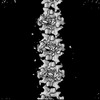
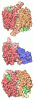
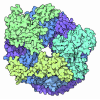
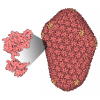
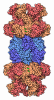
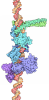
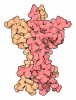
Journal: Nature / Year: 2026 Title: Cytoplasmic lattices are megadalton storage complexes in mammalian oocytes. Authors: Zeynep Ilgın Kılıç / Joyce van Loenhout / Marten Chaillet / Robert M van Es / Paula Sobrevals Alcaraz / Harmjan R Vos / Willem E M Noteborn / Miguel Ricardo Leung / Abstract: Mammalian oocytes store proteins for embryonic development on abundant structures called cytoplasmic lattices (CPLs). However, the mechanisms by which they achieve this are unclear, largely because ...Mammalian oocytes store proteins for embryonic development on abundant structures called cytoplasmic lattices (CPLs). However, the mechanisms by which they achieve this are unclear, largely because the molecular composition of the lattices themselves is unknown. Here we use cryo-electron microscopy and artificial intelligence-based modelling to reveal the molecular architecture and protein composition of native CPLs from mouse oocytes. We find that CPLs are formed by at least 13 different proteins that assemble into a megadalton-scale complex, including multiple copies of maternal effect factors such as PADI6 and the subcortical maternal complex. We show that proteins that are essential for early embryonic development are structural components of the CPLs, including the cytoskeletal proteins α-tubulin and β-tubulin, which are incorporated into CPLs as unpolymerized dimers, and an array of ubiquitination factors such as the epigenetic regulator and E3 ligase UHRF1, ubiquitin-conjugating E2 enzymes, and ubiquitin ligase substrate adapters. This represents an elegant molecular mechanism by which oocytes stockpile vital proteins through direct incorporation into highly stable supramolecular assemblies. Our findings provide a structural framework for understanding how disrupting stored maternal factors leads to infertility and developmental defects.
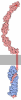
Name: Tubulin alpha-1A chain / type: protein_or_peptide / ID: 9 / Number of copies: 1 / Enantiomer: LEVO EC number: Hydrolases; Acting on acid anhydrides; Acting on GTP to facilitate cellular and subcellular movement
In the structure databanks used in Yorodumi, some data are registered as the other names, "COVID-19 virus" and "2019-nCoV". Here are the details of the virus and the list of structure data.
Jan 31, 2019. EMDB accession codes are about to change! (news from PDBe EMDB page)
EMDB accession codes are about to change! (news from PDBe EMDB page)
The allocation of 4 digits for EMDB accession codes will soon come to an end. Whilst these codes will remain in use, new EMDB accession codes will include an additional digit and will expand incrementally as the available range of codes is exhausted. The current 4-digit format prefixed with “EMD-” (i.e. EMD-XXXX) will advance to a 5-digit format (i.e. EMD-XXXXX), and so on. It is currently estimated that the 4-digit codes will be depleted around Spring 2019, at which point the 5-digit format will come into force.
The EM Navigator/Yorodumi systems omit the EMD- prefix.
Related info.:Q: What is EMD? / ID/Accession-code notation in Yorodumi/EM Navigator
Yorodumi is a browser for structure data from EMDB, PDB, SASBDB, etc.
This page is also the successor to EM Navigator detail page, and also detail information page/front-end page for Omokage search.
The word "yorodu" (or yorozu) is an old Japanese word meaning "ten thousand". "mi" (miru) is to see.
Related info.:EMDB / PDB / SASBDB / Comparison of 3 databanks / Yorodumi Search / Aug 31, 2016. New EM Navigator & Yorodumi / Yorodumi Papers / Jmol/JSmol / Function and homology information / Changes in new EM Navigator and Yorodumi
 Movie
Movie Controller


 Open data
 Basic information
 Map data
 Sample
 Keywords
 Function and homology information
 Mus musculus (house mouse)
 Authors
 Netherlands, 1 items
  Citation
 Structure visualization
 Downloads & links
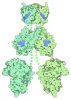
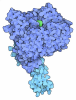
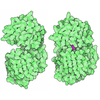
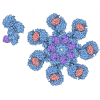
 emd_54838.png
 https://data.pdbj.org/pub/emdb/structures/EMD-54838



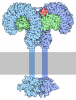
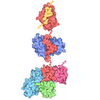
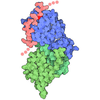
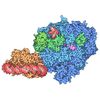
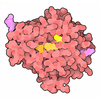
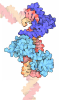
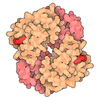
 Z (Sec.)
 Y (Row.)
 X (Col.)


 Sample components
 Processing
 Electron microscopy
 FIELD EMISSION GUN