[English] 日本語
Yorodumi
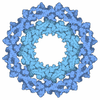
- EMDB-54657: Composite map of the A. thaliana nuclera pore complex -

+
Open data


ID or keywords:

Loading...

-
Basic information

Entry
Database: EMDB / ID: EMD-54657
TitleComposite map of the A. thaliana nuclera pore complex
Map dataComposite NPC map
Sample
  • Complex: Nuclear pore complex
Keywordsnuclear pore complex / NUCLEAR PROTEIN / MEMBRANE PROTEIN
Function / homology
Function and homology information


negative regulation of auxin mediated signaling pathway / regulation of timing of transition from vegetative to reproductive phase / long-day photoperiodism, flowering / nuclear pore transmembrane ring / zygote asymmetric cell division / induced systemic resistance / vegetative to reproductive phase transition of meristem / systemic acquired resistance / systemic acquired resistance, salicylic acid mediated signaling pathway / innate immune response-activating signaling pathway ...negative regulation of auxin mediated signaling pathway / regulation of timing of transition from vegetative to reproductive phase / long-day photoperiodism, flowering / nuclear pore transmembrane ring / zygote asymmetric cell division / induced systemic resistance / vegetative to reproductive phase transition of meristem / systemic acquired resistance / systemic acquired resistance, salicylic acid mediated signaling pathway / innate immune response-activating signaling pathway / nuclear pore inner ring / developmental process / nuclear pore organization / response to auxin / embryo development ending in seed dormancy / response to abscisic acid / plasmodesma / structural constituent of nuclear pore / RNA export from nucleus / nucleocytoplasmic transport / poly(A)+ mRNA export from nucleus / porin activity / ribosomal large subunit export from nucleus / mRNA transport / nuclear pore / mRNA export from nucleus / vesicle-mediated transport / ribosomal small subunit export from nucleus / nuclear periphery / protein export from nucleus / response to cold / response to bacterium / circadian regulation of gene expression / defense response / RING-type E3 ubiquitin transferase / protein import into nucleus / ubiquitin-protein transferase activity / nuclear envelope / protein transport / nuclear membrane / protein-macromolecule adaptor activity / nucleic acid binding / protein ubiquitination / innate immune response / negative regulation of DNA-templated transcription / nucleolus / structural molecule activity / endoplasmic reticulum / Golgi apparatus / mitochondrion / zinc ion binding / nucleus / plasma membrane / cytosol / cytoplasm
Similarity search - Function
Nuclear pore complex protein NUP160 / Nuclear pore complex protein NUP214 / E3 ubiquitin-protein ligase HOS1 / NUP160, helical domain / Nucleoporin protein Ndc1-Nup / Aladin seven-bladed propeller / Nucleoporin, NUP53 / Aladin / ELYS-like domain / Nuclear pore complex assembly ...Nuclear pore complex protein NUP160 / Nuclear pore complex protein NUP214 / E3 ubiquitin-protein ligase HOS1 / NUP160, helical domain / Nucleoporin protein Ndc1-Nup / Aladin seven-bladed propeller / Nucleoporin, NUP53 / Aladin / ELYS-like domain / Nuclear pore complex assembly / Nucleoporin Nup88 / Nuclear pore component / : / : / Nup160 C-terminal TPR / NUP160/120 middle TPR / RNA-recognition motif (RRM) Nup35-type domain / Nup53/35/40-type RNA recognition motif / RNA-recognition motif (RRM) Nup35-type domain profile. / Nucleoporin NUP88/NUP82 / Nucleoporin Nup188 / Nucleoporin, Nup155-like, C-terminal, subdomain 3 / Nucleoporin Nup120/160, beta-propeller domain / Nucleoporin Nup54/Nup57/Nup44 / Nucleoporin Nup54, alpha-helical domain / Nucleoporin complex subunit 54 / Nucleoporin, NSP1-like, C-terminal / Nucleoporin NSP1/NUP62 / Nsp1-like C-terminal region / Nucleoporin Nup85-like / Nucleoporin Nup120/160 / Nup85 Nucleoporin / Nuclear pore protein 84/107 / Nuclear pore protein 84 / 107 / Nuclear pore complex protein Nup133-like / Nucleoporin, Nup155-like, C-terminal, subdomain 1 / Nucleoporin, Nup155-like, C-terminal, subdomain 2 / Nucleoporin, Nup155-like / Nucleoporin Nup186/Nup192/Nup205 / Nuclear pore complex scaffold, nucleoporins 186/192/205 / Nucleoporin, Nup133/Nup155-like, C-terminal / Non-repetitive/WGA-negative nucleoporin C-terminal / Nucleoporin interacting component Nup93/Nic96 / Nup93/Nic96 / Nucleoporin, Nup133/Nup155-like, N-terminal / Nup133 N terminal like / Nuclear pore complex protein NUP96, C-terminal domain / Nuclear protein 96 / Nuclear pore complex protein Nup98-Nup96-like, autopeptidase S59 domain / Nuclear pore complex protein Nup98-Nup96-like, autopeptidase S59 domain superfamily / Sec13/Seh1 family / Nucleoporin peptidase S59-like / Nup98-96 autopeptidase S59 / NUP C-terminal domain profile. / RNA-binding domain superfamily / WD domain, G-beta repeat / Zinc finger, RING/FYVE/PHD-type / G-protein beta WD-40 repeat / Nucleotide-binding alpha-beta plait domain superfamily / Trp-Asp (WD) repeats profile. / Trp-Asp (WD) repeats circular profile. / WD40 repeats / WD40 repeat / WD40-repeat-containing domain superfamily / WD40/YVTN repeat-like-containing domain superfamily
Similarity search - Domain/homology
Nuclear pore complex protein NUP155 / Nuclear pore complex protein NUP214 / Nuclear pore complex protein NUP133 / Nucleoporin (DUF3414) / Nuclear pore complex protein NUP205 / Nuclear pore complex protein NUP35 / Nuclear pore complex protein NUP93A / Protein transport protein SEC13 homolog B / Nuclear pore complex protein NUP43 / E3 ubiquitin-protein ligase HOS1 ...Nuclear pore complex protein NUP155 / Nuclear pore complex protein NUP214 / Nuclear pore complex protein NUP133 / Nucleoporin (DUF3414) / Nuclear pore complex protein NUP205 / Nuclear pore complex protein NUP35 / Nuclear pore complex protein NUP93A / Protein transport protein SEC13 homolog B / Nuclear pore complex protein NUP43 / E3 ubiquitin-protein ligase HOS1 / Aladin / Nuclear pore complex protein NUP54 / Nuclear pore complex protein NUP107 / Nuclear pore complex protein NUP62 / Nucleoporin protein Ndc1-Nup protein / Nuclear pore complex protein NUP96 / Nuclear pore complex protein NUP85 / Protein SEH1 / Nuclear pore complex protein NUP160 / Nuclear pore complex protein NUP88
Similarity search - Component
Biological speciesArabidopsis thaliana (thale cress)
Methodsubtomogram averaging / cryo EM / Resolution: 33.0 Å
AuthorsSanchez Carrillo IB / Hoffmann PC / Obarska-Kosinska A / Fourcassie V / Beck M / Germain H
Funding support Germany, European Union, 3 items
OrganizationGrant numberCountry
Max Planck Society Germany
European Research Council (ERC)101054823European Union
European Molecular Biology Organization (EMBO)ALTF 33-2021European Union
CitationJournal: Nat Plants / Year: 2025
Title: In situ architecture of the nuclear pore complex of the higher plant Arabidopsis thaliana.
Authors: Ingrid Berenice Sanchez Carrillo / Patrick C Hoffmann / Agnieszka Obarska-Kosinska / Victor Fourcassié / Martin Beck / Hugo Germain /
Abstract: The nucleus is enclosed by the nuclear envelope, which contains nuclear pore complexes (NPCs). While NPCs have been well studied in vertebrates, yeast and algae, in situ structural data for higher ...The nucleus is enclosed by the nuclear envelope, which contains nuclear pore complexes (NPCs). While NPCs have been well studied in vertebrates, yeast and algae, in situ structural data for higher plants is lacking. Here we show that individual nucleoporins of Arabidopsis thaliana and humans exhibit high structural similarity. We report an in situ NPC structure of higher plants, derived from A. thaliana root protoplasts using cryo-electron tomography, subtomogram averaging and homology-based integrative modelling. We present the AtNPC model based on predictions of A. thaliana nucleoporins (NUPs), supported by mass spectrometry. Here the AtNPC scaffold contains one Y-complex ring at the cytosolic and two at the nuclear ring. The AtNPC contains prominent NUP155 connector elements that are conserved in human NPCs but not in Chlamydomonas reinhardtii NPCs. Our model suggests that the ELYS homologue HOS1 plays an important role in the head-to-tail connection of Y-complexes in AtNPCs.
History
DepositionAug 5, 2025-
Header (metadata) releaseNov 12, 2025-
Map releaseNov 12, 2025-
UpdateDec 3, 2025-
Current statusDec 3, 2025Processing site: PDBe / Status: Released

-
Structure visualization

Supplemental images

Downloads & links

-
Map

FileDownload / File: emd_54657.map.gz / Format: CCP4 / Size: 30.5 MB / Type: IMAGE STORED AS FLOATING POINT NUMBER (4 BYTES)
AnnotationComposite NPC map
Projections & slices

Image control

Size
Brightness
Contrast
Others
AxesZ (Sec.)Y (Row.)X (Col.)
8.7 Å/pix.
x 200 pix.
= 1740.8 Å
8.7 Å/pix.
x 200 pix.
= 1740.8 Å
8.7 Å/pix.
x 200 pix.
= 1740.8 Å

Surface

Projections

Slices (1/3)

Slices (1/2)

Slices (2/3)

Images are generated by Spider.

Voxel sizeX=Y=Z: 8.704 Å
Density
Contour LevelBy AUTHOR: 0.07
Minimum - Maximum-0.33343223 - 0.38045403
Average (Standard dev.)0.0027647496 (±0.025010884)
SymmetrySpace group: 1
Details

EMDB XML:

Map geometry
Axis orderXYZ
Origin000
Dimensions200200200
Spacing200200200
CellA=B=C: 1740.8 Å
α=β=γ: 90.0 °

-
Supplemental data

-
Sample components

-
Entire : Nuclear pore complex

EntireName: Nuclear pore complex
Components
  • Complex: Nuclear pore complex

-
Supramolecule #1: Nuclear pore complex

SupramoleculeName: Nuclear pore complex / type: complex / ID: 1 / Parent: 0
Source (natural)Organism: Arabidopsis thaliana (thale cress)

-
Experimental details

-
Structure determination

Methodcryo EM
Processingsubtomogram averaging
Aggregation statecell

-
Sample preparation

BufferpH: 5.7
VitrificationCryogen name: ETHANE
DetailsCryo-FIB lamellae of isolated A.thaliana root protoplasts

-
Electron microscopy

MicroscopeTFS KRIOS
Image recordingFilm or detector model: GATAN K3 BIOQUANTUM (6k x 4k) / Average electron dose: 2.2 e/Å2
Electron beamAcceleration voltage: 300 kV / Electron source: FIELD EMISSION GUN
Electron opticsIllumination mode: FLOOD BEAM / Imaging mode: BRIGHT FIELD / Nominal defocus max: 5.0 µm / Nominal defocus min: 2.5 µm
Experimental equipment
Model: Titan Krios / Image courtesy: FEI Company

-
Image processing

Final reconstructionApplied symmetry - Point group: C1 (asymmetric) / Resolution.type: BY AUTHOR / Resolution: 33.0 Å / Resolution method: OTHER / Software - Name: novaSTA / Details: composite map / Number subtomograms used: 632
ExtractionNumber tomograms: 37 / Number images used: 79 / Software - Name: novaSTA
CTF correctionType: PHASE FLIPPING ONLY
Final angle assignmentType: NOT APPLICABLE

+
About Yorodumi

-
News

-
Feb 9, 2022. New format data for meta-information of EMDB entries

New format data for meta-information of EMDB entries

  • Version 3 of the EMDB header file is now the official format.
  • The previous official version 1.9 will be removed from the archive.

Related info.:EMDB header

External links:wwPDB to switch to version 3 of the EMDB data model

-
Aug 12, 2020. Covid-19 info

Covid-19 info

URL: https://pdbj.org/emnavi/covid19.php

New page: Covid-19 featured information page in EM Navigator.

Related info.:Covid-19 info / Mar 5, 2020. Novel coronavirus structure data

+
Mar 5, 2020. Novel coronavirus structure data

Novel coronavirus structure data

Related info.:Yorodumi Speices / Aug 12, 2020. Covid-19 info

External links:COVID-19 featured content - PDBj / Molecule of the Month (242):Coronavirus Proteases

+
Jan 31, 2019. EMDB accession codes are about to change! (news from PDBe EMDB page)

EMDB accession codes are about to change! (news from PDBe EMDB page)

  • The allocation of 4 digits for EMDB accession codes will soon come to an end. Whilst these codes will remain in use, new EMDB accession codes will include an additional digit and will expand incrementally as the available range of codes is exhausted. The current 4-digit format prefixed with “EMD-” (i.e. EMD-XXXX) will advance to a 5-digit format (i.e. EMD-XXXXX), and so on. It is currently estimated that the 4-digit codes will be depleted around Spring 2019, at which point the 5-digit format will come into force.
  • The EM Navigator/Yorodumi systems omit the EMD- prefix.

Related info.:Q: What is EMD? / ID/Accession-code notation in Yorodumi/EM Navigator

External links:EMDB Accession Codes are Changing Soon! / Contact to PDBj

+
Jul 12, 2017. Major update of PDB

Major update of PDB

  • wwPDB released updated PDB data conforming to the new PDBx/mmCIF dictionary.
  • This is a major update changing the version number from 4 to 5, and with Remediation, in which all the entries are updated.
  • In this update, many items about electron microscopy experimental information are reorganized (e.g. em_software).
  • Now, EM Navigator and Yorodumi are based on the updated data.

External links:wwPDB Remediation / Enriched Model Files Conforming to OneDep Data Standards Now Available in the PDB FTP Archive

-
Yorodumi

Thousand views of thousand structures

  • Yorodumi is a browser for structure data from EMDB, PDB, SASBDB, etc.
  • This page is also the successor to EM Navigator detail page, and also detail information page/front-end page for Omokage search.
  • The word "yorodu" (or yorozu) is an old Japanese word meaning "ten thousand". "mi" (miru) is to see.

Related info.:EMDB / PDB / SASBDB / Comparison of 3 databanks / Yorodumi Search / Aug 31, 2016. New EM Navigator & Yorodumi / Yorodumi Papers / Jmol/JSmol / Function and homology information / Changes in new EM Navigator and Yorodumi

Read more