positive regulation of establishment of protein localization to telomere / scaRNA localization to Cajal body / positive regulation of protein localization to Cajal body / zona pellucida receptor complex / tubulin complex assembly / positive regulation of telomerase RNA localization to Cajal body / chaperonin-containing T-complex / BBSome-mediated cargo-targeting to cilium / Formation of tubulin folding intermediates by CCT/TriC / Folding of actin by CCT/TriC ...positive regulation of establishment of protein localization to telomere / scaRNA localization to Cajal body / positive regulation of protein localization to Cajal body / zona pellucida receptor complex / tubulin complex assembly / positive regulation of telomerase RNA localization to Cajal body / chaperonin-containing T-complex / BBSome-mediated cargo-targeting to cilium / Formation of tubulin folding intermediates by CCT/TriC / Folding of actin by CCT/TriC / Prefoldin mediated transfer of substrate to CCT/TriC / RHOBTB1 GTPase cycle / WD40-repeat domain binding / pericentriolar material / Association of TriC/CCT with target proteins during biosynthesis / chaperone-mediated protein complex assembly / RHOBTB2 GTPase cycle / Hydrolases; Acting on acid anhydrides; In phosphorus-containing anhydrides / beta-tubulin binding / positive regulation of telomere maintenance via telomerase / heterochromatin / protein folding chaperone / Gene and protein expression by JAK-STAT signaling after Interleukin-12 stimulation / acrosomal vesicle / ATP-dependent protein folding chaperone / : / mRNA 3'-UTR binding / response to virus / mRNA 5'-UTR binding / azurophil granule lumen / melanosome / Cooperation of PDCL (PhLP1) and TRiC/CCT in G-protein beta folding / G-protein beta-subunit binding / protein folding / cell body / secretory granule lumen / microtubule / ficolin-1-rich granule lumen / cytoskeleton / protein stabilization / cadherin binding / ubiquitin protein ligase binding / centrosome / Neutrophil degranulation / Golgi apparatus / ATP hydrolysis activity / RNA binding / extracellular exosome / extracellular region / ATP binding / identical protein binding / cytosol / cytoplasm Similarity search - Function
T-complex protein 1, alpha subunit / T-complex protein 1, eta subunit / T-complex protein 1, theta subunit / T-complex protein 1, zeta subunit / T-complex protein 1, delta subunit / T-complex protein 1, gamma subunit / T-complex protein 1, epsilon subunit / T-complex protein 1, beta subunit / : / : ...T-complex protein 1, alpha subunit / T-complex protein 1, eta subunit / T-complex protein 1, theta subunit / T-complex protein 1, zeta subunit / T-complex protein 1, delta subunit / T-complex protein 1, gamma subunit / T-complex protein 1, epsilon subunit / T-complex protein 1, beta subunit / : / : / Chaperonins TCP-1 signature 1. / Chaperonins TCP-1 signature 2. / Chaperonin TCP-1, conserved site / Chaperonins TCP-1 signature 3. / Chaperone tailless complex polypeptide 1 (TCP-1) / GroEL-like equatorial domain superfamily / TCP-1-like chaperonin intermediate domain superfamily / GroEL-like apical domain superfamily / TCP-1/cpn60 chaperonin family / Chaperonin Cpn60/GroEL/TCP-1 family Similarity search - Domain/homology
T-complex protein 1 subunit alpha / T-complex protein 1 subunit zeta / T-complex protein 1 subunit epsilon / T-complex protein 1 subunit gamma / T-complex protein 1 subunit theta / T-complex protein 1 subunit delta / T-complex protein 1 subunit beta / T-complex protein 1 subunit eta Similarity search - Component
Biological species
Homo sapiens (human)
Method
single particle reconstruction / cryo EM / Resolution: 2.71 Å
Spanish Ministry of Science, Innovation, and Universities
PID2022-137175NB-I00
Spain
Citation
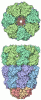
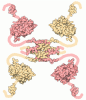
Journal: Methods Mol Biol / Year: 2026 Title: CryoEM Strategies for Elucidating the Closed State Architecture of CCT. Authors: Jorge Gutiérrez-Seijo / Ana Cuervo / Sergio Pipaón / David Gil-Cantero / Carmen Majano / César Santiago / José María Valpuesta / Jorge Cuéllar / Abstract: Cryo-electron microscopy (CryoEM) has emerged as a state-of-the-art technique in structural biology, thanks to advances in sample preparation, high-voltage electron microscopy, direct electron ...Cryo-electron microscopy (CryoEM) has emerged as a state-of-the-art technique in structural biology, thanks to advances in sample preparation, high-voltage electron microscopy, direct electron detectors, and sophisticated image processing software. In this study, we investigate the eukaryotic chaperonin CCT, a ~1 MDa hetero-oligomeric complex essential for the folding of key substrates such as actin, tubulin, and WD40 family members. While several open-state structures of CCT have been resolved, the highest-resolution reconstructions have been obtained in the closed state. This is primarily due to the increased structural rigidity of the complex when its apical domains become immobilized in this conformation. However, the pseudo-symmetric arrangement of subunits in the closed state poses challenges for subunit identification. Here, we present a workflow for obtaining a high-resolution CryoEM structure of closed CCT, achieved without the use of nanobodies, substrates, or any tools designed to increase CCT asymmetry. Our results demonstrate that subunit assignment and atomic modeling are achievable by exploiting subunit-intrinsic structural features alone.
In the structure databanks used in Yorodumi, some data are registered as the other names, "COVID-19 virus" and "2019-nCoV". Here are the details of the virus and the list of structure data.
Jan 31, 2019. EMDB accession codes are about to change! (news from PDBe EMDB page)
EMDB accession codes are about to change! (news from PDBe EMDB page)
The allocation of 4 digits for EMDB accession codes will soon come to an end. Whilst these codes will remain in use, new EMDB accession codes will include an additional digit and will expand incrementally as the available range of codes is exhausted. The current 4-digit format prefixed with “EMD-” (i.e. EMD-XXXX) will advance to a 5-digit format (i.e. EMD-XXXXX), and so on. It is currently estimated that the 4-digit codes will be depleted around Spring 2019, at which point the 5-digit format will come into force.
The EM Navigator/Yorodumi systems omit the EMD- prefix.
Related info.:Q: What is EMD? / ID/Accession-code notation in Yorodumi/EM Navigator
Yorodumi is a browser for structure data from EMDB, PDB, SASBDB, etc.
This page is also the successor to EM Navigator detail page, and also detail information page/front-end page for Omokage search.
The word "yorodu" (or yorozu) is an old Japanese word meaning "ten thousand". "mi" (miru) is to see.
Related info.:EMDB / PDB / SASBDB / Comparison of 3 databanks / Yorodumi Search / Aug 31, 2016. New EM Navigator & Yorodumi / Yorodumi Papers / Jmol/JSmol / Function and homology information / Changes in new EM Navigator and Yorodumi
 Movie
Movie Controller


 Open data
 Basic information
 Map data
 Sample
 Keywords
 Function and homology information
 Homo sapiens (human)
 Authors
 Spain, 1 items
  Citation
 Structure visualization
 Downloads & links
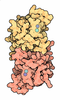
 emd_54634.png
 https://data.pdbj.org/pub/emdb/structures/EMD-54634
 Z (Sec.)
 Y (Row.)
 X (Col.)


 Sample components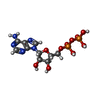

 Processing
 Electron microscopy
 FIELD EMISSION GUN

