National Institutes of Health/National Institute Of Allergy and Infectious Diseases (NIH/NIAID)
U54AI170791
United States
Wellcome Trust
CC2058
United Kingdom
Medical Research Council (MRC, United Kingdom)
CC2058
United Kingdom
Cancer Research UK
CC2058
United Kingdom
Citation
Journal: Nat Commun / Year: 2026 Title: Core nucleosomes are refractory to lentiviral DNA integration. Authors: Joshua Hope / Emma Punch / Nicola J Cook / Matthew R Singer / Dhira Joshi / Parmit K Singh / Andrea Nans / Nathan P Sweeney / Willem Vanderlinden / Alan N Engelman / Peter Cherepanov / Abstract: HIV-1 and other lentiviruses hijack the cellular chromatin-binding protein LEDGF/p75 to facilitate integration into active transcription units. However, the mechanism of chromatin engagement by ...HIV-1 and other lentiviruses hijack the cellular chromatin-binding protein LEDGF/p75 to facilitate integration into active transcription units. However, the mechanism of chromatin engagement by lentiviral intasomes and the structural role of LEDGF/p75 in this process remain poorly understood. To address these gaps, we studied the activities of native HIV-1 preintegration complexes and in vitro-assembled lentiviral intasomes in the presence of chromatinized target DNA. While LEDGF/p75 was both essential and minimally sufficient to enhance lentiviral integration into chromatin containing histone H3 trimethylated on Lys36, it unexpectedly facilitated integration outside of the nucleosome core particles. LEDGF/p75 additionally inhibited integration into unmodified chromatin in a dose-dependent manner, promoting integration into naked DNA. To explore the structural foundation for these activities, we imaged maedi-visna virus intasomes saturated with LEDGF/p75 before and after strand transfer by cryogenic electron microscopy. The structures revealed that the host factor alters the target DNA binding platform of the lentiviral intasome, imposing significant constraints on the path and configuration of target DNA to impede nucleosome engagement. Our results establish the preference of lentiviral intasomes for linker DNA regions within H3K36Me3-enriched chromatin and show that LEDGF/p75 plays a specific structural role at the viral-host target DNA interface.
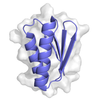
Protein or peptide: PC4 and SFRS1-interacting protein
Ligand: ZINC ION
-
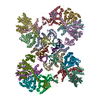
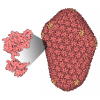
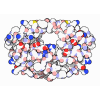
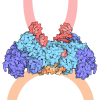
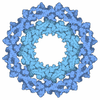
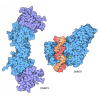
Supramolecule #1: MVV CSC intasome in complex with LEDGF
Supramolecule
Name: MVV CSC intasome in complex with LEDGF / type: complex / ID: 1 / Parent: 0 / Macromolecule list: #1-#4 Details: Integrase and LEDGF were produced in E. coli. The complex was assembled in vitro.
Source (natural)
Organism: Visna-maedi virus / Strain: KV1772
Molecular weight
Theoretical: 902 KDa
-
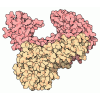
Macromolecule #1: Gag-Pol polyprotein
Macromolecule
Name: Gag-Pol polyprotein / type: protein_or_peptide / ID: 1 / Number of copies: 16 / Enantiomer: LEVO
Name: ZINC ION / type: ligand / ID: 5 / Number of copies: 16 / Formula: ZN
Molecular weight
Theoretical: 65.409 Da
-
Experimental details
-
Structure determination
Method
cryo EM
Processing
single particle reconstruction
Aggregation state
particle
-
Sample preparation
Buffer
pH: 6.5
Sugar embedding
Material: vitreous ice
Grid
Model: Quantifoil R1.2/1.3 / Material: GOLD / Mesh: 300 / Support film - Material: GRAPHENE OXIDE / Support film - topology: HOLEY Details: Graphene oxide was functionalised with amine-PEG4-DBCO
Vitrification
Cryogen name: ETHANE / Instrument: FEI VITROBOT MARK IV
Details
150 mM NaCl, 20 mM BisTris pH 6.5, 3mM CaCl2
-
Electron microscopy
Microscope
TFS KRIOS
Specialist optics
Energy filter - Name: TFS Selectris / Energy filter - Slit width: 7 eV
Image recording
Film or detector model: FEI FALCON IV (4k x 4k) / Average electron dose: 40.8 e/Å2
Electron beam
Acceleration voltage: 300 kV / Electron source: FIELD EMISSION GUN
In the structure databanks used in Yorodumi, some data are registered as the other names, "COVID-19 virus" and "2019-nCoV". Here are the details of the virus and the list of structure data.
Jan 31, 2019. EMDB accession codes are about to change! (news from PDBe EMDB page)
EMDB accession codes are about to change! (news from PDBe EMDB page)
The allocation of 4 digits for EMDB accession codes will soon come to an end. Whilst these codes will remain in use, new EMDB accession codes will include an additional digit and will expand incrementally as the available range of codes is exhausted. The current 4-digit format prefixed with “EMD-” (i.e. EMD-XXXX) will advance to a 5-digit format (i.e. EMD-XXXXX), and so on. It is currently estimated that the 4-digit codes will be depleted around Spring 2019, at which point the 5-digit format will come into force.
The EM Navigator/Yorodumi systems omit the EMD- prefix.
Related info.:Q: What is EMD? / ID/Accession-code notation in Yorodumi/EM Navigator
Yorodumi is a browser for structure data from EMDB, PDB, SASBDB, etc.
This page is also the successor to EM Navigator detail page, and also detail information page/front-end page for Omokage search.
The word "yorodu" (or yorozu) is an old Japanese word meaning "ten thousand". "mi" (miru) is to see.
Related info.:EMDB / PDB / SASBDB / Comparison of 3 databanks / Yorodumi Search / Aug 31, 2016. New EM Navigator & Yorodumi / Yorodumi Papers / Jmol/JSmol / Function and homology information / Changes in new EM Navigator and Yorodumi
 Movie
Movie Controller


 Open data
 Basic information
 Map data
 Sample
 Keywords
 Function and homology information
 Visna-maedi virus /
  Homo sapiens (human) / DNA molecule (others)
 Authors
 United States,
  United Kingdom, 4 items
  Citation
 Structure visualization
 Downloads & links
 emd_54482.png
 https://data.pdbj.org/pub/emdb/structures/EMD-54482


 Z (Sec.)
 Y (Row.)
 X (Col.)


 Sample components
 Escherichia coli (E. coli)
 Processing
 Electron microscopy
 FIELD EMISSION GUN