EIPOD fellowship under Marie Sklodowska-Curie Actions COFUND
664726
Germany
Citation
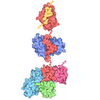
Journal: Nat Commun / Year: 2026 Title: Mechanistic insights into recruitment and regulation of the RNA helicase UPF1 in replication-dependent histone mRNA decay. Authors: Alexandrina Machado de Amorim / Guangpu Xue / Wenxia He / Theresa Dittmers / Sarah Lewandowski / Cecilia Perez-Borrajero / Juliane Bethmann / Nevena Mateva / Clemens Krage / Vidhyadhar ...Authors: Alexandrina Machado de Amorim / Guangpu Xue / Wenxia He / Theresa Dittmers / Sarah Lewandowski / Cecilia Perez-Borrajero / Juliane Bethmann / Nevena Mateva / Clemens Krage / Vidhyadhar Nandana / Bernhard Loll / Tarek Hilal / Janosch Hennig / Henning Urlaub / William F Marzluff / Sutapa Chakrabarti / Abstract: Metazoan histone mRNAs are a unique class of mRNAs that lack the poly(A) tail present in all other eukaryotic transcripts. Instead, they end in a conserved stem-loop (SL) structure, necessitating a ...Metazoan histone mRNAs are a unique class of mRNAs that lack the poly(A) tail present in all other eukaryotic transcripts. Instead, they end in a conserved stem-loop (SL) structure, necessitating a decay mechanism that is distinct from deadenylation-initiated degradation. Here, combining structural and functional approaches, we elucidate molecular mechanisms of initiation of histone mRNA decay. At the end of S-phase, the RNA helicase UPF1, the exoribonuclease 3'hExo and stem-loop binding protein SLBP all contribute to histone mRNA degradation, although how they are mechanistically coupled remained unknown. The cryoEM structure of an UPF1:SL RNA complex, presented here, shows that binding of UPF1 partially melts the RNA stem in the absence of ATP, harnessing the free energy derived from RNA-binding to unwind RNA. This melting event primes the SL-RNA for decay by 3'hExo. Using biochemical and cellular analyses, we demonstrate that SLBP directly engages the UPF1 helicase core to attenuate its unwinding activity and prevent premature degradation. Activation of UPF1 at a later stage promotes SL-RNA decay. We provide direct evidence that UPF1, SLBP and 3'hExo form a degradosome-like assembly that functionally couples SL unwinding and degradation, highlighting a dynamic and intricate network of UPF1-centric interactions that orchestrates timely histone mRNA decay.
Name: RNA stem loop / type: rna / ID: 2 / Number of copies: 1
Source (natural)
Organism: synthetic construct (others)
Molecular weight
Theoretical: 11.896942 KDa
Sequence
String:
UUUUUUUUUU UUCCAAAGGC UCUUUUCAGA GCCACCCA
-
Macromolecule #3: ZINC ION
Macromolecule
Name: ZINC ION / type: ligand / ID: 3 / Number of copies: 3 / Formula: ZN
Molecular weight
Theoretical: 65.409 Da
-
Experimental details
-
Structure determination
Method
cryo EM
Processing
single particle reconstruction
Aggregation state
particle
-
Sample preparation
Concentration
5.6 mg/mL
Buffer
pH: 7.5
Grid
Model: Quantifoil R1.2/1.3 / Material: COPPER / Mesh: 200 / Support film - Material: CARBON / Support film - topology: HOLEY / Pretreatment - Type: GLOW DISCHARGE
Vitrification
Cryogen name: ETHANE / Chamber humidity: 100 % / Chamber temperature: 283 K / Instrument: FEI VITROBOT MARK IV
-
Electron microscopy
Microscope
TFS KRIOS
Image recording
Film or detector model: FEI FALCON III (4k x 4k) / Detector mode: COUNTING / Number grids imaged: 2 / Number real images: 5498 / Average exposure time: 40.57 sec. / Average electron dose: 44.0 e/Å2
Electron beam
Acceleration voltage: 300 kV / Electron source: FIELD EMISSION GUN
In the structure databanks used in Yorodumi, some data are registered as the other names, "COVID-19 virus" and "2019-nCoV". Here are the details of the virus and the list of structure data.
Jan 31, 2019. EMDB accession codes are about to change! (news from PDBe EMDB page)
EMDB accession codes are about to change! (news from PDBe EMDB page)
The allocation of 4 digits for EMDB accession codes will soon come to an end. Whilst these codes will remain in use, new EMDB accession codes will include an additional digit and will expand incrementally as the available range of codes is exhausted. The current 4-digit format prefixed with “EMD-” (i.e. EMD-XXXX) will advance to a 5-digit format (i.e. EMD-XXXXX), and so on. It is currently estimated that the 4-digit codes will be depleted around Spring 2019, at which point the 5-digit format will come into force.
The EM Navigator/Yorodumi systems omit the EMD- prefix.
Related info.:Q: What is EMD? / ID/Accession-code notation in Yorodumi/EM Navigator
Yorodumi is a browser for structure data from EMDB, PDB, SASBDB, etc.
This page is also the successor to EM Navigator detail page, and also detail information page/front-end page for Omokage search.
The word "yorodu" (or yorozu) is an old Japanese word meaning "ten thousand". "mi" (miru) is to see.
Related info.:EMDB / PDB / SASBDB / Comparison of 3 databanks / Yorodumi Search / Aug 31, 2016. New EM Navigator & Yorodumi / Yorodumi Papers / Jmol/JSmol / Function and homology information / Changes in new EM Navigator and Yorodumi
 Movie
Movie Controller


 Open data
 Basic information
 Map data
 Sample
 Keywords
 Function and homology information
 Homo sapiens (human) / synthetic construct (others)
 Authors
 Germany, 6 items
  Citation

 Structure visualization
 Downloads & links
 emd_53417.png
 https://data.pdbj.org/pub/emdb/structures/EMD-53417

 Z (Sec.)
 Y (Row.)
 X (Col.)


 Sample components
 Escherichia coli DH5[alpha] (bacteria)
 Processing
 Electron microscopy
 FIELD EMISSION GUN

