Journal: bioRxiv / Year: 2024 Title: Structure of the microtubule anchoring factor NEDD1 bound to the γ-tubulin ring complex. Authors: Hugo Muñoz-Hernández / Yixin Xu / Daniel Zhang / Allen Xue / Amol Aher / Aitor Pellicer Camardiel / Ellie Walker / Florina Marxer / Tarun M Kapoor / Michal Wieczorek / Abstract: The γ-tubulin ring complex (γ-TuRC) is an essential multiprotein assembly, in which γ-tubulin, GCP2-6, actin, MZT1 and MZT2 form an asymmetric cone-shaped structure that provides a template for ...The γ-tubulin ring complex (γ-TuRC) is an essential multiprotein assembly, in which γ-tubulin, GCP2-6, actin, MZT1 and MZT2 form an asymmetric cone-shaped structure that provides a template for microtubule nucleation. The γ-TuRC is recruited to microtubule organizing centers (MTOCs), such as centrosomes and pre-existing mitotic spindle microtubules, via the evolutionarily-conserved attachment factor NEDD1. NEDD1 contains an N-terminal WD40 domain that binds to microtubules, and a C-terminal domain that associates with the γ-TuRC. However, the structural basis of the NEDD1-γ-TuRC interaction is not known. Here, we report cryo-electron microscopy (cryo-EM) structures of NEDD1 bound to the human γ-TuRC in the absence or presence of the activating factor CDK5RAP2, which interacts with GCP2 to induce conformational changes in the γ-TuRC and promote its microtubule nucleating function. We found that the C-terminus of NEDD1 forms a tetrameric α-helical assembly that contacts the lumen of the γ-TuRC cone, is anchored to GCP4, 5 and 6 via protein modules consisting of MZT1 & GCP3 subcomplexes, and orients its microtubule-binding WD40 domains away from the complex. We biochemically tested our structural models by identifying NEDD1 mutants unable to pull-down -tubulin from cultured cells. The structure of the γ-TuRC simultaneously bound to NEDD1 and CDK5RAP2 reveals that both factors can associate with the "open" conformation of the complex. Our results show that NEDD1 does not induce conformational changes in the γ-TuRC, but suggest that anchoring of γ-TuRC-capped microtubules by NEDD1 would be structurally compatible with the significant conformational changes experienced by the γ-TuRC during microtubule nucleation.
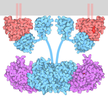
Entire : Cryo-EM reconstruction of the NEDD1 and CDK5RAP2 bound to the gam...
Entire
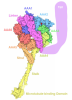
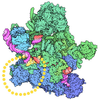
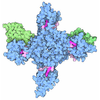
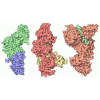
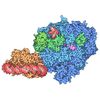
Name: Cryo-EM reconstruction of the NEDD1 and CDK5RAP2 bound to the gamma-tubulin ring complex
Components
Complex: Cryo-EM reconstruction of the NEDD1 and CDK5RAP2 bound to the gamma-tubulin ring complex
Protein or peptide: Gamma-tubulin complex component 3
Protein or peptide: Mitotic-spindle organizing protein 1
Protein or peptide: Protein NEDD1
Protein or peptide: Actin, cytoplasmic 1, N-terminally processed
Protein or peptide: Tubulin gamma-1 chain
Protein or peptide: Gamma-tubulin complex component 4
Protein or peptide: Isoform 3 of Gamma-tubulin complex component 2
Protein or peptide: TUBGCP6 protein
Protein or peptide: Gamma-tubulin complex component 5
Protein or peptide: Mitotic-spindle organizing protein 2B
Protein or peptide: CDK5 regulatory subunit-associated protein 2
+
Supramolecule #1: Cryo-EM reconstruction of the NEDD1 and CDK5RAP2 bound to the gam...
Supramolecule
Name: Cryo-EM reconstruction of the NEDD1 and CDK5RAP2 bound to the gamma-tubulin ring complex type: complex / ID: 1 / Parent: 0 / Macromolecule list: all
In the structure databanks used in Yorodumi, some data are registered as the other names, "COVID-19 virus" and "2019-nCoV". Here are the details of the virus and the list of structure data.
Jan 31, 2019. EMDB accession codes are about to change! (news from PDBe EMDB page)
EMDB accession codes are about to change! (news from PDBe EMDB page)
The allocation of 4 digits for EMDB accession codes will soon come to an end. Whilst these codes will remain in use, new EMDB accession codes will include an additional digit and will expand incrementally as the available range of codes is exhausted. The current 4-digit format prefixed with “EMD-” (i.e. EMD-XXXX) will advance to a 5-digit format (i.e. EMD-XXXXX), and so on. It is currently estimated that the 4-digit codes will be depleted around Spring 2019, at which point the 5-digit format will come into force.
The EM Navigator/Yorodumi systems omit the EMD- prefix.
Related info.:Q: What is EMD? / ID/Accession-code notation in Yorodumi/EM Navigator
Yorodumi is a browser for structure data from EMDB, PDB, SASBDB, etc.
This page is also the successor to EM Navigator detail page, and also detail information page/front-end page for Omokage search.
The word "yorodu" (or yorozu) is an old Japanese word meaning "ten thousand". "mi" (miru) is to see.
Related info.:EMDB / PDB / SASBDB / Comparison of 3 databanks / Yorodumi Search / Aug 31, 2016. New EM Navigator & Yorodumi / Yorodumi Papers / Jmol/JSmol / Function and homology information / Changes in new EM Navigator and Yorodumi
 Movie
Movie Controller

 Yorodumi
 Open data
 Basic information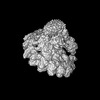
 Map data
 Sample
 Keywords
 Function and homology information
 Homo sapiens (human)
 Authors
 Switzerland, 2 items
  Citation
 Structure visualization
 Downloads & links
 emd_53399.png
 http://ftp.pdbj.org/pub/emdb/structures/EMD-53399

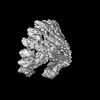




 Z (Sec.)
 Y (Row.)
 X (Col.)


 Sample components
 Trichoplusia ni (cabbage looper)
 Escherichia coli BL21(DE3) (bacteria)
 Processing
 Electron microscopy
 FIELD EMISSION GUN

