negative regulation of cytoplasmic translational initiation / transcription antitermination factor activity, RNA binding / ornithine decarboxylase inhibitor activity / misfolded RNA binding / Group I intron splicing / RNA folding / transcriptional attenuation / endoribonuclease inhibitor activity / positive regulation of ribosome biogenesis / RNA-binding transcription regulator activity ...negative regulation of cytoplasmic translational initiation / transcription antitermination factor activity, RNA binding / ornithine decarboxylase inhibitor activity / misfolded RNA binding / Group I intron splicing / RNA folding / transcriptional attenuation / endoribonuclease inhibitor activity / positive regulation of ribosome biogenesis / RNA-binding transcription regulator activity / four-way junction DNA binding / negative regulation of cytoplasmic translation / regulation of mRNA stability / translation repressor activity / negative regulation of translational initiation / negative regulation of DNA-templated DNA replication initiation / mRNA regulatory element binding translation repressor activity / positive regulation of RNA splicing / regulation of DNA-templated transcription elongation / response to reactive oxygen species / cytosolic ribosome assembly / ribosome assembly / assembly of large subunit precursor of preribosome / transcription antitermination / DNA endonuclease activity / regulation of cell growth / translational initiation / DNA-templated transcription termination / response to radiation / maintenance of translational fidelity / mRNA 5'-UTR binding / regulation of translation / large ribosomal subunit / transferase activity / ribosomal small subunit assembly / ribosome binding / ribosomal small subunit biogenesis / ribosome biogenesis / 5S rRNA binding / ribosomal large subunit assembly / small ribosomal subunit / cytosolic small ribosomal subunit / small ribosomal subunit rRNA binding / large ribosomal subunit rRNA binding / cytosolic large ribosomal subunit / cytoplasmic translation / tRNA binding / negative regulation of translation / rRNA binding / ribosome / translation / structural constituent of ribosome / response to antibiotic / negative regulation of DNA-templated transcription / hydrolase activity / mRNA binding / DNA binding / DNA-templated transcription / RNA binding / zinc ion binding / membrane / cytosol / cytoplasm Similarity search - Function
Ribosomal protein S21, conserved site / Ribosomal protein S21 signature. / Ribosomal protein L25, short-form / Ribosomal protein S14, bacterial/plastid / Ribosomal protein L31 type A / Ribosomal protein S16, conserved site / Ribosomal protein S16 signature. / Ribosomal protein S21 superfamily / Ribosomal protein S21 / Ribosomal protein L31 signature. ...Ribosomal protein S21, conserved site / Ribosomal protein S21 signature. / Ribosomal protein L25, short-form / Ribosomal protein S14, bacterial/plastid / Ribosomal protein L31 type A / Ribosomal protein S16, conserved site / Ribosomal protein S16 signature. / Ribosomal protein S21 superfamily / Ribosomal protein S21 / Ribosomal protein L31 signature. / Ribosomal protein L31 / Ribosomal protein L31 superfamily / Ribosomal protein L31 / Ribosomal protein S21 / Ribosomal protein L9 signature. / Ribosomal protein L9, bacteria/chloroplast / Ribosomal protein L9, C-terminal / Ribosomal protein L9, C-terminal domain / Ribosomal protein L16 signature 1. / Ribosomal protein L21, conserved site / Ribosomal protein L21 signature. / Ribosomal protein L9, C-terminal domain superfamily / Ribosomal protein L6, conserved site / Ribosomal protein L6 signature 1. / : / Ribosomal protein L16 signature 2. / Ribosomal protein L16, conserved site / Ribosomal protein L17 signature. / Ribosomal L25p family / Ribosomal protein L25 / Ribosomal protein L36 signature. / Ribosomal protein L25/Gln-tRNA synthetase, N-terminal / Ribosomal protein L25/Gln-tRNA synthetase, anti-codon-binding domain superfamily / : / Ribosomal protein L33, conserved site / Ribosomal protein L33 signature. / Ribosomal protein L28/L24 superfamily / Ribosomal protein L32p, bacterial type / Ribosomal protein L35, conserved site / Ribosomal protein L35 signature. / Ribosomal protein L9 / Ribosomal protein L9, N-terminal domain superfamily / Ribosomal protein L9, N-terminal / Ribosomal protein L9, N-terminal domain / Ribosomal protein L28 / Ribosomal protein L35, non-mitochondrial / Ribosomal protein L18, bacterial-type / Ribosomal protein S6, conserved site / Ribosomal protein S6 signature. / Ribosomal protein S3, bacterial-type / Ribosomal protein S13, bacterial-type / Ribosomal protein S19, bacterial-type / : / Ribosomal protein S7, bacterial/organellar-type / Ribosomal protein L6, bacterial-type / Ribosomal protein S11, bacterial-type / Ribosomal protein S20 / Ribosomal protein S20 superfamily / Ribosomal protein S20 / Ribosomal protein S4, bacterial-type / Ribosomal protein S5, bacterial-type / Ribosomal protein L9/RNase H1, N-terminal / 30S ribosomal protein S17 / Ribosomal protein L5, bacterial-type / Ribosomal protein L19, conserved site / Ribosomal protein L19 signature. / Ribosomal protein S6, plastid/chloroplast / : / Ribosomal protein L20 signature. / Ribosomal protein L36 / Ribosomal protein L36 superfamily / Ribosomal protein L36 / Ribosomal protein L34, conserved site / Ribosomal protein L34 signature. / Ribosomal protein L14P, bacterial-type / Ribosomal protein L27, conserved site / Ribosomal protein L27 signature. / Ribosomal protein S2, bacteria/mitochondria/plastid / Ribosomal protein L22, bacterial/chloroplast-type / Ribosomal protein L35 / Ribosomal protein L35 superfamily / Ribosomal protein L35 / Ribosomal protein L33 / Ribosomal protein L2, bacterial/organellar-type / Ribosomal protein S18, conserved site / Ribosomal protein S18 signature. / Ribosomal protein L18 / Ribosomal L18 of archaea, bacteria, mitoch. and chloroplast / Ribosomal protein L33 / Ribosomal L28 family / Ribosomal protein S9, bacterial/plastid / Ribosomal protein L33 superfamily / Ribosomal protein L28/L24 / Ribosomal protein L30, bacterial-type / Ribosomal protein S16 / Ribosomal protein S16 domain superfamily / Ribosomal protein S16 / L28p-like / Ribosomal protein L16 / Ribosomal protein S15, bacterial-type Similarity search - Domain/homology
Small ribosomal subunit protein bS6 / Small ribosomal subunit protein uS7 / Large ribosomal subunit protein uL15 / Large ribosomal subunit protein bL19 / Large ribosomal subunit protein bL20 / Large ribosomal subunit protein bL27 / Large ribosomal subunit protein bL28 / Large ribosomal subunit protein uL29 / Large ribosomal subunit protein bL31 / Large ribosomal subunit protein bL32 ...Small ribosomal subunit protein bS6 / Small ribosomal subunit protein uS7 / Large ribosomal subunit protein uL15 / Large ribosomal subunit protein bL19 / Large ribosomal subunit protein bL20 / Large ribosomal subunit protein bL27 / Large ribosomal subunit protein bL28 / Large ribosomal subunit protein uL29 / Large ribosomal subunit protein bL31 / Large ribosomal subunit protein bL32 / Large ribosomal subunit protein bL33 / Large ribosomal subunit protein bL34 / Large ribosomal subunit protein bL35 / Large ribosomal subunit protein bL36A / Large ribosomal subunit protein bL9 / Small ribosomal subunit protein uS10 / Small ribosomal subunit protein uS11 / Small ribosomal subunit protein uS12 / Small ribosomal subunit protein uS13 / Small ribosomal subunit protein bS16 / Small ribosomal subunit protein bS18 / Small ribosomal subunit protein uS19 / Small ribosomal subunit protein bS20 / Small ribosomal subunit protein uS2 / Small ribosomal subunit protein uS3 / Small ribosomal subunit protein uS4 / Small ribosomal subunit protein uS5 / Small ribosomal subunit protein uS8 / Small ribosomal subunit protein uS9 / Large ribosomal subunit protein uL13 / Large ribosomal subunit protein uL14 / Large ribosomal subunit protein uL16 / Large ribosomal subunit protein uL23 / Small ribosomal subunit protein uS15 / Large ribosomal subunit protein bL17 / Large ribosomal subunit protein bL21 / Large ribosomal subunit protein uL30 / Large ribosomal subunit protein uL6 / Small ribosomal subunit protein uS14 / Small ribosomal subunit protein uS17 / Large ribosomal subunit protein uL18 / Large ribosomal subunit protein uL2 / Large ribosomal subunit protein uL3 / Large ribosomal subunit protein uL24 / Large ribosomal subunit protein uL4 / Large ribosomal subunit protein uL22 / Large ribosomal subunit protein uL5 / Small ribosomal subunit protein bS21 / Large ribosomal subunit protein bL25 Similarity search - Component
Biological species
Escherichia coli B (bacteria) / Streptococcus sanguinis (bacteria)
Method
single particle reconstruction / cryo EM / Resolution: 2.26 Å
National Institutes of Health/National Cancer Institute (NIH/NCI)
R35 GM127134
United States
National Institutes of Health/National Cancer Institute (NIH/NCI)
NIH R01 AI162961
United States
Canadian Institutes of Health Research (CIHR)
FDN148463
Canada
German Research Foundation (DFG)
WI3285/12-1
Germany
Citation
Journal: Res Sq / Year: 2025 Title: Saskemycin, a potent and selective antimycobacterial agent targeting a unique site on the ribosome. Authors: Gerard Wright / Michael Cook / Min Xu / Martino Morici / Dmitrii Travin / Wenliang Wang / Dorota Klepacki / Nandini Chhabra / Vishwas Rao / Henok Sahile / Dirk Hackenberger / Haaris Safdari ...Authors: Gerard Wright / Michael Cook / Min Xu / Martino Morici / Dmitrii Travin / Wenliang Wang / Dorota Klepacki / Nandini Chhabra / Vishwas Rao / Henok Sahile / Dirk Hackenberger / Haaris Safdari / Max Berger / Martina Corazza / Austin Bond / Allison Guitor / Dominique Tertigas / Lijun Wang / Adam Schaenzer / Linda Ejim / Venkateswarlu Yarlagadda / James Gomez / Michael Surette / Yossef Av-Gay / Neeraj Dhar / Deborah Hung / Nora Vázquez-Laslop / Alexander Mankin / Daniel Wilson / Abstract: Tuberculosis is the deadliest bacterial disease on the planet. The months-long regimen of multiple antibiotics required to treat tuberculosis profoundly affects the microbiome and leads to the ...Tuberculosis is the deadliest bacterial disease on the planet. The months-long regimen of multiple antibiotics required to treat tuberculosis profoundly affects the microbiome and leads to the development of antimicrobial resistance. Furthermore, non-tuberculous mycobacterial infections pose an increasing clinical challenge. Consequently, there is a growing need for new narrow-spectrum mycobacteria-targeting antibiotics with different mechanisms of action. Here, we report the discovery and characterization of a natural glycolipid antibiotic, saskemycin (SKM), which demonstrates potent and highly selective activity against mycobacteria. Genome sequencing, chemical analysis, and isotope feeding strategies reveal the unique structure and biosynthetic origin of SKM. SKM binds to the small ribosomal subunit at a site not targeted by any of the clinically relevant antibiotics acting on the ribosome. Bound to the ribosome, SKM corrupts the decoding center in a unique way, preventing stable binding of aminoacyl-tRNA in the A site and inhibiting translation in a sequence context-specific manner. Self-resistance in the producing organism is conferred by methylation of a single 16S rRNA nucleotide by SasO and SasN rRNA methyltransferases. These enzymes are orthologs of the ubiquitous RsmC and SpoU methyltransferases found in most bacterial genera but absent in mycobacteria, rationalizing SKM's exquisite selectivity. The discovery of SKM provides an entry point for the development of selective, microbiome-sparing antimycobacterial antibiotics with a unique structure, binding site, and mechanism of action.
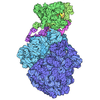
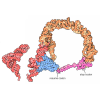
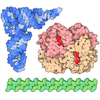
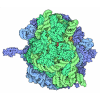
Supramolecule #1: Cryo-EM structure of SKM-70S ribosomal stalled complex in the maj...
Supramolecule
Name: Cryo-EM structure of SKM-70S ribosomal stalled complex in the major state (vacant A-site, canon) type: complex / ID: 1 / Parent: 0 / Macromolecule list: #1-#55
Source (natural)
Organism: Escherichia coli B (bacteria)
Molecular weight
Theoretical: 2.5 MDa
+
Macromolecule #1: Small ribosomal subunit protein bS1
Macromolecule
Name: Small ribosomal subunit protein bS1 / type: protein_or_peptide / ID: 1 Details: Only a small fraction of the protein is visible and therefore modelled Number of copies: 1 / Enantiomer: LEVO
Type of model: INSILICO MODEL In silico model: Molmap generated by a modified version of the pdb 7K00, containing no sample-specific component (deleted drugs, no tRNAs, no mRNA).
Final reconstruction
Resolution.type: BY AUTHOR / Resolution: 2.26 Å / Resolution method: FSC 0.143 CUT-OFF / Software - Name: RELION (ver. 5) / Number images used: 343986
Initial angle assignment
Type: MAXIMUM LIKELIHOOD
Final angle assignment
Type: MAXIMUM LIKELIHOOD
FSC plot (resolution estimation)
+
About Yorodumi
-
News
-
Feb 9, 2022. New format data for meta-information of EMDB entries
New format data for meta-information of EMDB entries
Version 3 of the EMDB header file is now the official format.
The previous official version 1.9 will be removed from the archive.
In the structure databanks used in Yorodumi, some data are registered as the other names, "COVID-19 virus" and "2019-nCoV". Here are the details of the virus and the list of structure data.
Jan 31, 2019. EMDB accession codes are about to change! (news from PDBe EMDB page)
EMDB accession codes are about to change! (news from PDBe EMDB page)
The allocation of 4 digits for EMDB accession codes will soon come to an end. Whilst these codes will remain in use, new EMDB accession codes will include an additional digit and will expand incrementally as the available range of codes is exhausted. The current 4-digit format prefixed with “EMD-” (i.e. EMD-XXXX) will advance to a 5-digit format (i.e. EMD-XXXXX), and so on. It is currently estimated that the 4-digit codes will be depleted around Spring 2019, at which point the 5-digit format will come into force.
The EM Navigator/Yorodumi systems omit the EMD- prefix.
Related info.:Q: What is EMD? / ID/Accession-code notation in Yorodumi/EM Navigator
Yorodumi is a browser for structure data from EMDB, PDB, SASBDB, etc.
This page is also the successor to EM Navigator detail page, and also detail information page/front-end page for Omokage search.
The word "yorodu" (or yorozu) is an old Japanese word meaning "ten thousand". "mi" (miru) is to see.
Related info.:EMDB / PDB / SASBDB / Comparison of 3 databanks / Yorodumi Search / Aug 31, 2016. New EM Navigator & Yorodumi / Yorodumi Papers / Jmol/JSmol / Function and homology information / Changes in new EM Navigator and Yorodumi
 Movie
Movie Controller

 Yorodumi
 Open data
 Basic information
 Map data
 Sample
 Keywords
 Function and homology information
 Escherichia coli B (bacteria) /
  Authors
 United States,
  Canada,
  Germany, 4 items
  Citation
 Structure visualization
 Downloads & links
 emd_53311.png
 http://ftp.pdbj.org/pub/emdb/structures/EMD-53311


 Z (Sec.)
 Y (Row.)
 X (Col.)


 Sample components
 Processing
 Electron microscopy
 FIELD EMISSION GUN

