Protein or peptide: X-ray repair cross-complementing protein 6
Protein or peptide: Bifunctional 3'-5' exonuclease/ATP-dependent helicase WRN
Protein or peptide: X-ray repair cross-complementing protein 5
DNA: DNA
DNA: DNA
Ligand: INOSITOL HEXAKISPHOSPHATE
Ligand: MAGNESIUM ION
Keywords
WRN / Ku70 / Ku80 / NHEJ / DNA BINDING PROTEIN
Function / homology
Function and homology information
positive regulation of strand invasion / 3'-flap-structured DNA binding / forked DNA-dependent helicase activity / telomeric G-quadruplex DNA binding / 8-hydroxy-2'-deoxyguanosine DNA binding / telomeric D-loop binding / DNA geometric change / Ku70:Ku80 complex / negative regulation of t-circle formation / DNA end binding ...positive regulation of strand invasion / 3'-flap-structured DNA binding / forked DNA-dependent helicase activity / telomeric G-quadruplex DNA binding / 8-hydroxy-2'-deoxyguanosine DNA binding / telomeric D-loop binding / DNA geometric change / Ku70:Ku80 complex / negative regulation of t-circle formation / DNA end binding / telomere maintenance via semi-conservative replication / four-way junction helicase activity / Y-form DNA binding / small-subunit processome assembly / positive regulation of lymphocyte differentiation / DNA-dependent protein kinase complex / telomeric D-loop disassembly / DNA-dependent protein kinase-DNA ligase 4 complex / nonhomologous end joining complex / cellular response to X-ray / t-circle formation / G-quadruplex DNA binding / bubble DNA binding / regulation of smooth muscle cell proliferation / exonuclease activity / MutLalpha complex binding / double-strand break repair via classical nonhomologous end joining / Cytosolic sensors of pathogen-associated DNA / Impaired BRCA2 binding to PALB2 / nuclear telomere cap complex / protein localization to nucleolus / IRF3-mediated induction of type I IFN / response to UV-C / Processive synthesis on the C-strand of the telomere / cellular hyperosmotic salinity response / Removal of the Flap Intermediate from the C-strand / U3 snoRNA binding / regulation of telomere maintenance / recombinational repair / protein localization to chromosome, telomeric region / DNA metabolic process / 2-LTR circle formation / DNA synthesis involved in DNA repair / Homologous DNA Pairing and Strand Exchange / Defective homologous recombination repair (HRR) due to BRCA1 loss of function / Defective HDR through Homologous Recombination Repair (HRR) due to PALB2 loss of BRCA1 binding function / Defective HDR through Homologous Recombination Repair (HRR) due to PALB2 loss of BRCA2/RAD51/RAD51C binding function / Resolution of D-loop Structures through Synthesis-Dependent Strand Annealing (SDSA) / HDR through Single Strand Annealing (SSA) / telomeric repeat DNA binding / Resolution of D-loop Structures through Holliday Junction Intermediates / Impaired BRCA2 binding to RAD51 / DNA 3'-5' helicase / 5'-deoxyribose-5-phosphate lyase activity / Presynaptic phase of homologous DNA pairing and strand exchange / ATP-dependent activity, acting on DNA / 3'-5' DNA helicase activity / telomere maintenance via telomerase / mismatch repair / SUMOylation of DNA damage response and repair proteins / four-way junction DNA binding / 3'-5' exonuclease activity / activation of innate immune response / telomere maintenance / cyclin binding / replication fork processing / cellular response to starvation / DNA-(apurinic or apyrimidinic site) lyase / class I DNA-(apurinic or apyrimidinic site) endonuclease activity / site of DNA damage / double-strand break repair via nonhomologous end joining / replication fork / small-subunit processome / Nonhomologous End-Joining (NHEJ) / cellular response to gamma radiation / protein-DNA complex / base-excision repair / G2/M DNA damage checkpoint / cellular senescence / HDR through Homologous Recombination (HRR) / enzyme activator activity / double-strand break repair / manganese ion binding / DNA recombination / Processing of DNA double-strand break ends / double-stranded DNA binding / scaffold protein binding / secretory granule lumen / transcription regulator complex / Regulation of TP53 Activity through Phosphorylation / ficolin-1-rich granule lumen / DNA replication / innate immune response / Hydrolases; Acting on ester bonds / damaged DNA binding / DNA helicase activity / chromosome, telomeric region / nuclear speck / transcription cis-regulatory region binding / ribonucleoprotein complex Similarity search - Function
Helicase Helix-turn-helix domain / Helix-turn-helix domain / RQC domain / RQC / RQC domain / Ku70, bridge and pillars domain superfamily / : / Ku70 / Ku, C-terminal / Ku, C-terminal domain superfamily ...Helicase Helix-turn-helix domain / Helix-turn-helix domain / RQC domain / RQC / RQC domain / Ku70, bridge and pillars domain superfamily / : / Ku70 / Ku, C-terminal / Ku, C-terminal domain superfamily / Ku C terminal domain like / Helicase and RNase D C-terminal / ATP-dependent DNA helicase RecQ, zinc-binding domain / RecQ zinc-binding / HRDC domain / HRDC domain / DNA helicase, ATP-dependent, RecQ type / HRDC domain profile. / Ku80 / Ku70/Ku80 C-terminal arm / Ku70/Ku80 C-terminal arm / Ku70/Ku80, N-terminal alpha/beta / Ku70/Ku80 N-terminal alpha/beta domain / Ku70/Ku80 beta-barrel domain / Ku70 and Ku80 are 70kDa and 80kDa subunits of the Lupus Ku autoantigen / Ku70/Ku80 beta-barrel domain / SPOC-like, C-terminal domain superfamily / SAP domain superfamily / HRDC domain superfamily / 3'-5' exonuclease / SAP motif profile. / SAP domain / Putative DNA-binding (bihelical) motif predicted to be involved in chromosomal organisation / SAP domain / 3'-5' exonuclease / 3'-5' exonuclease domain / HRDC-like superfamily / von Willebrand factor (vWF) type A domain / von Willebrand factor, type A / DEAD/DEAH box helicase domain / DEAD/DEAH box helicase / von Willebrand factor A-like domain superfamily / Helicase conserved C-terminal domain / helicase superfamily c-terminal domain / Superfamilies 1 and 2 helicase C-terminal domain profile. / Superfamilies 1 and 2 helicase ATP-binding type-1 domain profile. / DEAD-like helicases superfamily / Helicase, C-terminal / Helicase superfamily 1/2, ATP-binding domain / Ribonuclease H superfamily / Ribonuclease H-like superfamily / Winged helix DNA-binding domain superfamily / Winged helix-like DNA-binding domain superfamily / P-loop containing nucleoside triphosphate hydrolase Similarity search - Domain/homology
DNA repair protein Ku70 / DNA repair protein Ku80 / Bifunctional 3'-5' exonuclease/ATP-dependent helicase WRN Similarity search - Component
Biological species
Homo sapiens (human)
Method
single particle reconstruction / cryo EM / Resolution: 3.33 Å
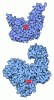
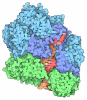
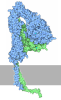
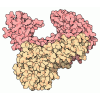
Journal: Nat Commun / Year: 2026 Title: Structural basis of Ku-mediated activation of WRN exonuclease activity. Authors: Sayma Zahid / Jeanne Chauvat / Ilaria Ceppi / Floriana Cappiello / Benedetta Perdichizzi / Philippe Frit / Dennis Gomez / Steven W Hardwick / Pierre Legrand / Julien Karazi / Sonia Baconnais ...Authors: Sayma Zahid / Jeanne Chauvat / Ilaria Ceppi / Floriana Cappiello / Benedetta Perdichizzi / Philippe Frit / Dennis Gomez / Steven W Hardwick / Pierre Legrand / Julien Karazi / Sonia Baconnais / Gérard Pehau-Arnaudet / Sébastien Britton / Jean-Baptiste Charbonnier / Amanda K Chaplin / Pietro Pichierri / Petr Cejka / Patrick Calsou / Virginie Ropars / Abstract: Werner (WRN) is the only human RecQ helicase family member with DNA exonuclease activity. WRN promotes genome stability through its functions in DNA replication, repair and telomere maintenance, the ...Werner (WRN) is the only human RecQ helicase family member with DNA exonuclease activity. WRN promotes genome stability through its functions in DNA replication, repair and telomere maintenance, the deficiency of which presents clinically as Werner syndrome, causing premature aging and cancer predisposition. The main DNA double strand-break sensor Ku70/80 heterodimer (Ku) is a known partner of WRN, which stimulates its nuclease activity. However, the molecular basis of Ku-WRN interplay is currently unknown. Here, we present a high resolution cryo-EM structure of human Ku bound to DNA in complex with the N-terminal WRN exonuclease domain. This structure reveals multiple interaction sites between WRN and the Ku:DNA complex. The catalytic domain of WRN-exo engages with the DNA ends, stabilized by the vWA-like Ku80 domain interacting with the N-terminal APLF-like Ku binding motif (A-KBM) of WRN. Most surprisingly, we visualize the SAP domain of Ku70 stabilized within this complex, and we identify specific contacts mediating this interaction. These interactions are validated by assessing the impact of point mutations on either side of the Ku-WRN interfaces on exonuclease activity with purified recombinant proteins, and on live protein recruitment at biphoton laser-damaged nuclear sites. Finally, we show that disruption of WRN-Ku70 interaction results in aberrant resection of stalled replication forks. Together, we define the architecture of the Ku-WRN exonuclease domain interface and its impact on WRN exonuclease activity, recruitment and replication fork processing.
Protein or peptide: X-ray repair cross-complementing protein 6
Protein or peptide: Bifunctional 3'-5' exonuclease/ATP-dependent helicase WRN
Protein or peptide: X-ray repair cross-complementing protein 5
DNA: DNA
DNA: DNA
Ligand: INOSITOL HEXAKISPHOSPHATE
Ligand: MAGNESIUM ION
-
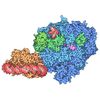
Supramolecule #1: Ku70/80 bound to WRN exo and DNA
Supramolecule
Name: Ku70/80 bound to WRN exo and DNA / type: complex / ID: 1 / Parent: 0 / Macromolecule list: #1-#5
Source (natural)
Organism: Homo sapiens (human)
Molecular weight
Theoretical: 250 KDa
-
Macromolecule #1: X-ray repair cross-complementing protein 6
Macromolecule
Name: X-ray repair cross-complementing protein 6 / type: protein_or_peptide / ID: 1 / Number of copies: 1 / Enantiomer: LEVO EC number: Hydrolases; Acting on acid anhydrides; Acting on acid anhydrides to facilitate cellular and subcellular movement
Macromolecule #3: X-ray repair cross-complementing protein 5
Macromolecule
Name: X-ray repair cross-complementing protein 5 / type: protein_or_peptide / ID: 3 / Number of copies: 1 / Enantiomer: LEVO EC number: Hydrolases; Acting on acid anhydrides; Acting on acid anhydrides to facilitate cellular and subcellular movement
In the structure databanks used in Yorodumi, some data are registered as the other names, "COVID-19 virus" and "2019-nCoV". Here are the details of the virus and the list of structure data.
Jan 31, 2019. EMDB accession codes are about to change! (news from PDBe EMDB page)
EMDB accession codes are about to change! (news from PDBe EMDB page)
The allocation of 4 digits for EMDB accession codes will soon come to an end. Whilst these codes will remain in use, new EMDB accession codes will include an additional digit and will expand incrementally as the available range of codes is exhausted. The current 4-digit format prefixed with “EMD-” (i.e. EMD-XXXX) will advance to a 5-digit format (i.e. EMD-XXXXX), and so on. It is currently estimated that the 4-digit codes will be depleted around Spring 2019, at which point the 5-digit format will come into force.
The EM Navigator/Yorodumi systems omit the EMD- prefix.
Related info.:Q: What is EMD? / ID/Accession-code notation in Yorodumi/EM Navigator
Yorodumi is a browser for structure data from EMDB, PDB, SASBDB, etc.
This page is also the successor to EM Navigator detail page, and also detail information page/front-end page for Omokage search.
The word "yorodu" (or yorozu) is an old Japanese word meaning "ten thousand". "mi" (miru) is to see.
Related info.:EMDB / PDB / SASBDB / Comparison of 3 databanks / Yorodumi Search / Aug 31, 2016. New EM Navigator & Yorodumi / Yorodumi Papers / Jmol/JSmol / Function and homology information / Changes in new EM Navigator and Yorodumi
 Movie
Movie Controller


 Open data
 Basic information
 Map data
 Sample
 Keywords
 Function and homology information
 Homo sapiens (human)
 Authors
 France, 1 items
  Citation


 Structure visualization
 Downloads & links
 emd_52524.png
 https://data.pdbj.org/pub/emdb/structures/EMD-52524


 X (Sec.)
 Y (Row.)
 Z (Col.)


 Sample components
 Processing
 Electron microscopy
 FIELD EMISSION GUN

