 Movie
Movie Controller
 Structure viewers
 About Yorodumi Papers


+Search query
-Structure paper
| Title | Structural basis of Ku-mediated activation of WRN exonuclease activity. |
|---|---|
| Journal, issue, pages | Nat Commun, Vol. 17, Issue 1, Year 2026 |
| Publish date | May 13, 2026 |
 Authors Authors | Sayma Zahid / Jeanne Chauvat / Ilaria Ceppi / Floriana Cappiello / Benedetta Perdichizzi / Philippe Frit / Dennis Gomez / Steven W Hardwick / Pierre Legrand / Julien Karazi / Sonia Baconnais / Gérard Pehau-Arnaudet / Sébastien Britton / Jean-Baptiste Charbonnier / Amanda K Chaplin / Pietro Pichierri / Petr Cejka / Patrick Calsou / Virginie Ropars /     |
| PubMed Abstract | Werner (WRN) is the only human RecQ helicase family member with DNA exonuclease activity. WRN promotes genome stability through its functions in DNA replication, repair and telomere maintenance, the ...Werner (WRN) is the only human RecQ helicase family member with DNA exonuclease activity. WRN promotes genome stability through its functions in DNA replication, repair and telomere maintenance, the deficiency of which presents clinically as Werner syndrome, causing premature aging and cancer predisposition. The main DNA double strand-break sensor Ku70/80 heterodimer (Ku) is a known partner of WRN, which stimulates its nuclease activity. However, the molecular basis of Ku-WRN interplay is currently unknown. Here, we present a high resolution cryo-EM structure of human Ku bound to DNA in complex with the N-terminal WRN exonuclease domain. This structure reveals multiple interaction sites between WRN and the Ku:DNA complex. The catalytic domain of WRN-exo engages with the DNA ends, stabilized by the vWA-like Ku80 domain interacting with the N-terminal APLF-like Ku binding motif (A-KBM) of WRN. Most surprisingly, we visualize the SAP domain of Ku70 stabilized within this complex, and we identify specific contacts mediating this interaction. These interactions are validated by assessing the impact of point mutations on either side of the Ku-WRN interfaces on exonuclease activity with purified recombinant proteins, and on live protein recruitment at biphoton laser-damaged nuclear sites. Finally, we show that disruption of WRN-Ku70 interaction results in aberrant resection of stalled replication forks. Together, we define the architecture of the Ku-WRN exonuclease domain interface and its impact on WRN exonuclease activity, recruitment and replication fork processing. |
 External links External links | Nat Commun / PubMed:42129166 / PubMed Central |
| Methods | EM (single particle) |
| Resolution | 3.33 Å |
| Structure data | EMDB-52524, PDB-9hzg: |
| Chemicals | 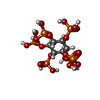 ChemComp-IHP:  ChemComp-MG: |
| Source |
|
 Keywords Keywords | DNA BINDING PROTEIN / WRN / Ku70 / Ku80 / NHEJ |


 homo sapiens (human)