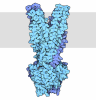
cytochrome o ubiquinol oxidase complex / ubiquinol oxidase (H+-transporting) / cytochrome bo3 ubiquinol oxidase activity / aerobic electron transport chain / oxidoreductase activity, acting on diphenols and related substances as donors, oxygen as acceptor / cytochrome-c oxidase activity / proton transmembrane transporter activity / electron transport coupled proton transport / ATP synthesis coupled electron transport / aerobic respiration ...cytochrome o ubiquinol oxidase complex / ubiquinol oxidase (H+-transporting) / cytochrome bo3 ubiquinol oxidase activity / aerobic electron transport chain / oxidoreductase activity, acting on diphenols and related substances as donors, oxygen as acceptor / cytochrome-c oxidase activity / proton transmembrane transporter activity / electron transport coupled proton transport / ATP synthesis coupled electron transport / aerobic respiration / respiratory electron transport chain / copper ion binding / heme binding / metal ion binding / plasma membrane 類似検索 - 分子機能
Cytochrome o ubiquinol oxidase, subunit I / : / Cytochrome o ubiquinol oxidase, subunit III / Cytochrome o ubiquinol oxidase subunit IV / Ubiquinol oxidase subunit III domain / Cytochrome C oxidase subunit IV, prokaryotes / COX aromatic rich motif / Prokaryotic Cytochrome C oxidase subunit IV / COX Aromatic Rich Motif / Cytochrome o ubiquinol oxidase subunit II ...Cytochrome o ubiquinol oxidase, subunit I / : / Cytochrome o ubiquinol oxidase, subunit III / Cytochrome o ubiquinol oxidase subunit IV / Ubiquinol oxidase subunit III domain / Cytochrome C oxidase subunit IV, prokaryotes / COX aromatic rich motif / Prokaryotic Cytochrome C oxidase subunit IV / COX Aromatic Rich Motif / Cytochrome o ubiquinol oxidase subunit II / Ubiquinol oxidase subunit 2, cupredoxin domain / Cytochrome C oxidase subunit II, transmembrane domain / Cytochrome oxidase subunit II transmembrane region profile. / Cytochrome c oxidase subunit III / Cytochrome c oxidase subunit III-like / Cytochrome c oxidase, subunit III, 4-helical bundle / Cytochrome c oxidase subunit III / Heme-copper oxidase subunit III family profile. / Cytochrome c oxidase subunit III-like superfamily / Cytochrome c/quinol oxidase subunit II / Cytochrome C oxidase subunit II, transmembrane domain superfamily / Cytochrome c oxidase, subunit I, copper-binding site / Heme-copper oxidase catalytic subunit, copper B binding region signature. / Cytochrome c oxidase-like, subunit I domain / Cytochrome oxidase subunit I profile. / Cytochrome C oxidase subunit II, periplasmic domain / Cytochrome c oxidase subunit II-like C-terminal / Cytochrome oxidase subunit II copper A binding domain profile. / Cytochrome c oxidase subunit I / Cytochrome c oxidase-like, subunit I superfamily / Cytochrome C and Quinol oxidase polypeptide I / Cupredoxin / Prokaryotic membrane lipoprotein lipid attachment site profile. 類似検索 - ドメイン・相同性
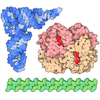
ジャーナル: PLoS One / 年: 2026 タイトル: Exploration of a workflow for the classification and identification of co-purified protein complexes yields new structures and multiple MSP assembly states. 著者: Qingyang Zhang / Abhinandan Venkatesha Murthy / Carsten Mim / 要旨: Native protein complexes have garnered interest as targets for structural dissemination. Cryogenic electron microscopy (cryo-EM) with its ability to image protein mixtures is the most promising tool ...Native protein complexes have garnered interest as targets for structural dissemination. Cryogenic electron microscopy (cryo-EM) with its ability to image protein mixtures is the most promising tool to enable structural proteomics. Additionally, image processing has evolved and can deal with conformational and compositional heterogeneity. Integrative approaches, namely mass spectrometry in conjunction with cryo-EM, have made it possible to characterize and identify complex mixtures. However, this comes at a cost of generating models and interpreting mass spectra. Here we present a modified approach that builds on publicly available software. By generating maps around 4 Å and unsupervised model building we were able to identify the most abundant proteins in our sample. This sample consisted of co-purified membrane proteins in nanodiscs. We found a novel structure and unexpected nanodisc assemblies. Our maps imply a direct interaction between membrane proteins and membrane scaffolding proteins.
 ムービー
ムービー コントローラー


 データを開く
 基本情報
基本情報
 マップデータ
 試料
試料 キーワード
キーワード 機能・相同性情報
 Escherichia coli (大腸菌)
 データ登録者
 スウェーデン, 1件
  引用
引用
 構造の表示
構造の表示
 ダウンロードとリンク
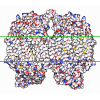
 emd_52451.png
 https://data.pdbj.org/pub/emdb/structures/EMD-52451


 Z
Z Y
Y X
X


 試料の構成要素
 解析
解析 電子顕微鏡法
 FIELD EMISSION GUN

