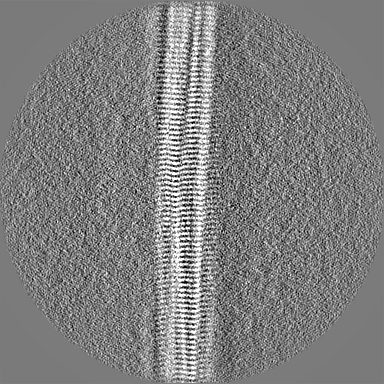
+
データを開く
-
基本情報
| 登録情報 | ![]() | ||||||||||||||||||
|---|---|---|---|---|---|---|---|---|---|---|---|---|---|---|---|---|---|---|---|
| タイトル | In vitro grown G14R Alpha-Synuclein Fibrils | ||||||||||||||||||
マップデータ | G14R_3d0_map | ||||||||||||||||||
試料 |
| ||||||||||||||||||
キーワード | Alpha-Synuclein / G14R Mutation / Fibrils / Cryo-EM / Protein Aggregation / Amyloid Structure / PROTEIN FIBRIL | ||||||||||||||||||
| 機能・相同性 | 機能・相同性情報negative regulation of mitochondrial electron transport, NADH to ubiquinone / neutral lipid metabolic process / regulation of acyl-CoA biosynthetic process / negative regulation of dopamine uptake involved in synaptic transmission / negative regulation of norepinephrine uptake / response to desipramine / positive regulation of SNARE complex assembly / positive regulation of hydrogen peroxide catabolic process / supramolecular fiber / regulation of synaptic vesicle recycling ...negative regulation of mitochondrial electron transport, NADH to ubiquinone / neutral lipid metabolic process / regulation of acyl-CoA biosynthetic process / negative regulation of dopamine uptake involved in synaptic transmission / negative regulation of norepinephrine uptake / response to desipramine / positive regulation of SNARE complex assembly / positive regulation of hydrogen peroxide catabolic process / supramolecular fiber / regulation of synaptic vesicle recycling / negative regulation of chaperone-mediated autophagy / regulation of reactive oxygen species biosynthetic process / positive regulation of protein localization to cell periphery / mitochondrial membrane organization / negative regulation of exocytosis / regulation of glutamate secretion / dopamine biosynthetic process / response to iron(II) ion / positive regulation of neurotransmitter secretion / regulation of macrophage activation / negative regulation of dopamine metabolic process / negative regulation of platelet-derived growth factor receptor signaling pathway / SNARE complex assembly / negative regulation of thrombin-activated receptor signaling pathway / Lewy body / regulation of locomotion / negative regulation of microtubule polymerization / positive regulation of inositol phosphate biosynthetic process / synaptic vesicle priming / regulation of norepinephrine uptake / transporter regulator activity / protein kinase inhibitor activity / synaptic vesicle transport / dopamine uptake involved in synaptic transmission / regulation of dopamine secretion / positive regulation of receptor recycling / positive regulation of exocytosis / cuprous ion binding / mitochondrial ATP synthesis coupled electron transport / nuclear outer membrane / dynein complex binding / response to magnesium ion / synaptic vesicle exocytosis / positive regulation of endocytosis / negative regulation of serotonin uptake / response to type II interferon / kinesin binding / cysteine-type endopeptidase inhibitor activity / regulation of presynapse assembly / synaptic vesicle endocytosis / alpha-tubulin binding / beta-tubulin binding / phospholipase binding / phospholipid metabolic process / supramolecular fiber organization / behavioral response to cocaine / cellular response to fibroblast growth factor stimulus / inclusion body / cellular response to epinephrine stimulus / Hsp70 protein binding / enzyme inhibitor activity / response to interleukin-1 / axon terminus / cellular response to copper ion / positive regulation of release of sequestered calcium ion into cytosol / regulation of microtubule cytoskeleton organization / SNARE binding / adult locomotory behavior / glutathione metabolic process / protein tetramerization / excitatory postsynaptic potential / protein sequestering activity / tubulin binding / phosphoprotein binding / microglial cell activation / ferrous iron binding / fatty acid metabolic process / PKR-mediated signaling / receptor internalization / phospholipid binding / synapse organization / regulation of long-term neuronal synaptic plasticity / protein destabilization / tau protein binding / enzyme activator activity / terminal bouton / positive regulation of inflammatory response / long-term synaptic potentiation / synaptic vesicle membrane / actin cytoskeleton / growth cone / actin binding / cellular response to oxidative stress / neuron apoptotic process / cell cortex / histone binding / response to lipopolysaccharide / microtubule binding / amyloid fibril formation / chemical synaptic transmission 類似検索 - 分子機能 | ||||||||||||||||||
| 生物種 | Homo sapiens (ヒト) | ||||||||||||||||||
| 手法 | 単粒子再構成法 / クライオ電子顕微鏡法 / 解像度: 3.0 Å | ||||||||||||||||||
データ登録者 | Sicking K / Fernandez-Busnadiego R | ||||||||||||||||||
| 資金援助 | ドイツ, 米国, 5件
| ||||||||||||||||||
引用 | ジャーナル: medRxiv / 年: 2025 タイトル: A novel alpha-synuclein G14R missense variant is associated with atypical neuropathological features. 著者: Christof Brücke / Mohammed Al-Azzani / Nagendran Ramalingam / Maria Ramón / Rita L Sousa / Fiamma Buratti / Michael Zech / Kevin Sicking / Leslie Amaral / Ellen Gelpi / Aswathy Chandran / ...著者: Christof Brücke / Mohammed Al-Azzani / Nagendran Ramalingam / Maria Ramón / Rita L Sousa / Fiamma Buratti / Michael Zech / Kevin Sicking / Leslie Amaral / Ellen Gelpi / Aswathy Chandran / Aishwarya Agarwal / Susana R Chaves / Claudio O Fernández / Ulf Dettmer / Janin Lautenschläger / Markus Zweckstetter / Ruben Fernandez Busnadiego / Alexander Zimprich / Tiago Fleming Outeiro / ![]() 要旨: BACKGROUND: Parkinson's disease (PD) affects millions of people worldwide, but only 5-10% of patients suffer from a monogenic form of the disease with Mendelian inheritance. , the gene encoding for ...BACKGROUND: Parkinson's disease (PD) affects millions of people worldwide, but only 5-10% of patients suffer from a monogenic form of the disease with Mendelian inheritance. , the gene encoding for the protein alpha-synuclein (aSyn), was the first to be associated with familial forms of PD and, since then, several missense variants and multiplications of the gene have been established as rare causes of autosomal dominant forms of PD. AIM AND METHODS: A patient carrying aSyn missense mutation and his family members were studied. We present the clinical features, genetic testing - whole exome sequencing (WES), and neuropathological ...AIM AND METHODS: A patient carrying aSyn missense mutation and his family members were studied. We present the clinical features, genetic testing - whole exome sequencing (WES), and neuropathological findings. The functional consequences of this aSyn variant were extensively investigated using biochemical, biophysical, and cellular assays. RESULTS: The patient exhibited a complex neurodegenerative disease that included generalized myocloni, bradykinesia, dystonia of the left arm and apraxia. WES identified a novel heterozygous variant ...RESULTS: The patient exhibited a complex neurodegenerative disease that included generalized myocloni, bradykinesia, dystonia of the left arm and apraxia. WES identified a novel heterozygous variant (cDNA 40G>A; protein G14R). Neuropathological examination showed extensive atypical aSyn pathology with frontotemporal lobar degeneration (FTLD) and nigral degeneration pattern with abundant ring-like neuronal inclusions, and few oligodendroglial inclusions. Sanger sequencing confirmed the variant in the healthy, elderly parent of the patient patient suggesting incomplete penetrance. NMR studies suggest that the G14R mutation induces a local structural alteration in aSyn, and lower thioflavin T binding in in vitro fibrillization assays. Interestingly, the G14R aSyn fibers display different fibrillar morphologies as revealed by cryo-electron microscopy. Cellular studies of the G14R variant revealed increased inclusion formation, enhanced membrane association, and impaired dynamic reversibility of serine-129 phosphorylation. SUMMARY: The atypical neuropathological features observed, which are reminiscent of those observed for the G51D aSyn variant, suggest a causal role of the variant with a distinct clinical and ...SUMMARY: The atypical neuropathological features observed, which are reminiscent of those observed for the G51D aSyn variant, suggest a causal role of the variant with a distinct clinical and pathological phenotype, which is further supported by the properties of the mutant aSyn, compatible with the strain hypothesis of proteinopathies. | ||||||||||||||||||
| 履歴 |
|
-
構造の表示
| 添付画像 |
|---|
-
ダウンロードとリンク
-EMDBアーカイブ
| マップデータ | emd_52166.map.gz | 202.8 MB | EMDBマップデータ形式 | |
|---|---|---|---|---|
| ヘッダ (付随情報) | emd-52166-v30.xml emd-52166.xml | 21 KB 21 KB | 表示 表示 | EMDBヘッダ |
| FSC (解像度算出) | emd_52166_fsc.xml | 13.6 KB | 表示 | FSCデータファイル |
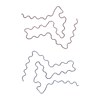
| 画像 | emd_52166.png | 42.2 KB | ||
| Filedesc metadata | emd-52166.cif.gz | 6.1 KB | ||
| その他 | emd_52166_half_map_1.map.gz emd_52166_half_map_2.map.gz | 171.4 MB 171.4 MB | ||
| アーカイブディレクトリ | http://ftp.pdbj.org/pub/emdb/structures/EMD-52166 ftp://ftp.pdbj.org/pub/emdb/structures/EMD-52166 | HTTPS FTP |
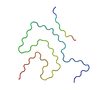
-関連構造データ
| 関連構造データ | ![]() 9hgsMC ![]() 9hxaC M: このマップから作成された原子モデル C: 同じ文献を引用 ( |
|---|---|
| 類似構造データ | 類似検索 - 機能・相同性 F&H 検索 |
-
リンク
| EMDBのページ | EMDB (EBI/PDBe) / EMDataResource |
|---|
-
マップ
| ファイル | ダウンロード / ファイル: emd_52166.map.gz / 形式: CCP4 / 大きさ: 216 MB / タイプ: IMAGE STORED AS FLOATING POINT NUMBER (4 BYTES) | ||||||||||||||||||||||||||||||||||||
|---|---|---|---|---|---|---|---|---|---|---|---|---|---|---|---|---|---|---|---|---|---|---|---|---|---|---|---|---|---|---|---|---|---|---|---|---|---|
| 注釈 | G14R_3d0_map | ||||||||||||||||||||||||||||||||||||
| 投影像・断面図 | 画像のコントロール
画像は Spider により作成 | ||||||||||||||||||||||||||||||||||||
| ボクセルのサイズ | X=Y=Z: 0.92 Å | ||||||||||||||||||||||||||||||||||||
| 密度 |
| ||||||||||||||||||||||||||||||||||||
| 対称性 | 空間群: 1 | ||||||||||||||||||||||||||||||||||||
| 詳細 | EMDB XML:
|
-添付データ
-ハーフマップ: half2
| ファイル | emd_52166_half_map_1.map | ||||||||||||
|---|---|---|---|---|---|---|---|---|---|---|---|---|---|
| 注釈 | half2 | ||||||||||||
| 投影像・断面図 |
| ||||||||||||
| 密度ヒストグラム |
-ハーフマップ: half1
| ファイル | emd_52166_half_map_2.map | ||||||||||||
|---|---|---|---|---|---|---|---|---|---|---|---|---|---|
| 注釈 | half1 | ||||||||||||
| 投影像・断面図 |
| ||||||||||||
| 密度ヒストグラム |
-
試料の構成要素
-全体 : Alpha-Synuclein G14R
| 全体 | 名称: Alpha-Synuclein G14R |
|---|---|
| 要素 |
|
-超分子 #1: Alpha-Synuclein G14R
| 超分子 | 名称: Alpha-Synuclein G14R / タイプ: organelle_or_cellular_component / ID: 1 / 親要素: 0 / 含まれる分子: all |
|---|---|
| 由来(天然) | 生物種: Homo sapiens (ヒト) |
| 分子量 | 理論値: 14.46 kDa/nm |
-分子 #1: Alpha-synuclein
| 分子 | 名称: Alpha-synuclein / タイプ: protein_or_peptide / ID: 1 / コピー数: 1 / 光学異性体: LEVO |
|---|---|
| 由来(天然) | 生物種: Homo sapiens (ヒト) |
| 分子量 | 理論値: 14.576251 KDa |
| 組換発現 | 生物種: ![]() |
| 配列 | 文字列: MDVFMKGLSK AKERVVAAAE KTKQGVAEAA GKTKEGVLYV GSKTKEGVVH GVATVAEKTK EQVTNVGGAV VTGVTAVAQK TVEGAGSIA AATGFVKKDQ LGKNEEGAPQ EGILEDMPVD PDNEAYEMPS EEGYQDYEPE A UniProtKB: Alpha-synuclein |
-実験情報
-構造解析
| 手法 | クライオ電子顕微鏡法 |
|---|---|
解析 | 単粒子再構成法 |
| 試料の集合状態 | filament |
-
試料調製
| 緩衝液 | pH: 7 |
|---|---|
| 凍結 | 凍結剤: ETHANE-PROPANE |
-
電子顕微鏡法
| 顕微鏡 | TFS KRIOS |
|---|---|
| 撮影 | フィルム・検出器のモデル: FEI FALCON IV (4k x 4k) 平均電子線量: 40.0 e/Å2 |
| 電子線 | 加速電圧: 300 kV / 電子線源: FIELD EMISSION GUN |
| 電子光学系 | 照射モード: FLOOD BEAM / 撮影モード: OTHER / 最大 デフォーカス(公称値): 2.4 µm / 最小 デフォーカス(公称値): 1.2 µm |
| 実験機器 | ![]() モデル: Titan Krios / 画像提供: FEI Company |
ムービー
コントローラー
万見について


キーワード
Homo sapiens (ヒト)
データ登録者
ドイツ,
米国, 5件
引用


Z (Sec.)
Y (Row.)
X (Col.)


解析
FIELD EMISSION GUN