organelle inner membrane / bacteriochlorophyll binding / plasma membrane light-harvesting complex / photosynthetic electron transport in photosystem II / photosynthesis, light reaction / endomembrane system / electron transfer activity / iron ion binding / heme binding / metal ion binding / plasma membrane Similarity search - Function
Photosynthetic reaction centre, cytochrome c subunit / Multihaem cytochrome, PRC subunit superfamily / Photosynthetic reaction centre cytochrome C subunit / Antenna complex, beta subunit, conserved site / Antenna complexes beta subunits signature. / Antenna complex, alpha subunit / Antenna complex, alpha subunit conserved site / Antenna complexes alpha subunits signature. / Antenna complex, alpha/beta subunit / Light-harvesting protein B beta chain ...Photosynthetic reaction centre, cytochrome c subunit / Multihaem cytochrome, PRC subunit superfamily / Photosynthetic reaction centre cytochrome C subunit / Antenna complex, beta subunit, conserved site / Antenna complexes beta subunits signature. / Antenna complex, alpha subunit / Antenna complex, alpha subunit conserved site / Antenna complexes alpha subunits signature. / Antenna complex, alpha/beta subunit / Light-harvesting protein B beta chain / Antenna complex, beta domain superfamily / Antenna complex alpha/beta subunit / Light-harvesting complex / Photosynthetic reaction centre, M subunit / Photosynthetic reaction centre, L subunit / Multiheme cytochrome superfamily / : / Photosynthetic reaction centre, L/M / Photosystem II protein D1/D2 superfamily / Photosynthetic reaction centre protein / Photosynthetic reaction center proteins signature. / Prokaryotic membrane lipoprotein lipid attachment site profile. Similarity search - Domain/homology
Reaction center protein M chain / Light-harvesting protein / Reaction center protein L chain / Uncharacterized protein / Light-harvesting protein / Light-harvesting protein / Photosynthetic reaction center cytochrome c subunit Similarity search - Component
Biological species
Gemmatimonas groenlandica (bacteria)
Method
single particle reconstruction / cryo EM / Resolution: 2.3 Å
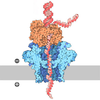
Journal: mSystems / Year: 2026 Title: Two solutions for efficient light-harvesting in phototrophic . Authors: Alastair T Gardiner / Yibo Jin / David Bína / Maarten Joosten / David Kaftan / Izabela Mujakić / Zdenko Gardian / Pablo Castro-Hartmann / Pu Qian / Michal Koblížek / Abstract: Phototrophic Gemmatimonadota represent a unique group of phototrophic bacteria that acquired a complete set of photosynthetic genes via horizontal gene transfer and later evolved independently. () ...Phototrophic Gemmatimonadota represent a unique group of phototrophic bacteria that acquired a complete set of photosynthetic genes via horizontal gene transfer and later evolved independently. () contains photosynthetic complexes with two concentric light-harvesting antenna rings that absorb at 816 and 868 nm, allowing it to better exploit the light conditions found deeper in the water column. The closely related species , with highly similar photosynthetic genes, harvests infrared light using a single 860 nm absorption band. The cryo-electron microscopy structure of the photosynthetic complex reveals that the outer antenna lacks monomeric bacteriochlorophylls, resulting in a smaller optical antenna cross-section. The spectrum is red-shifted relative to due to the formation of a H-bond enabled by a different rotamer conformation of αTrp in the outer ring. This H-bond forms with a neighboring bacteriochlorophyll and increases the intra-dimer exciton coupling, affecting the exciton localization probability within the rings and increasing exciton cooperativity between the complexes. The functional consequences of the spectral shift, caused solely by a subtle conformational change of a single residue, represent a novel mechanism in which phototrophic organisms adjust their antennae for particular light conditions and enable to grow higher in the water column where more photons are available.IMPORTANCEThe photoheterotrophic species of the phylum Gemmatimonadota employ unique photosynthetic complexes with two concentric antenna rings around a central reaction center. In contrast to other phototrophic species, these organisms have not evolved any regulatory systems to control the expression of their photosynthetic apparatus under different light conditions. Despite the overall similarity, the complexes present in and have different absorption properties in the near-infrared region of the spectrum that make them more suitable for low or medium light, respectively. The main difference in absorption depends on the conformation of a single tryptophan residue that can form an H-bond with a neighboring bacteriochlorophyll. The presence or absence of this H-bond affects how the protein scaffold interacts with the bacteriochlorophylls, which in turn determines how light energy is transferred within and between the photosynthetic complexes.
Name: reaction centre Hc sub unit / type: protein_or_peptide / ID: 5 / Details: native protein / Number of copies: 1 / Enantiomer: LEVO
Source (natural)
Organism: Gemmatimonas groenlandica (bacteria)
Molecular weight
Theoretical: 19.669318 KDa
Sequence
String:
MSDIKAVPAD SYNGSALIPT GDPMIDGVGP SSWANRSDTP DMTFHNTAKI VPMRLDPTYS IAKGDPDPRG LPVVAADKQV AGTVIELWV NRAEPQVTYY EVQLTGSERR VMLPAGFVQW PNFGLWGNDK LLVKAITAAQ FANVPALKRD DQITLLEEDM V CAYYAGGH LYAMAERSEP II
+
Macromolecule #6: Photosynthetic reaction center cytochrome c subunit
Macromolecule
Name: Photosynthetic reaction center cytochrome c subunit / type: protein_or_peptide / ID: 6 / Details: native protein / Number of copies: 1 / Enantiomer: LEVO
Cryogen name: ETHANE / Chamber humidity: 100 % / Chamber temperature: 277 K / Instrument: FEI VITROBOT MARK III / Details: blot time, 3 sec blot force, 3.
Details
in buffer solution with detergent beta-DDM. ~4 mg/ml
-
Electron microscopy
Microscope
TFS KRIOS
Temperature
Min: 88.0 K / Max: 92.0 K
Specialist optics
Energy filter - Name: TFS Selectris X / Energy filter - Slit width: 10 eV
Image recording
Film or detector model: FEI FALCON IV (4k x 4k) / Number grids imaged: 1 / Number real images: 23012 / Average exposure time: 5.13 sec. / Average electron dose: 60.0 e/Å2 / Details: images were collected in AFIS model
Electron beam
Acceleration voltage: 300 kV / Electron source: FIELD EMISSION GUN
Number selected: 935540 Details: cryosparc blob selection first, then model reference selection for final 3d reconstruction
CTF correction
Software - Name: CTFFIND (ver. 4.0) / Details: CTF collection was performed within cryosparc / Type: PHASE FLIPPING AND AMPLITUDE CORRECTION
Startup model
Type of model: INSILICO MODEL / In silico model: cryosparc ab-init Details: a subset of randomly picked-up particles were used for initial model generation.
Final reconstruction
Number classes used: 1 / Applied symmetry - Point group: C1 (asymmetric) / Algorithm: BACK PROJECTION / Resolution.type: BY AUTHOR / Resolution: 2.3 Å / Resolution method: FSC 0.143 CUT-OFF / Software - Name: cryoSPARC (ver. 4.2.1) / Details: performed in cryosparc / Number images used: 116858
Number classes: 2 / Avg.num./class: 120000 / Software - Name: cryoSPARC (ver. 4.2.1) Details: This complex has two confirmations. 2 classs 3D classification was used for the final separation of the two confirmation.
FSC plot (resolution estimation)
-
Atomic model buiding 1
Initial model
Chain - Source name: AlphaFold / Chain - Initial model type: in silico model
Details
Initial model was established with coot. The model was fitted into map using chimera. The refinement was performed y the use of Phenix.
Refinement
Space: REAL / Protocol: RIGID BODY FIT / Overall B value: 60 / Target criteria: map to model
Output model
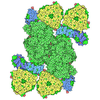
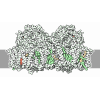
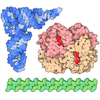
PDB-9h22: Cryo EM structure of RC-dLH complex model II from Gemmatimonas groenlandica
+
About Yorodumi
-
News
-
Feb 9, 2022. New format data for meta-information of EMDB entries
New format data for meta-information of EMDB entries
Version 3 of the EMDB header file is now the official format.
The previous official version 1.9 will be removed from the archive.
In the structure databanks used in Yorodumi, some data are registered as the other names, "COVID-19 virus" and "2019-nCoV". Here are the details of the virus and the list of structure data.
Jan 31, 2019. EMDB accession codes are about to change! (news from PDBe EMDB page)
EMDB accession codes are about to change! (news from PDBe EMDB page)
The allocation of 4 digits for EMDB accession codes will soon come to an end. Whilst these codes will remain in use, new EMDB accession codes will include an additional digit and will expand incrementally as the available range of codes is exhausted. The current 4-digit format prefixed with “EMD-” (i.e. EMD-XXXX) will advance to a 5-digit format (i.e. EMD-XXXXX), and so on. It is currently estimated that the 4-digit codes will be depleted around Spring 2019, at which point the 5-digit format will come into force.
The EM Navigator/Yorodumi systems omit the EMD- prefix.
Related info.:Q: What is EMD? / ID/Accession-code notation in Yorodumi/EM Navigator
Yorodumi is a browser for structure data from EMDB, PDB, SASBDB, etc.
This page is also the successor to EM Navigator detail page, and also detail information page/front-end page for Omokage search.
The word "yorodu" (or yorozu) is an old Japanese word meaning "ten thousand". "mi" (miru) is to see.
Related info.:EMDB / PDB / SASBDB / Comparison of 3 databanks / Yorodumi Search / Aug 31, 2016. New EM Navigator & Yorodumi / Yorodumi Papers / Jmol/JSmol / Function and homology information / Changes in new EM Navigator and Yorodumi
 Movie
Movie Controller

 Yorodumi
 Open data
 Basic information
 Map data
 Sample
 Keywords
 Function and homology information
 Gemmatimonas groenlandica (bacteria)
 Authors
 Czech Republic, 1 items
  Citation

 Structure visualization
 Downloads & links
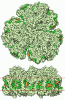
 emd_51788.png
 https://data.pdbj.org/pub/emdb/structures/EMD-51788


 Z (Sec.)
 Y (Row.)
 X (Col.)


 Sample components
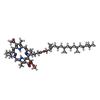
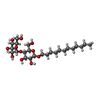


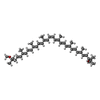
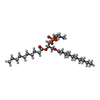


 Processing
 Electron microscopy
 FIELD EMISSION GUN

