 Movie
Movie Controller

[English] 日本語
 Yorodumi
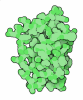
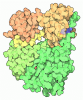
- EMDB-51324: Cryo-EM structure of Thromboxane A2 receptor-miniGq protein compl... -
+ Open data

- Basic information
| Entry |  | |||||||||
|---|---|---|---|---|---|---|---|---|---|---|
| Title | Cryo-EM structure of Thromboxane A2 receptor-miniGq protein complex bound to U46619 | |||||||||
 Map data Map data | sharpened composite cryo-EM map of Thromboxane A2 receptor-Gq Protein Complex bound to U46619 | |||||||||
 Sample Sample |
| |||||||||
 Keywords Keywords | Single particle cryo-EM / GPCR / G-proteins / MEMBRANE PROTEIN | |||||||||
| Function / homology |  Function and homology information Function and homology informationthromboxane A2 receptor activity / Prostanoid ligand receptors / positive regulation of blood pressure / negative regulation of cell migration involved in sprouting angiogenesis / response to testosterone / positive regulation of blood coagulation / positive regulation of vasoconstriction / response to nutrient / guanyl-nucleotide exchange factor activity / acrosomal vesicle ...thromboxane A2 receptor activity / Prostanoid ligand receptors / positive regulation of blood pressure / negative regulation of cell migration involved in sprouting angiogenesis / response to testosterone / positive regulation of blood coagulation / positive regulation of vasoconstriction / response to nutrient / guanyl-nucleotide exchange factor activity / acrosomal vesicle / positive regulation of angiogenesis / Olfactory Signaling Pathway / Activation of the phototransduction cascade / G protein-coupled acetylcholine receptor signaling pathway / G beta:gamma signalling through PLC beta / Presynaptic function of Kainate receptors / Thromboxane signalling through TP receptor / Activation of G protein gated Potassium channels / Inhibition of voltage gated Ca2+ channels via Gbeta/gamma subunits / G-protein activation / Glucagon signaling in metabolic regulation / G beta:gamma signalling through CDC42 / Prostacyclin signalling through prostacyclin receptor / Synthesis, secretion, and inactivation of Glucagon-like Peptide-1 (GLP-1) / photoreceptor disc membrane / G beta:gamma signalling through BTK / ADP signalling through P2Y purinoceptor 12 / Sensory perception of sweet, bitter, and umami (glutamate) taste / Glucagon-type ligand receptors / Adrenaline,noradrenaline inhibits insulin secretion / Vasopressin regulates renal water homeostasis via Aquaporins / G alpha (z) signalling events / Glucagon-like Peptide-1 (GLP1) regulates insulin secretion / ADP signalling through P2Y purinoceptor 1 / cellular response to catecholamine stimulus / G beta:gamma signalling through PI3Kgamma / ADORA2B mediated anti-inflammatory cytokines production / adenylate cyclase-activating dopamine receptor signaling pathway / cellular response to prostaglandin E stimulus / Cooperation of PDCL (PhLP1) and TRiC/CCT in G-protein beta folding / cellular response to lipopolysaccharide / GPER1 signaling / positive regulation of cytosolic calcium ion concentration / heterotrimeric G-protein complex / Inactivation, recovery and regulation of the phototransduction cascade / G alpha (12/13) signalling events / G-protein beta-subunit binding / extracellular vesicle / Thrombin signalling through proteinase activated receptors (PARs) / adenylate cyclase-activating G protein-coupled receptor signaling pathway / signaling receptor complex adaptor activity / GTPase binding / Ca2+ pathway / High laminar flow shear stress activates signaling by PIEZO1 and PECAM1:CDH5:KDR in endothelial cells / G alpha (i) signalling events / G alpha (s) signalling events / response to ethanol / G alpha (q) signalling events / Ras protein signal transduction / Extra-nuclear estrogen signaling / response to xenobiotic stimulus / inflammatory response / G protein-coupled receptor signaling pathway / lysosomal membrane / GTPase activity / synapse / protein-containing complex binding / signal transduction / extracellular exosome / membrane / plasma membrane / cytosol / cytoplasm Similarity search - Function | |||||||||
| Biological species |  Homo sapiens (human) Homo sapiens (human) | |||||||||
| Method | single particle reconstruction / cryo EM / Resolution: 3.26 Å | |||||||||
 Authors Authors | Matzov D / Krawinski P / Caffrey M / Shalev Benami M | |||||||||
| Funding support | European Union, 1 items
| |||||||||
 Citation Citation | Journal: Nat Commun / Year: 2026 Title: Structural and dynamic insights into agonist recognition and function of the thromboxane A receptor. Authors: Pawel Krawinski / Donna Matzov / Aoife Ryder / Kanhaya Lal / Dmitry S Karlov / Georges Chalhoub / Eamon P Mulvaney / B Therese Kinsella / Peter J McCormick / Martin Caffrey / Irina G ...Authors: Pawel Krawinski / Donna Matzov / Aoife Ryder / Kanhaya Lal / Dmitry S Karlov / Georges Chalhoub / Eamon P Mulvaney / B Therese Kinsella / Peter J McCormick / Martin Caffrey / Irina G Tikhonova / Moran Shalev-Benami /    Abstract: The thromboxane A receptor (TP), expressed in platelets and smooth muscle, plays an important role in blood clotting and muscle contraction. The endogenous ligand of this G protein-coupled receptor ...The thromboxane A receptor (TP), expressed in platelets and smooth muscle, plays an important role in blood clotting and muscle contraction. The endogenous ligand of this G protein-coupled receptor (GPCR), thromboxane A (TXA), is a short-lived arachidonic acid metabolite with a half-life of ∼30 seconds, which makes investigating the TP structure and activation mechanism highly challenging. Here we determine the structures of the TP in complex with the synthetic agonists, U46619 and I-BOP, stable analogues of the natural ligand, in the presence of the signalling protein partner, G. The structures reveal a unique activation switch for the receptor that differs from typical class A GPCR family members. Complemented by functional studies, mutational analysis, docking, and molecular dynamics (MD) simulations, our investigation highlights the differences between agonist and antagonist binding and explores the ligand entry mechanism to the binding pocket from within the membrane via a molecular gate composed of two transmembrane helices. In addition, our study provides crucial information to aid in the rational design of compounds targeting the TP, and offers mechanistic insights into inherited disorders associated with mutations in the TP. | |||||||||
| History |
|
- Structure visualization
| Supplemental images |
|---|

- Downloads & links
-EMDB archive
| Map data | emd_51324.map.gz | 125.5 MB | EMDB map data format | |
|---|---|---|---|---|
| Header (meta data) | emd-51324-v30.xmlemd-51324.xml | 24 KB 24 KB | Display Display | EMDB header |
| Images |  emd_51324.png emd_51324.png | 79.8 KB | ||
| Filedesc metadata | emd-51324.cif.gz | 7.2 KB | ||
| Others | emd_51324_additional_1.map.gz | 87.2 MB | ||
| Archive directory |  https://data.pdbj.org/pub/emdb/structures/EMD-51324ftp://data.pdbj.org/pub/emdb/structures/EMD-51324 https://data.pdbj.org/pub/emdb/structures/EMD-51324ftp://data.pdbj.org/pub/emdb/structures/EMD-51324 | HTTPS FTP |
-Related structure data
| Related structure data |  9gg5MC  9gggC C: citing same article ( M: atomic model generated by this map |
|---|---|
| Similar structure data |


-Links
| EMDB pages | EMDB (EBI/PDBe) / EMDataResource |
|---|---|
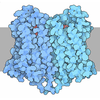
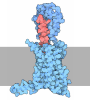
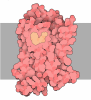
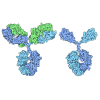
| Related items in Molecule of the Month |

-Map
| File | Download / File: emd_51324.map.gz / Format: CCP4 / Size: 178 MB / Type: IMAGE STORED AS FLOATING POINT NUMBER (4 BYTES) | ||||||||||||||||||||||||||||||||||||
|---|---|---|---|---|---|---|---|---|---|---|---|---|---|---|---|---|---|---|---|---|---|---|---|---|---|---|---|---|---|---|---|---|---|---|---|---|---|
| Annotation | sharpened composite cryo-EM map of Thromboxane A2 receptor-Gq Protein Complex bound to U46619 | ||||||||||||||||||||||||||||||||||||
| Projections & slices | Image control
Images are generated by Spider. | ||||||||||||||||||||||||||||||||||||
| Voxel size | X=Y=Z: 0.8423 Å | ||||||||||||||||||||||||||||||||||||
| Density |
| ||||||||||||||||||||||||||||||||||||
| Symmetry | Space group: 1 | ||||||||||||||||||||||||||||||||||||
| Details | EMDB XML:
|
 Z (Sec.)
 Y (Row.)
 X (Col.)


-Supplemental data
-Additional map: composite cryo-EM map of Thromboxane A2 receptor-Gq Protein...
| File | emd_51324_additional_1.map | ||||||||||||
|---|---|---|---|---|---|---|---|---|---|---|---|---|---|
| Annotation | composite cryo-EM map of Thromboxane A2 receptor-Gq Protein Complex bound to U46619 | ||||||||||||
| Projections & Slices |
| ||||||||||||
| Density Histograms |


- Sample components
-Entire : Thromboxane A2 receptor-Gq Protein Complex
| Entire | Name: Thromboxane A2 receptor-Gq Protein Complex |
|---|---|
| Components |
|
-Supramolecule #1: Thromboxane A2 receptor-Gq Protein Complex
| Supramolecule | Name: Thromboxane A2 receptor-Gq Protein Complex / type: complex / ID: 1 / Parent: 0 / Macromolecule list: #1-#4 |
|---|---|
| Source (natural) | Organism: Homo sapiens (human) |
-Macromolecule #1: Thromboxane A2 receptor
| Macromolecule | Name: Thromboxane A2 receptor / type: protein_or_peptide / ID: 1 / Details: Thromboxane A2 receptor / Number of copies: 1 / Enantiomer: LEVO |
|---|---|
| Source (natural) | Organism: Homo sapiens (human) |
| Molecular weight | Theoretical: 37.462969 KDa |
| Recombinant expression | Organism:   Spodoptera frugiperda (fall armyworm) Spodoptera frugiperda (fall armyworm) |
| Sequence | String: MWPNGSSLGP CFRPTNITLE ERRLIASPWF AASFCVVGLA SNLLALSVLA GARQGGSHTR SSFLTFLCGL VLTDFLGLLV TGTIVVSQH AALFEWHAVD PGCRLCRFMG VVMIFFGLSP LLLGAAMASE RYLGITRPFS RPAVASQRRA WATVGLVWAA A LALGLLPL ...String: MWPNGSSLGP CFRPTNITLE ERRLIASPWF AASFCVVGLA SNLLALSVLA GARQGGSHTR SSFLTFLCGL VLTDFLGLLV TGTIVVSQH AALFEWHAVD PGCRLCRFMG VVMIFFGLSP LLLGAAMASE RYLGITRPFS RPAVASQRRA WATVGLVWAA A LALGLLPL LGVGRYTVQY PGSWCFLTLG AESGDVAFGL LFSMLGGLSV GLSFLLNTVS VATLCHVYHG QEAAQQRPRD SE VEMMAQL LGIMVVASVC WLPLLVFIAQ TVLRNPPAMS PAGQLSRTTE KELLIYLRVA TWNQILDPWV YILFRRAVLR RLQ PRLSTR PRSLSLQPQL TQRSGLQ UniProtKB: Thromboxane A2 receptor |
-Macromolecule #2: Engineered miniGq
| Macromolecule | Name: Engineered miniGq / type: protein_or_peptide / ID: 2 / Details: Mini Gq / Number of copies: 1 / Enantiomer: LEVO |
|---|---|
| Source (natural) | Organism: Homo sapiens (human) |
| Molecular weight | Theoretical: 28.084832 KDa |
| Recombinant expression | Organism: Spodoptera frugiperda (fall armyworm) |
| Sequence | String: MGSTVSAEDK AAAERSKMID KNLREDGEKA RRTLRLLLLG ADNSGKSTIV KQMRILHGGS GGSGGTSGIF ETKFQVDKVN FHMFDVGGQ RDERRKWIQC FNDVTAIIFV VDSSDYNRLQ EALNDFKSIW NNRWLRTISV ILFLNKQDLL AEKVLAGKSK I EDYFPEFA ...String: MGSTVSAEDK AAAERSKMID KNLREDGEKA RRTLRLLLLG ADNSGKSTIV KQMRILHGGS GGSGGTSGIF ETKFQVDKVN FHMFDVGGQ RDERRKWIQC FNDVTAIIFV VDSSDYNRLQ EALNDFKSIW NNRWLRTISV ILFLNKQDLL AEKVLAGKSK I EDYFPEFA RYTTPEDATP EPGEDPRVTR AKYFIRKEFV DISTASGDGR HICYPHFTCA VDTENARRIF NDCKDIILQM NL REYNLV |
-Macromolecule #3: Guanine nucleotide-binding protein G(I)/G(S)/G(T) subunit beta-1
| Macromolecule | Name: Guanine nucleotide-binding protein G(I)/G(S)/G(T) subunit beta-1 type: protein_or_peptide / ID: 3 / Number of copies: 1 / Enantiomer: LEVO |
|---|---|
| Source (natural) | Organism: Homo sapiens (human) |
| Molecular weight | Theoretical: 37.41693 KDa |
| Recombinant expression | Organism: Spodoptera frugiperda (fall armyworm) |
| Sequence | String: MSELDQLRQE AEQLKNQIRD ARKACADATL SQITNNIDPV GRIQMRTRRT LRGHLAKIYA MHWGTDSRLL VSASQDGKLI IWDSYTTNK VHAIPLRSSW VMTCAYAPSG NYVACGGLDN ICSIYNLKTR EGNVRVSREL AGHTGYLSCC RFLDDNQIVT S SGDTTCAL ...String: MSELDQLRQE AEQLKNQIRD ARKACADATL SQITNNIDPV GRIQMRTRRT LRGHLAKIYA MHWGTDSRLL VSASQDGKLI IWDSYTTNK VHAIPLRSSW VMTCAYAPSG NYVACGGLDN ICSIYNLKTR EGNVRVSREL AGHTGYLSCC RFLDDNQIVT S SGDTTCAL WDIETGQQTT TFTGHTGDVM SLSLAPDTRL FVSGACDASA KLWDVREGMC RQTFTGHESD INAICFFPNG NA FATGSDD ATCRLFDLRA DQELMTYSHD NIICGITSVS FSKSGRLLLA GYDDFNCNVW DALKADRAGV LAGHDNRVSC LGV TDDGMA VATGSWDSFL KIWN UniProtKB: Guanine nucleotide-binding protein G(I)/G(S)/G(T) subunit beta-1 |
-Macromolecule #4: Guanine nucleotide-binding protein G(I)/G(S)/G(O) subunit gamma-2
| Macromolecule | Name: Guanine nucleotide-binding protein G(I)/G(S)/G(O) subunit gamma-2 type: protein_or_peptide / ID: 4 / Number of copies: 1 / Enantiomer: LEVO |
|---|---|
| Source (natural) | Organism: Homo sapiens (human) |
| Molecular weight | Theoretical: 7.861143 KDa |
| Recombinant expression | Organism: Spodoptera frugiperda (fall armyworm) |
| Sequence | String: MASNNTASIA QARKLVEQLK MEANIDRIKV SKAAADLMAY CEAHAKEDPL LTPVPASENP FREKKFFCAI L UniProtKB: Guanine nucleotide-binding protein G(I)/G(S)/G(O) subunit gamma-2 |
-Macromolecule #5: (5Z)-7-{(1R,4S,5S,6R)-6-[(1E,3S)-3-hydroxyoct-1-en-1-yl]-2-oxabic...
| Macromolecule | Name: (5Z)-7-{(1R,4S,5S,6R)-6-[(1E,3S)-3-hydroxyoct-1-en-1-yl]-2-oxabicyclo[2.2.1]hept-5-yl}hept-5-enoic acid type: ligand / ID: 5 / Number of copies: 1 / Formula: PUC |
|---|---|
| Molecular weight | Theoretical: 350.492 Da |
| Chemical component information |  ChemComp-PUC: |
-Macromolecule #6: CHOLESTEROL
| Macromolecule | Name: CHOLESTEROL / type: ligand / ID: 6 / Number of copies: 4 / Formula: CLR |
|---|---|
| Molecular weight | Theoretical: 386.654 Da |
| Chemical component information | 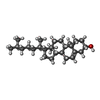 ChemComp-CLR: |
-Experimental details
-Structure determination
| Method | cryo EM |
|---|---|
 Processing Processing | single particle reconstruction |
| Aggregation state | particle |
-Sample preparation
| Buffer | pH: 7.5 |
|---|---|
| Grid | Model: Quantifoil R1.2/1.3 / Material: GOLD / Mesh: 300 / Pretreatment - Type: GLOW DISCHARGE / Pretreatment - Time: 90 sec. |
| Vitrification | Cryogen name: ETHANE |
- Electron microscopy
| Microscope | TFS KRIOS |
|---|---|
| Image recording | Film or detector model: GATAN K3 (6k x 4k) / Average electron dose: 38.4 e/Å2 |
| Electron beam | Acceleration voltage: 300 kV / Electron source:  FIELD EMISSION GUN FIELD EMISSION GUN |
| Electron optics | Illumination mode: FLOOD BEAM / Imaging mode: BRIGHT FIELD / Cs: 2.7 mm / Nominal defocus max: 20.0 µm / Nominal defocus min: 8.0 µm |
| Experimental equipment |  Model: Titan Krios / Image courtesy: FEI Company |
