[English] 日本語
Yorodumi
- EMDB-49762: Identification and non-clinical characterization of SAR444200, a ... -

+
Open data


ID or keywords:

Loading...

-
Basic information

Entry
Database: EMDB / ID: EMD-49762
TitleIdentification and non-clinical characterization of SAR444200, a novel anti-GPC3 T-cell engager for the treatment of GPC3+ solid tumors
Map data
Sample
  • Complex: GPC3 A0226018C08 complex
    • Complex: GPC3
      • Protein or peptide: Glypican-3
    • Complex: A0226018C08
      • Protein or peptide: A0226018C08
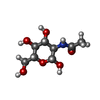
  • Ligand: 2-acetamido-2-deoxy-beta-D-glucopyranose
KeywordsOncoprotein / therapeutic / T-cell engager / IMMUNE SYSTEM
Function / homology
Function and homology information


peptidyl-dipeptidase inhibitor activity / mesonephric duct morphogenesis / regulation of protein localization to membrane / body morphogenesis / cell proliferation involved in kidney development / regulation of non-canonical Wnt signaling pathway / mesenchymal cell proliferation involved in ureteric bud development / Defective B3GALT6 causes EDSP2 and SEMDJL1 / Defective B4GALT7 causes EDS, progeroid type / Defective B3GAT3 causes JDSSDHD ...peptidyl-dipeptidase inhibitor activity / mesonephric duct morphogenesis / regulation of protein localization to membrane / body morphogenesis / cell proliferation involved in kidney development / regulation of non-canonical Wnt signaling pathway / mesenchymal cell proliferation involved in ureteric bud development / Defective B3GALT6 causes EDSP2 and SEMDJL1 / Defective B4GALT7 causes EDS, progeroid type / Defective B3GAT3 causes JDSSDHD / Defective EXT2 causes exostoses 2 / Defective EXT1 causes exostoses 1, TRPS2 and CHDS / cell proliferation involved in metanephros development / Glycosaminoglycan-protein linkage region biosynthesis / HS-GAG biosynthesis / cell migration involved in gastrulation / HS-GAG degradation / negative regulation of growth / positive regulation of Wnt signaling pathway, planar cell polarity pathway / positive regulation of BMP signaling pathway / coronary vasculature development / positive regulation of smoothened signaling pathway / embryonic hindlimb morphogenesis / anterior/posterior axis specification / regulation of canonical Wnt signaling pathway / Wnt signaling pathway, planar cell polarity pathway / branching involved in ureteric bud morphogenesis / smoothened signaling pathway / bone mineralization / RSV-host interactions / Respiratory syncytial virus (RSV) attachment and entry / positive regulation of endocytosis / anatomical structure morphogenesis / canonical Wnt signaling pathway / Retinoid metabolism and transport / side of membrane / lysosomal lumen / lung development / osteoclast differentiation / epithelial cell proliferation / positive regulation of D-glucose import across plasma membrane / Post-translational protein phosphorylation / negative regulation of smoothened signaling pathway / response to bacterium / negative regulation of canonical Wnt signaling pathway / Golgi lumen / Regulation of Insulin-like Growth Factor (IGF) transport and uptake by Insulin-like Growth Factor Binding Proteins (IGFBPs) / negative regulation of epithelial cell proliferation / positive regulation of protein catabolic process / cell migration / positive regulation of canonical Wnt signaling pathway / Attachment and Entry / endoplasmic reticulum lumen / cell surface / plasma membrane
Similarity search - Function
Glypican, conserved site / Glypicans signature. / Glypican / Glypican
Similarity search - Domain/homology
Biological speciesHomo sapiens (human) / Lama glama (llama)
Methodsingle particle reconstruction / cryo EM / Resolution: 7.45 Å
AuthorsBatchelor JD / Svidritskiy E
Funding support1 items
OrganizationGrant numberCountry
Not funded
CitationJournal: Mol Cancer Ther / Year: 2025
Title: Identification and non-clinical characterization of SAR444200, a novel anti-GPC3 NANOBODY® T-cell engager, for the treatment of GPC3+ solid tumors.
Authors: Paolo Meoni / Ana Paula B Vintém / Virna F Cortez-Retamozo / Jasper Jacobs / Evelyn De Tavernier / Paola Fiorentini / Diane Van Hoorick / Joseph D Batchelor / Egor Svidritskiy / Yu Qiu / ...Authors: Paolo Meoni / Ana Paula B Vintém / Virna F Cortez-Retamozo / Jasper Jacobs / Evelyn De Tavernier / Paola Fiorentini / Diane Van Hoorick / Joseph D Batchelor / Egor Svidritskiy / Yu Qiu / Eline Dejonckheere / Aiqun Li / Lily I Pao / Marie-Ange Buyse /
Abstract: T-cell engager (TCE) immunotherapy has demonstrated significant clinical activity in multiple cancers by inducing co-engagement of T-cells and tumor cells, resulting in T-cell activation and T-cell- ...T-cell engager (TCE) immunotherapy has demonstrated significant clinical activity in multiple cancers by inducing co-engagement of T-cells and tumor cells, resulting in T-cell activation and T-cell-dependent cellular cytotoxicity (TDCC) against tumor cells. Current-generation TCEs are predominantly composed of antibody-based binding domains targeting the CD3e molecule of the T-cell antigen receptor (TCR)/CD3 complex on T-cells and a tumor-associated antigen on tumor cells. However, limitations of this approach include cytokine release syndrome and a limited therapeutic window. Here, we report the generation and preclinical evaluation of SAR444200, the first NANOBODY®-based TCE clinical candidate binding to TCRαβ and GPC3 to co-engage T-cells and GPC3+ tumor cells, causing TDCC. SAR444200 bound with nanomolar to picomolar affinity to TCRαβ and GPC3 respectively and induced in vitro TDCC against multiple human tumor cell lines with differential GPC3 expression with picomolar potency. In vivo analysis using human cancer cell line-derived (HuH-7 and HepG2) xenografts in immunodeficient mice showed complete tumor regression at doses starting from 0.7 mg/kg. In exploratory non-human primate studies, intravenous administration of SAR444200 was well tolerated up to 8 mg/kg and exhibited greater than dose-proportional clearances and dose-proportional maximum concentrations across the tested dose range. The highly potent and efficacious activity of SAR444200 in diverse models of GPC3+ tumors and the extremely wide tolerated dose range merits further development of this compound. Furthermore, NANOBODY®-based TCEs developed using an anti-TCRαβ moiety may have specific advantages for the development of TCEs.
History
DepositionMar 18, 2025-
Header (metadata) releaseJan 14, 2026-
Map releaseJan 14, 2026-
UpdateJan 14, 2026-
Current statusJan 14, 2026Processing site: RCSB / Status: Released

-
Structure visualization

Supplemental images

Downloads & links

-
Map

FileDownload / File: emd_49762.map.gz / Format: CCP4 / Size: 244.1 MB / Type: IMAGE STORED AS FLOATING POINT NUMBER (4 BYTES)
Projections & slices

Image control

Size
Brightness
Contrast
Others
AxesZ (Sec.)Y (Row.)X (Col.)
0.89 Å/pix.
x 400 pix.
= 354. Å
0.89 Å/pix.
x 400 pix.
= 354. Å
0.89 Å/pix.
x 400 pix.
= 354. Å

Surface

Projections

Slices (1/3)

Slices (1/2)

Slices (2/3)

Images are generated by Spider.

Voxel sizeX=Y=Z: 0.885 Å
Density
Contour LevelBy AUTHOR: 0.15
Minimum - Maximum-0.3368519 - 0.57628983
Average (Standard dev.)-0.00034637743 (±0.016628671)
SymmetrySpace group: 1
Details

EMDB XML:

Map geometry
Axis orderXYZ
Origin000
Dimensions400400400
Spacing400400400
CellA=B=C: 354.0 Å
α=β=γ: 90.0 °

-
Supplemental data

-
Half map: #2

Fileemd_49762_half_map_1.map
Projections & Slices
AxesZYX

Projections

Slices (1/2)
Density Histograms

-
Half map: #1

Fileemd_49762_half_map_2.map
Projections & Slices
AxesZYX

Projections

Slices (1/2)
Density Histograms

-
Sample components

-
Entire : GPC3 A0226018C08 complex

EntireName: GPC3 A0226018C08 complex
Components
  • Complex: GPC3 A0226018C08 complex
    • Complex: GPC3
      • Protein or peptide: Glypican-3
    • Complex: A0226018C08
      • Protein or peptide: A0226018C08
  • Ligand: 2-acetamido-2-deoxy-beta-D-glucopyranose

-
Supramolecule #1: GPC3 A0226018C08 complex

SupramoleculeName: GPC3 A0226018C08 complex / type: complex / ID: 1 / Parent: 0 / Macromolecule list: #1-#2

-
Supramolecule #2: GPC3

SupramoleculeName: GPC3 / type: complex / ID: 2 / Parent: 1 / Macromolecule list: #1
Source (natural)Organism: Homo sapiens (human)

-
Supramolecule #3: A0226018C08

SupramoleculeName: A0226018C08 / type: complex / ID: 3 / Parent: 1 / Macromolecule list: #2
Source (natural)Organism: Lama glama (llama)

-
Macromolecule #1: Glypican-3

MacromoleculeName: Glypican-3 / type: protein_or_peptide / ID: 1 / Number of copies: 1 / Enantiomer: LEVO
Source (natural)Organism: Homo sapiens (human)
Molecular weightTheoretical: 40.474969 KDa
Recombinant expressionOrganism: Homo sapiens (human)
SequenceString: CHQVRGSDLQ VCLPKGPTCC SRKMEEKYQL TARLNMEQLL QSASMELKFL IIQNAAVFQE AFEIVVRHAK NYTNAMFKNN YPSLTPQAF EFVGEFFTDV SLYILGSDIN VDDMVNELFD SLFPVIYTQL MNPGLDINEC LRGARRDLKV FGFPKLIMTQ V SKSLQVTI ...String:
CHQVRGSDLQ VCLPKGPTCC SRKMEEKYQL TARLNMEQLL QSASMELKFL IIQNAAVFQE AFEIVVRHAK NYTNAMFKNN YPSLTPQAF EFVGEFFTDV SLYILGSDIN VDDMVNELFD SLFPVIYTQL MNPGLDINEC LRGARRDLKV FGFPKLIMTQ V SKSLQVTI FLQALNLGIE VNTTDHLKSK DCGRMLTRMW YCSYCQGLMM VKPCGGYCNV VMQGCMAGVV EIDKYWREYI LS LEELVNG MDMENVLLGL FSTIHDSIQY VQKNAGKLTT TIGKLCTLSS RRRELIQKLK SFISFYSALP GYICSHSPVA END TLCWNG QELVERYSQP VVSQIIDKLH INQLLRTMS

UniProtKB: Glypican-3

-
Macromolecule #2: A0226018C08

MacromoleculeName: A0226018C08 / type: protein_or_peptide / ID: 2 / Number of copies: 1 / Enantiomer: LEVO
Source (natural)Organism: Lama glama (llama)
Molecular weightTheoretical: 13.82049 KDa
Recombinant expressionOrganism: Escherichia coli (E. coli)
SequenceString:
EVQLVESGGG LVQPGLRLSC VASGFTFSSF AMTWVRRPPG KGLEWVATIT NGGVTSYRDS VKGRFTISRD NAKNTLYLEM TSLNPEDTA VYICANARRT GPRAPTDIGS YRGQGTLVTV SSHHHHHH

-
Macromolecule #3: 2-acetamido-2-deoxy-beta-D-glucopyranose

MacromoleculeName: 2-acetamido-2-deoxy-beta-D-glucopyranose / type: ligand / ID: 3 / Number of copies: 2 / Formula: NAG
Molecular weightTheoretical: 221.208 Da
Chemical component information

ChemComp-NAG:
2-acetamido-2-deoxy-beta-D-glucopyranose

-
Experimental details

-
Structure determination

Methodcryo EM
Processingsingle particle reconstruction
Aggregation state2D array

-
Sample preparation

BufferpH: 7.4
VitrificationCryogen name: ETHANE

-
Electron microscopy

MicroscopeTFS KRIOS
Image recordingFilm or detector model: GATAN K2 QUANTUM (4k x 4k) / Average electron dose: 80.0 e/Å2
Electron beamAcceleration voltage: 300 kV / Electron source: FIELD EMISSION GUN
Electron opticsIllumination mode: FLOOD BEAM / Imaging mode: BRIGHT FIELD / Nominal defocus max: 2.5 µm / Nominal defocus min: 1.0 µm
Experimental equipment
Model: Titan Krios / Image courtesy: FEI Company

+
Image processing

CTF correctionType: NONE
Startup modelType of model: NONE
Final reconstructionResolution.type: BY AUTHOR / Resolution: 7.45 Å / Resolution method: FSC 0.143 CUT-OFF / Number images used: 27317
Initial angle assignmentType: NOT APPLICABLE
Final angle assignmentType: MAXIMUM LIKELIHOOD

+
About Yorodumi

-
News

-
Feb 9, 2022. New format data for meta-information of EMDB entries

New format data for meta-information of EMDB entries

  • Version 3 of the EMDB header file is now the official format.
  • The previous official version 1.9 will be removed from the archive.

Related info.:EMDB header

External links:wwPDB to switch to version 3 of the EMDB data model

-
Aug 12, 2020. Covid-19 info

Covid-19 info

URL: https://pdbj.org/emnavi/covid19.php

New page: Covid-19 featured information page in EM Navigator.

Related info.:Covid-19 info / Mar 5, 2020. Novel coronavirus structure data

+
Mar 5, 2020. Novel coronavirus structure data

Novel coronavirus structure data

Related info.:Yorodumi Speices / Aug 12, 2020. Covid-19 info

External links:COVID-19 featured content - PDBj / Molecule of the Month (242):Coronavirus Proteases

+
Jan 31, 2019. EMDB accession codes are about to change! (news from PDBe EMDB page)

EMDB accession codes are about to change! (news from PDBe EMDB page)

  • The allocation of 4 digits for EMDB accession codes will soon come to an end. Whilst these codes will remain in use, new EMDB accession codes will include an additional digit and will expand incrementally as the available range of codes is exhausted. The current 4-digit format prefixed with “EMD-” (i.e. EMD-XXXX) will advance to a 5-digit format (i.e. EMD-XXXXX), and so on. It is currently estimated that the 4-digit codes will be depleted around Spring 2019, at which point the 5-digit format will come into force.
  • The EM Navigator/Yorodumi systems omit the EMD- prefix.

Related info.:Q: What is EMD? / ID/Accession-code notation in Yorodumi/EM Navigator

External links:EMDB Accession Codes are Changing Soon! / Contact to PDBj

+
Jul 12, 2017. Major update of PDB

Major update of PDB

  • wwPDB released updated PDB data conforming to the new PDBx/mmCIF dictionary.
  • This is a major update changing the version number from 4 to 5, and with Remediation, in which all the entries are updated.
  • In this update, many items about electron microscopy experimental information are reorganized (e.g. em_software).
  • Now, EM Navigator and Yorodumi are based on the updated data.

External links:wwPDB Remediation / Enriched Model Files Conforming to OneDep Data Standards Now Available in the PDB FTP Archive

-
Yorodumi

Thousand views of thousand structures

  • Yorodumi is a browser for structure data from EMDB, PDB, SASBDB, etc.
  • This page is also the successor to EM Navigator detail page, and also detail information page/front-end page for Omokage search.
  • The word "yorodu" (or yorozu) is an old Japanese word meaning "ten thousand". "mi" (miru) is to see.

Related info.:EMDB / PDB / SASBDB / Comparison of 3 databanks / Yorodumi Search / Aug 31, 2016. New EM Navigator & Yorodumi / Yorodumi Papers / Jmol/JSmol / Function and homology information / Changes in new EM Navigator and Yorodumi

Read more