National Institutes of Health/National Institute of General Medical Sciences (NIH/NIGMS)
GM143805
United States
Citation
Journal: IUCrJ / Year: 2025 Title: Magellon - an extensible platform for cryo-EM data visualization, management and processing. Authors: Behdad Khoshbin / Puneeth Damodar / Rupali R Garje / Frank H Schotanus / Nandagopal Nair / Lai Wei / Jan Hannes Schäfer / Gabriel C Lander / Michael A Cianfrocco / Scott M Stagg / Abstract: Single-particle cryo-electron microscopy (cryo-EM) has revolutionized structural biology by enabling high-resolution determination of macromolecular structures. However, the field faces challenges in ...Single-particle cryo-electron microscopy (cryo-EM) has revolutionized structural biology by enabling high-resolution determination of macromolecular structures. However, the field faces challenges in data management, processing workflow integration and software extensibility. We present Magellon, an innovative cryo-EM software platform that addresses these challenges through a modern microservices architecture. Magellon consists of an extensible backend with a web based frontend that we call Magellon Viewer. Together, these combine high-performance computing capabilities with an intuitive user interface, enabling researchers to efficiently process and analyze cryo-EM data. The platform's distinguishing features include a plugin based architecture, distributed processing capabilities, comprehensive monitoring systems, and a novel approach to data organization and visualization. A key philosophy of the approach is that the Magellon backend provides a platform that uses robust industry-standard libraries to orchestrate computational tasks while offering users and developers flexibility in selecting the computational resources for performing calculations. Magellon represents a significant advancement in cryo-EM software infrastructure, offering flexibility, scalability and extensibility while maintaining ease of use.
In the structure databanks used in Yorodumi, some data are registered as the other names, "COVID-19 virus" and "2019-nCoV". Here are the details of the virus and the list of structure data.
Jan 31, 2019. EMDB accession codes are about to change! (news from PDBe EMDB page)
EMDB accession codes are about to change! (news from PDBe EMDB page)
The allocation of 4 digits for EMDB accession codes will soon come to an end. Whilst these codes will remain in use, new EMDB accession codes will include an additional digit and will expand incrementally as the available range of codes is exhausted. The current 4-digit format prefixed with “EMD-” (i.e. EMD-XXXX) will advance to a 5-digit format (i.e. EMD-XXXXX), and so on. It is currently estimated that the 4-digit codes will be depleted around Spring 2019, at which point the 5-digit format will come into force.
The EM Navigator/Yorodumi systems omit the EMD- prefix.
Related info.:Q: What is EMD? / ID/Accession-code notation in Yorodumi/EM Navigator
Yorodumi is a browser for structure data from EMDB, PDB, SASBDB, etc.
This page is also the successor to EM Navigator detail page, and also detail information page/front-end page for Omokage search.
The word "yorodu" (or yorozu) is an old Japanese word meaning "ten thousand". "mi" (miru) is to see.
Related info.:EMDB / PDB / SASBDB / Comparison of 3 databanks / Yorodumi Search / Aug 31, 2016. New EM Navigator & Yorodumi / Yorodumi Papers / Jmol/JSmol / Function and homology information / Changes in new EM Navigator and Yorodumi
 Movie
Movie Controller


 Open data
 Basic information
 Map data
 Sample
 Keywords
 Mus musculus (house mouse)
 Authors
 United States, 1 items
  Citation
 Structure visualization
 Downloads & links
 EMDB map data format
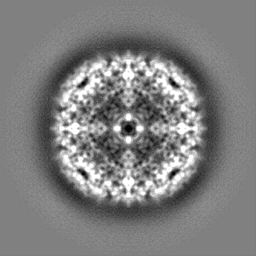
 emd_49574.png
 https://data.pdbj.org/pub/emdb/structures/EMD-49574
 Z (Sec.)
 Y (Row.)
 X (Col.)




 Sample components
 Escherichia coli (E. coli)
 Processing
 Electron microscopy
 FIELD EMISSION GUN

