 Movie
Movie Controller

[English] 日本語
 Yorodumi
- EMDB-49257: In-situ structure of the flagellar motor of Campylobacter jejuni ... -
+ Open data

- Basic information
| Entry |  | |||||||||
|---|---|---|---|---|---|---|---|---|---|---|
| Title | In-situ structure of the flagellar motor of Campylobacter jejuni rpoN deletion mutant | |||||||||
 Map data Map data | In-situ structure of the flagellar motor of Campylobacter jejuni rpoN deletion mutant | |||||||||
 Sample Sample |
| |||||||||
 Keywords Keywords | C. jejuni / Flagella / Complex / Flagellar motor / MOTOR PROTEIN | |||||||||
| Biological species |  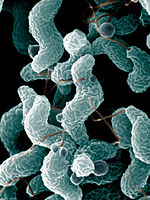 Campylobacter jejuni (Campylobacter) Campylobacter jejuni (Campylobacter) | |||||||||
| Method | subtomogram averaging / cryo EM / Resolution: 41.3 Å | |||||||||
 Authors Authors | Tachiyama S / Liu J | |||||||||
| Funding support |  United States, 2 items United States, 2 items
| |||||||||
 Citation Citation | Journal: Nat Microbiol / Year: 2026 Title: Structural insights into the assembly and evolution of a complex bacterial flagellar motor. Authors: Xueyin Feng / Shoichi Tachiyama / Jing He / Siqi Zhu / Hang Zhao / Jack M Botting / Yanran Liu / Yuanyuan Chen / Canfeng Hua / María Lara-Tejero / Matthew A B Baker / Xiang Gao / Jun Liu / Beile Gao /   Abstract: Knowledge of bacterial flagella has largely come from studies of the simpler motors of Escherichia coli and Salmonella enterica. However, many bacteria harbour more complex motors. The function, ...Knowledge of bacterial flagella has largely come from studies of the simpler motors of Escherichia coli and Salmonella enterica. However, many bacteria harbour more complex motors. The function, mechanisms and evolution associated with such auxiliary motor structures are unclear. Here we deploy structural, genetic, biochemical and functional approaches to characterize complex adaptations of the flagellar motor in Campylobacter jejuni. We observed an E ring formed by 17 FlgY homodimers around the MS ring, a cage-like structure made of FcpMNO and PflD, and PflA-PflB interactions in a spoke-rim formation between the E ring and cage. These scaffolds stabilized the 17 torque-generating stator complexes. Phylogenetic analyses suggest an ancient origin and widespread prevalence of the E ring and spokes across diverse flagellated bacteria, and co-option of type IV pilus components in the ancestral motor of phylum Campylobacterota. Collectively, these data provide insight into the assembly, function and evolution of complex flagellar motors. | |||||||||
| History |
|
- Structure visualization
| Supplemental images |
|---|

- Downloads & links
-EMDB archive
| Map data | emd_49257.map.gz | 55 MB |  EMDB map data format EMDB map data format | |
|---|---|---|---|---|
| Header (meta data) | emd-49257-v30.xmlemd-49257.xml | 14.3 KB 14.3 KB | Display Display | EMDB header |
| Images |  emd_49257.png emd_49257.png | 421 KB | ||
| Filedesc metadata | emd-49257.cif.gz | 4.2 KB | ||
| Others | emd_49257_half_map_1.map.gzemd_49257_half_map_2.map.gz | 55 MB 55 MB | ||
| Archive directory |  http://ftp.pdbj.org/pub/emdb/structures/EMD-49257ftp://ftp.pdbj.org/pub/emdb/structures/EMD-49257 http://ftp.pdbj.org/pub/emdb/structures/EMD-49257ftp://ftp.pdbj.org/pub/emdb/structures/EMD-49257 | HTTPS FTP |
-Related structure data
| Related structure data | C: citing same article ( |
|---|


-Links
| EMDB pages | EMDB (EBI/PDBe) / EMDataResource |
|---|
-Map
| File | Download / File: emd_49257.map.gz / Format: CCP4 / Size: 59.6 MB / Type: IMAGE STORED AS FLOATING POINT NUMBER (4 BYTES) | ||||||||||||||||||||||||||||||||||||
|---|---|---|---|---|---|---|---|---|---|---|---|---|---|---|---|---|---|---|---|---|---|---|---|---|---|---|---|---|---|---|---|---|---|---|---|---|---|
| Annotation | In-situ structure of the flagellar motor of Campylobacter jejuni rpoN deletion mutant | ||||||||||||||||||||||||||||||||||||
| Projections & slices | Image control
Images are generated by Spider. | ||||||||||||||||||||||||||||||||||||
| Voxel size | X=Y=Z: 4.296 Å | ||||||||||||||||||||||||||||||||||||
| Density |
| ||||||||||||||||||||||||||||||||||||
| Symmetry | Space group: 1 | ||||||||||||||||||||||||||||||||||||
| Details | EMDB XML:
|
 Z (Sec.)
 Y (Row.)
 X (Col.)


-Supplemental data
-Half map: Half map of the flagellar motor structure of...
| File | emd_49257_half_map_1.map | ||||||||||||
|---|---|---|---|---|---|---|---|---|---|---|---|---|---|
| Annotation | Half map of the flagellar motor structure of Campylobacter jejuni rpoN deletion mutant | ||||||||||||
| Projections & Slices |
| ||||||||||||
| Density Histograms |


-Half map: Half map of the flagellar motor structure of...
| File | emd_49257_half_map_2.map | ||||||||||||
|---|---|---|---|---|---|---|---|---|---|---|---|---|---|
| Annotation | Half map of the flagellar motor structure of Campylobacter jejuni rpoN deletion mutant | ||||||||||||
| Projections & Slices |
| ||||||||||||
| Density Histograms |


- Sample components
-Entire : Campylobacter jejuni
| Entire | Name: Campylobacter jejuni (Campylobacter) |
|---|---|
| Components |
|
-Supramolecule #1: Campylobacter jejuni
| Supramolecule | Name: Campylobacter jejuni / type: cell / ID: 1 / Parent: 0 |
|---|---|
| Source (natural) | Organism: Campylobacter jejuni (Campylobacter) |
-Experimental details
-Structure determination
| Method | cryo EM |
|---|---|
 Processing Processing | subtomogram averaging |
| Aggregation state | cell |
-Sample preparation
| Buffer | pH: 7.4 |
|---|---|
| Vitrification | Cryogen name: ETHANE-PROPANE |
- Electron microscopy
| Microscope | TFS GLACIOS |
|---|---|
| Image recording | Film or detector model: GATAN K3 (6k x 4k) / Average electron dose: 1.96 e/Å2 |
| Electron beam | Acceleration voltage: 200 kV / Electron source:  FIELD EMISSION GUN FIELD EMISSION GUN |
| Electron optics | Illumination mode: FLOOD BEAM / Imaging mode: BRIGHT FIELD / Nominal defocus max: 5.0 µm / Nominal defocus min: 3.0 µm |
-Image processing
| Final reconstruction | Applied symmetry - Point group: C17 (17 fold cyclic) / Resolution.type: BY AUTHOR / Resolution: 41.3 Å / Resolution method: FSC 0.5 CUT-OFF / Number subtomograms used: 163 |
|---|---|
| Extraction | Number tomograms: 195 / Number images used: 169 |
| CTF correction | Type: PHASE FLIPPING ONLY |
| Final angle assignment | Type: OTHER |
