 Movie
Movie Controller

[English] 日本語
 Yorodumi
- EMDB-48634: DNA-origami colloid for self-assembly of tubules: (10,0) monomer,... -
+ Open data

- Basic information
| Entry |  | |||||||||
|---|---|---|---|---|---|---|---|---|---|---|
| Title | DNA-origami colloid for self-assembly of tubules: (10,0) monomer, bound pair from side 2 interaction | |||||||||
 Map data Map data | Primary electron density map. | |||||||||
 Sample Sample |
| |||||||||
 Keywords Keywords | DNA origami / synthetic construct / DNA | |||||||||
| Biological species | synthetic construct (others) | |||||||||
| Method | single particle reconstruction / cryo EM / Resolution: 27.58 Å | |||||||||
 Authors Authors | Videbaek TE / Rogers WB | |||||||||
| Funding support |  United States, 1 items United States, 1 items
| |||||||||
 Citation Citation | Journal: Proc Natl Acad Sci U S A / Year: 2025 Title: Measuring multisubunit mechanics of geometrically programmed colloidal assemblies via cryo-EM multi-body refinement. Authors: Thomas E Videbæk / Daichi Hayakawa / Michael F Hagan / Gregory M Grason / Seth Fraden / W Benjamin Rogers / Abstract: Programmable self-assembly has recently enabled the creation of complex structures through precise control of the interparticle interactions and the particle geometries. Targeting ever more ...Programmable self-assembly has recently enabled the creation of complex structures through precise control of the interparticle interactions and the particle geometries. Targeting ever more structurally complex, dynamic, and functional assemblies necessitates going beyond the design of the structure itself, to the measurement and control of the local flexibility of the intersubunit connections and its impact on the collective mechanics of the entire assembly. In this study, we demonstrate a method to infer the mechanical properties of multisubunit assemblies using cryogenic electron microscopy (cryo-EM) and RELION's multi-body refinement. Specifically, we analyze the fluctuations of pairs of DNA-origami subunits that self-assemble into tubules. By measuring the fluctuations of dimers using cryo-EM, we extract mechanical properties such as the bending modulus and interparticle spring constant. These properties are then applied to elastic models to predict assembly outcomes, which align well with experimental observations. This approach not only provides a deeper understanding of nanoparticle mechanics but also opens pathways to refining subunit designs to achieve precise assembly behavior. This methodology could have broader applications in the study of nanomaterials, including protein assemblies, where understanding the interplay of mechanical properties and subunit geometry is essential for controlling complex self-assembled structures. | |||||||||
| History |
|
- Structure visualization
| Supplemental images |
|---|

- Downloads & links
-EMDB archive
| Map data | emd_48634.map.gz | 28.7 MB |  EMDB map data format EMDB map data format | |
|---|---|---|---|---|
| Header (meta data) | emd-48634-v30.xmlemd-48634.xml | 17.6 KB 17.6 KB | Display Display | EMDB header |
| FSC (resolution estimation) | emd_48634_fsc.xml | 7.3 KB | Display | FSC data file |
| Images |  emd_48634.png emd_48634.png | 47.8 KB | ||
| Filedesc metadata | emd-48634.cif.gz | 4.2 KB | ||
| Others | emd_48634_half_map_1.map.gzemd_48634_half_map_2.map.gz | 23.5 MB 23.5 MB | ||
| Archive directory |  http://ftp.pdbj.org/pub/emdb/structures/EMD-48634ftp://ftp.pdbj.org/pub/emdb/structures/EMD-48634 http://ftp.pdbj.org/pub/emdb/structures/EMD-48634ftp://ftp.pdbj.org/pub/emdb/structures/EMD-48634 | HTTPS FTP |
-Related structure data


-Links
| EMDB pages | EMDB (EBI/PDBe) / EMDataResource |
|---|
-Map
| File | Download / File: emd_48634.map.gz / Format: CCP4 / Size: 30.5 MB / Type: IMAGE STORED AS FLOATING POINT NUMBER (4 BYTES) | ||||||||||||||||||||||||||||||||||||
|---|---|---|---|---|---|---|---|---|---|---|---|---|---|---|---|---|---|---|---|---|---|---|---|---|---|---|---|---|---|---|---|---|---|---|---|---|---|
| Annotation | Primary electron density map. | ||||||||||||||||||||||||||||||||||||
| Projections & slices | Image control
Images are generated by Spider. | ||||||||||||||||||||||||||||||||||||
| Voxel size | X=Y=Z: 6.8952 Å | ||||||||||||||||||||||||||||||||||||
| Density |
| ||||||||||||||||||||||||||||||||||||
| Symmetry | Space group: 1 | ||||||||||||||||||||||||||||||||||||
| Details | EMDB XML:
|
 Z (Sec.)
 Y (Row.)
 X (Col.)


-Supplemental data
-Half map: Second half map of the structure.
| File | emd_48634_half_map_1.map | ||||||||||||
|---|---|---|---|---|---|---|---|---|---|---|---|---|---|
| Annotation | Second half map of the structure. | ||||||||||||
| Projections & Slices |
| ||||||||||||
| Density Histograms |


-Half map: First half map of the structure
| File | emd_48634_half_map_2.map | ||||||||||||
|---|---|---|---|---|---|---|---|---|---|---|---|---|---|
| Annotation | First half map of the structure | ||||||||||||
| Projections & Slices |
| ||||||||||||
| Density Histograms |


- Sample components
-Entire : DNA-origami colloid for self-assembly of tubules: (10,0) monomer,...
| Entire | Name: DNA-origami colloid for self-assembly of tubules: (10,0) monomer, bound pair from side 2 interaction |
|---|---|
| Components |
|
-Supramolecule #1: DNA-origami colloid for self-assembly of tubules: (10,0) monomer,...
| Supramolecule | Name: DNA-origami colloid for self-assembly of tubules: (10,0) monomer, bound pair from side 2 interaction type: complex / ID: 1 / Parent: 0 |
|---|---|
| Source (natural) | Organism: synthetic construct (others) / Synthetically produced: Yes |
| Molecular weight | Theoretical: 10.4 MDa |
-Experimental details
-Structure determination
| Method | cryo EM |
|---|---|
 Processing Processing | single particle reconstruction |
| Aggregation state | particle |
-Sample preparation
| Buffer | pH: 7 |
|---|---|
| Grid | Model: C-flat-1.2/1.3 / Material: COPPER / Mesh: 400 |
| Vitrification | Cryogen name: ETHANE |
- Electron microscopy
| Microscope | FEI TECNAI F20 |
|---|---|
| Image recording | Film or detector model: OTHER / Number real images: 584 / Average exposure time: 4.0 sec. / Average electron dose: 22.0 e/Å2 / Details: GATAN Oneview CMOS |
| Electron beam | Acceleration voltage: 200 kV / Electron source:  FIELD EMISSION GUN FIELD EMISSION GUN |
| Electron optics | Illumination mode: OTHER / Imaging mode: BRIGHT FIELD / Cs: 0.8 mm / Nominal defocus max: 2.2 µm / Nominal defocus min: 2.2 µm / Nominal magnification: 29000 |
| Sample stage | Specimen holder model: GATAN 626 SINGLE TILT LIQUID NITROGEN CRYO TRANSFER HOLDER Cooling holder cryogen: NITROGEN |
| Experimental equipment | 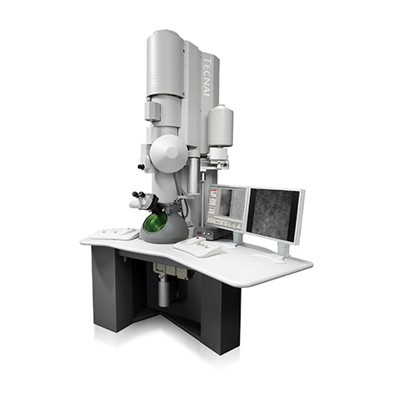 Model: Tecnai F20 / Image courtesy: FEI Company |

