Journal: Nat Commun / Year: 2025 Title: Modular programming of interaction and geometric specificity enables assembly of complex DNA origami nanostructures. Authors: Rupam Saha / Daichi Hayakawa / Thomas E Videbæk / Mason Price / Wei-Shao Wei / Juanita Pombo / Daniel Duke / Gaurav Arya / Gregory M Grason / W Benjamin Rogers / Seth Fraden / Abstract: Self-assembly of nanoscale building blocks with programmable geometries and interactions offers a powerful route to engineer materials that mimic the complexity of biological structures. DNA origami ...Self-assembly of nanoscale building blocks with programmable geometries and interactions offers a powerful route to engineer materials that mimic the complexity of biological structures. DNA origami provides an exceptional platform for this purpose, enabling precise control over subunit shape, binding angles, and interaction specificity. Here we present a modular DNA origami design approach to address the challenges of assembling geometrically complex nanoscale structures, including those with nonuniform curvatures. This approach features a core structure that completely conserves the scaffold routing across different designs and preserves more than 70% of the DNA staples between designs, dramatically reducing both cost and effort, while enabling precise and independent programming of subunit interactions and binding angles through adjustable overhang lengths and sequences. Using cryogenic electron microscopy, gel electrophoresis, and coarse-grained simulations, we validate a set of robust design rules and demonstrate the assembly of diverse self-limiting structures, including anisotropic shells, a T = 13 icosahedral shell, and a toroid with globally varying curvature. This modular strategy provides an efficient and cost-effective framework for the synthetic fabrication of complex nanostructures.
Cryogen name: ETHANE / Chamber humidity: 100 % / Chamber temperature: 293 K / Instrument: FEI VITROBOT MARK IV
-
Electron microscopy
Microscope
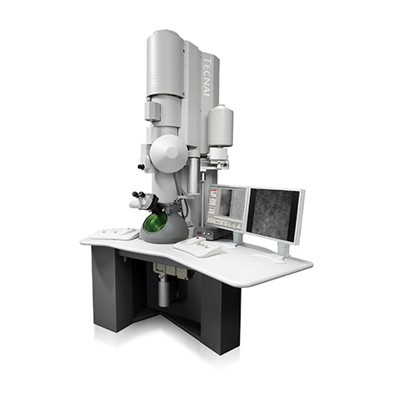
FEI TECNAI F20
Image recording
Film or detector model: OTHER / Digitization - Dimensions - Width: 4096 pixel / Digitization - Dimensions - Height: 4096 pixel / Number real images: 395 / Average exposure time: 3.5 sec. / Average electron dose: 25.0 e/Å2 / Details: Camera used is the Gatan OneView Camera (4k x 4k).
Electron beam
Acceleration voltage: 200 kV / Electron source: FIELD EMISSION GUN
Electron optics
Illumination mode: OTHER / Imaging mode: BRIGHT FIELD / Cs: 0.8 mm / Nominal defocus max: 4.0 µm / Nominal defocus min: 1.0 µm / Nominal magnification: 29000
Sample stage
Specimen holder model: GATAN 626 SINGLE TILT LIQUID NITROGEN CRYO TRANSFER HOLDER Cooling holder cryogen: NITROGEN
In the structure databanks used in Yorodumi, some data are registered as the other names, "COVID-19 virus" and "2019-nCoV". Here are the details of the virus and the list of structure data.
Jan 31, 2019. EMDB accession codes are about to change! (news from PDBe EMDB page)
EMDB accession codes are about to change! (news from PDBe EMDB page)
The allocation of 4 digits for EMDB accession codes will soon come to an end. Whilst these codes will remain in use, new EMDB accession codes will include an additional digit and will expand incrementally as the available range of codes is exhausted. The current 4-digit format prefixed with “EMD-” (i.e. EMD-XXXX) will advance to a 5-digit format (i.e. EMD-XXXXX), and so on. It is currently estimated that the 4-digit codes will be depleted around Spring 2019, at which point the 5-digit format will come into force.
The EM Navigator/Yorodumi systems omit the EMD- prefix.
Related info.:Q: What is EMD? / ID/Accession-code notation in Yorodumi/EM Navigator
Yorodumi is a browser for structure data from EMDB, PDB, SASBDB, etc.
This page is also the successor to EM Navigator detail page, and also detail information page/front-end page for Omokage search.
The word "yorodu" (or yorozu) is an old Japanese word meaning "ten thousand". "mi" (miru) is to see.
Related info.:EMDB / PDB / SASBDB / Comparison of 3 databanks / Yorodumi Search / Aug 31, 2016. New EM Navigator & Yorodumi / Yorodumi Papers / Jmol/JSmol / Function and homology information / Changes in new EM Navigator and Yorodumi
 Movie
Movie Controller

 Yorodumi
 Open data
 Basic information
 Map data
 Sample
 Keywords
 Authors
 United States, 2 items
  Citation
 Structure visualization
 Downloads & links
 EMDB map data format
 emd_48567.png
 https://data.pdbj.org/pub/emdb/structures/EMD-48567


 Z (Sec.)
 Y (Row.)
 X (Col.)


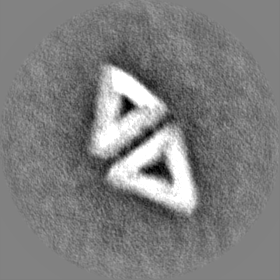


 Sample components
 Processing
 Electron microscopy
 FIELD EMISSION GUN