National Institutes of Health/National Institute of General Medical Sciences (NIH/NIGMS)
R35 GM149542
米国
National Institutes of Health/National Institute Of Allergy and Infectious Diseases (NIH/NIAID)
F32 AI145111
米国
National Institutes of Health/National Institute Of Allergy and Infectious Diseases (NIH/NIAID)
R01 AI171570
米国
National Institutes of Health/National Institute of General Medical Sciences (NIH/NIGMS)
K99 GM141364
米国
引用
ジャーナル: Nat Commun / 年: 2025 タイトル: Antibodies disrupt bacterial adhesion by ligand mimicry and allosteric interference. 著者: Kelli L Hvorecny / Gianluca Interlandi / Tim S Veth / Pavel Aprikian / Anna Manchenko / Veronika L Tchesnokova / Miles S Dickinson / Joel D Quispe / Nicholas M Riley / Rachel E Klevit / Pearl ...著者: Kelli L Hvorecny / Gianluca Interlandi / Tim S Veth / Pavel Aprikian / Anna Manchenko / Veronika L Tchesnokova / Miles S Dickinson / Joel D Quispe / Nicholas M Riley / Rachel E Klevit / Pearl Magala / Evgeni V Sokurenko / Justin M Kollman / 要旨: A critical step in infections is the attachment of microorganisms to host cells using lectins that bind glycans, making lectins promising antimicrobial targets. Upon binding mannosylated glycans, ...A critical step in infections is the attachment of microorganisms to host cells using lectins that bind glycans, making lectins promising antimicrobial targets. Upon binding mannosylated glycans, FimH, an adhesin in E. coli, undergoes an allosteric transition from an inactive to an active conformation that can act as a catch-bond. Distinct monoclonal antibodies that alter FimH glycan binding are available, but the mechanisms of action remain unclear. Here, we use cryo-electron microscopy, mass spectrometry, adhesion assays, and molecular dynamics simulations to determine the structure-function relationships underlying antibody-FimH binding. Our study demonstrates four mechanisms of action: ligand mimicry by an N-linked, high-mannose glycan; stabilization of the ligand pocket in the inactive state; conformational trapping of the active and inactive states; and locking of the ligand pocket through long-range allosteric effects. These structures reveal multiple mechanisms of antibody responses to an allosteric protein and provide blueprints for antimicrobials that target adhesins.
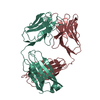
Half map of antibody fragments from mAb21, mAb475, and mAb824 bound to the E. coli adhesin protein FimH masked around variable regions and FimH lectin domain
Half map of antibody fragments from mAb21, mAb475, and mAb824 bound to the E. coli adhesin protein FimH masked around variable regions and FimH lectin domain
 ムービー
ムービー コントローラー


 データを開く
 基本情報
基本情報
 マップデータ
 試料
試料 キーワード
キーワード 機能・相同性情報
 Escherichia coli (大腸菌) /
 Mus musculus (ハツカネズミ)
 データ登録者
 米国, 4件
  引用
引用 構造の表示
構造の表示
 ダウンロードとリンク
 emd_48185.png
 http://ftp.pdbj.org/pub/emdb/structures/EMD-48185


 X (Sec.)
 Y (Row.)
 Z (Col.)


 試料の構成要素
 解析
解析 電子顕微鏡法
 FIELD EMISSION GUN