 Movie
Movie Controller


+ Open data

- Basic information
| Entry |  | |||||||||
|---|---|---|---|---|---|---|---|---|---|---|
| Title | TJ5-1 Fab in complex with NG2 COBRA hemagglutinin | |||||||||
 Map data Map data | TJ5-1 Fab in complex with NG2 COBRA hemagglutinin | |||||||||
 Sample Sample |
| |||||||||
 Keywords Keywords | Antibody / Fab / hemagglutinin / COBRA / VIRAL PROTEIN / VIRAL PROTEIN-Immune System complex | |||||||||
| Function / homology |  Function and homology information Function and homology informationviral budding from plasma membrane / clathrin-dependent endocytosis of virus by host cell / host cell surface receptor binding / fusion of virus membrane with host plasma membrane / fusion of virus membrane with host endosome membrane / viral envelope / virion attachment to host cell / host cell plasma membrane / virion membrane / membrane Similarity search - Function | |||||||||
| Biological species |  Homo sapiens (human) / Homo sapiens (human) /   Influenza A virus Influenza A virus | |||||||||
| Method | single particle reconstruction / cryo EM / Resolution: 3.24 Å | |||||||||
 Authors Authors | Nagashima K / Mousa J | |||||||||
| Funding support |  United States, 1 items United States, 1 items
| |||||||||
 Citation Citation | Journal: J Virol / Year: 2025 Title: Assessing the structural boundaries of broadly reactive antibody interactions with diverse H3 influenza hemagglutinin proteins. Authors: John V Dzimianski / Kaito A Nagashima / Joseph M Cruz / Giuseppe A Sautto / Sara M O'Rourke / Vitor H B Serrão / Ted M Ross / Jarrod J Mousa / Rebecca M DuBois / Abstract: Influenza virus infections are an ongoing seasonal disease burden and a persistent pandemic threat. Formulating successful vaccines remains a challenge due to accumulating mutations in circulating ...Influenza virus infections are an ongoing seasonal disease burden and a persistent pandemic threat. Formulating successful vaccines remains a challenge due to accumulating mutations in circulating strains, necessitating the development of innovative strategies to combat present and future viruses. One promising strategy for attaining greater vaccine effectiveness and longer-lasting protection is the use of computationally optimized broadly reactive antigens (COBRAs). The COBRA approach involves antigen design by generating iterative, layered consensus sequences based on current and historic viruses. Antigens designed by this process show a greater breadth of antibody-mediated protection compared to wild-type antigens, with effectiveness that often extends beyond the sequence design space of the COBRA. In particular, the use of COBRA hemagglutinin (HA) proteins has led to the discovery of broadly reactive antibodies that are suggestive of their therapeutic potential. Understanding the extent to which these antibodies are effective is key to assessing the resilience of vaccine-induced immunity to diverging influenza strains. To investigate this, we tested the binding of broadly reactive antibodies with a diverse panel of H3 HA proteins. Using cryo-electron microscopy, we defined the molecular characteristics of binding for these antibodies at the paratope-epitope interface. Through sequence and structural comparisons, we observed the correlative patterns between antibody affinity and antigen structure. These data shed light on the breadth and limitations of broadly reactive antibody responses in the context of an ever-changing landscape of influenza virus strains, yielding insights into strategies for universal vaccine design.IMPORTANCEFormulating effective influenza vaccines remains a challenge due to a constantly changing landscape of circulating viruses. This is particularly true for H3N2 viruses that undergo a high degree of antigenic drift. Several new vaccine designs can elicit broadly neutralizing antibodies that are effective against a range of influenza strains. More insight is needed, however, into how resilient these antibodies will be to future strains that evolve in the context of this selective pressure. Here, we measured the precise binding characteristics of three broadly neutralizing antibodies to 18 different hemagglutinin (HA) proteins representing almost 50 years of virus evolution. Using single-particle cryo-electron microscopy and X-ray crystallography, we determined the structural characteristics of the epitopes bound by these antibodies and identified specific amino acids that greatly impact the effectiveness of these antibodies. This provides important insights into the longevity of antibody efficacy that can help guide design choices in next-generation vaccines. | |||||||||
| History |
|
- Structure visualization
| Supplemental images |
|---|

- Downloads & links
-EMDB archive
| Map data | emd_47024.map.gz | 110.9 MB | EMDB map data format | |
|---|---|---|---|---|
| Header (meta data) | emd-47024-v30.xmlemd-47024.xml | 21.3 KB 21.3 KB | Display Display | EMDB header |
| Images |  emd_47024.png emd_47024.png | 20.1 KB | ||
| Filedesc metadata | emd-47024.cif.gz | 6.6 KB | ||
| Others | emd_47024_half_map_1.map.gzemd_47024_half_map_2.map.gz | 200.4 MB 200.4 MB | ||
| Archive directory |  https://data.pdbj.org/pub/emdb/structures/EMD-47024ftp://data.pdbj.org/pub/emdb/structures/EMD-47024 https://data.pdbj.org/pub/emdb/structures/EMD-47024ftp://data.pdbj.org/pub/emdb/structures/EMD-47024 | HTTPS FTP |
-Related structure data
| Related structure data |  9dn2MC  9b7gC  9b7hC  9b7iC  9do2C M: atomic model generated by this map C: citing same article ( |
|---|---|
| Similar structure data |


-Links
| EMDB pages | EMDB (EBI/PDBe) / EMDataResource |
|---|---|
| Related items in Molecule of the Month |
-Map
| File | Download / File: emd_47024.map.gz / Format: CCP4 / Size: 216 MB / Type: IMAGE STORED AS FLOATING POINT NUMBER (4 BYTES) | ||||||||||||||||||||||||||||||||||||
|---|---|---|---|---|---|---|---|---|---|---|---|---|---|---|---|---|---|---|---|---|---|---|---|---|---|---|---|---|---|---|---|---|---|---|---|---|---|
| Annotation | TJ5-1 Fab in complex with NG2 COBRA hemagglutinin | ||||||||||||||||||||||||||||||||||||
| Projections & slices | Image control
Images are generated by Spider. | ||||||||||||||||||||||||||||||||||||
| Voxel size | X=Y=Z: 1.093 Å | ||||||||||||||||||||||||||||||||||||
| Density |
| ||||||||||||||||||||||||||||||||||||
| Symmetry | Space group: 1 | ||||||||||||||||||||||||||||||||||||
| Details | EMDB XML:
|
 Z (Sec.)
 Y (Row.)
 X (Col.)


-Supplemental data
-Half map: Half Map A
| File | emd_47024_half_map_1.map | ||||||||||||
|---|---|---|---|---|---|---|---|---|---|---|---|---|---|
| Annotation | Half Map A | ||||||||||||
| Projections & Slices |
| ||||||||||||
| Density Histograms |


-Half map: Half Map B
| File | emd_47024_half_map_2.map | ||||||||||||
|---|---|---|---|---|---|---|---|---|---|---|---|---|---|
| Annotation | Half Map B | ||||||||||||
| Projections & Slices |
| ||||||||||||
| Density Histograms |


- Sample components
-Entire : Complex of TJ5-1 Fab fragment with NG2 COBRA hemagglutinin
| Entire | Name: Complex of TJ5-1 Fab fragment with NG2 COBRA hemagglutinin |
|---|---|
| Components |
|
-Supramolecule #1: Complex of TJ5-1 Fab fragment with NG2 COBRA hemagglutinin
| Supramolecule | Name: Complex of TJ5-1 Fab fragment with NG2 COBRA hemagglutinin type: complex / ID: 1 / Parent: 0 / Macromolecule list: #1-#3 |
|---|---|
| Source (natural) | Organism: Homo sapiens (human) |
-Macromolecule #1: Hemagglutinin
| Macromolecule | Name: Hemagglutinin / type: protein_or_peptide / ID: 1 / Number of copies: 3 / Enantiomer: LEVO |
|---|---|
| Source (natural) | Organism: Influenza A virus |
| Molecular weight | Theoretical: 64.499406 KDa |
| Recombinant expression | Organism: Homo sapiens (human) |
| Sequence | String: MKTIIALSYI LCLVFAQKIP GNDNSTATLC LGHHAVPNGT IVKTITNDRI EVTNATELVQ NSSIGEICDS PHQILDGENC TLIDALLGD PQCDGFQNKK WDLFVERSKA YSNCYPYDVP DYASLRSLVA SSGTLEFKNE SFNWTGVTQN GTSSACIRGS S SSFFSRLN ...String: MKTIIALSYI LCLVFAQKIP GNDNSTATLC LGHHAVPNGT IVKTITNDRI EVTNATELVQ NSSIGEICDS PHQILDGENC TLIDALLGD PQCDGFQNKK WDLFVERSKA YSNCYPYDVP DYASLRSLVA SSGTLEFKNE SFNWTGVTQN GTSSACIRGS S SSFFSRLN WLTHLNYTYP ALNVTMPNNE QFDKLYIWGV HHPGTDKDQI FLYAQSSGRI TVSTKRSQQA VIPNIGSRPR IR DIPSRIS IYWTIVKPGD ILLINSTGNL IAPRGYFKIR SGKSSIMRSD APIGKCKSEC ITPNGSIPND KPFQNVNRIT YGA CPRYVK QSTLKLATGM RNVPEKQTRG IFGAIAGFIE NGWEGMVDGW YGFRHQNSEG RGQAADLKST QAAIDQINGK LNRL IGKTN EKFHQIEKEF SEVEGRIQDL EKYVEDTKID LWSYNAELLV ALENQHTIDL TDSEMNKLFE KTKKQLRENA EDMGN GCFK IYHKCDNACI GSIRNGTYDH NVYRDEALNN RFQIKGVEGY IPEAPRDGQA YVRKDGEWVL LSTFLGSGLN DIFEAQ KIE WHEGHHHHHH UniProtKB: Hemagglutinin |
-Macromolecule #2: TJ5-1 heavy chain Fab fragment
| Macromolecule | Name: TJ5-1 heavy chain Fab fragment / type: protein_or_peptide / ID: 2 / Number of copies: 3 / Enantiomer: LEVO |
|---|---|
| Source (natural) | Organism: Homo sapiens (human) |
| Molecular weight | Theoretical: 12.931521 KDa |
| Recombinant expression | Organism: Homo sapiens (human) |
| Sequence | String: EVQLVQSGAE VKKPGASVKV SCKASGYTFT GFYLHWVRQA PGQGLEWMGW INPHSGDTDF AQKFQGKVTM TRDTSSNTVY MDVNRLTSD DTAVYYCVKN DIVLGMGVWG QGTTVIVSS |
-Macromolecule #3: TJ5-1 light chain Fab fragment
| Macromolecule | Name: TJ5-1 light chain Fab fragment / type: protein_or_peptide / ID: 3 / Number of copies: 3 / Enantiomer: LEVO |
|---|---|
| Source (natural) | Organism: Homo sapiens (human) |
| Molecular weight | Theoretical: 11.667729 KDa |
| Recombinant expression | Organism: Homo sapiens (human) |
| Sequence | String: QSVLTQPPSV SGAPGQRVTI SCTGSSSNIG AGYNVYWFQQ LPPTAPKLLN YGDNNRPSGV PDRFSASKSG TSASLAITGL QAEDEAEYY CQSYDSSLNA YVFGTGTKVT VL |
-Macromolecule #6: 2-acetamido-2-deoxy-beta-D-glucopyranose
| Macromolecule | Name: 2-acetamido-2-deoxy-beta-D-glucopyranose / type: ligand / ID: 6 / Number of copies: 15 / Formula: NAG |
|---|---|
| Molecular weight | Theoretical: 221.208 Da |
| Chemical component information | 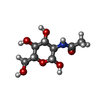 ChemComp-NAG: |
-Experimental details
-Structure determination
| Method | cryo EM |
|---|---|
 Processing Processing | single particle reconstruction |
| Aggregation state | particle |
-Sample preparation
| Buffer | pH: 7.5 |
|---|---|
| Vitrification | Cryogen name: ETHANE |
- Electron microscopy
| Microscope | TFS KRIOS |
|---|---|
| Image recording | Film or detector model: GATAN K2 SUMMIT (4k x 4k) / Average electron dose: 60.216 e/Å2 |
| Electron beam | Acceleration voltage: 300 kV / Electron source:  FIELD EMISSION GUN FIELD EMISSION GUN |
| Electron optics | Illumination mode: FLOOD BEAM / Imaging mode: BRIGHT FIELD / Nominal defocus max: 2.4 µm / Nominal defocus min: 0.8 µm |
| Experimental equipment |  Model: Titan Krios / Image courtesy: FEI Company |

