National Institutes of Health/National Institute Of Allergy and Infectious Diseases (NIH/NIAID)
U19 AI171413
米国
引用
ジャーナル: Nat Commun / 年: 2025 タイトル: Cryo-EM structures of Nipah virus polymerases and high-throughput RdRp assay development enable anti-NiV drug discovery. 著者: Zhenhang Chen / Jeanne Quirit Dudley / Colin Deniston / Cosmo Z Buffalo / Debjani Patra / Dongdong Cao / Julia Hunt / Ahmed Rohaim / Debapriya Sengupta / Lan Wen / Tiffany Tsang / Lili Xie / ...著者: Zhenhang Chen / Jeanne Quirit Dudley / Colin Deniston / Cosmo Z Buffalo / Debjani Patra / Dongdong Cao / Julia Hunt / Ahmed Rohaim / Debapriya Sengupta / Lan Wen / Tiffany Tsang / Lili Xie / Michael DiDonato / Glen Spraggon / Matthew C Clifton / Nadine Jarrousse / Judith Straimer / Bo Liang / 要旨: Transcription and replication of the Nipah virus (NiV) are driven by the large protein (L) together with its essential co-factor phosphoprotein (P). L encodes all the viral enzymatic functions, ...Transcription and replication of the Nipah virus (NiV) are driven by the large protein (L) together with its essential co-factor phosphoprotein (P). L encodes all the viral enzymatic functions, including RNA-dependent RNA polymerase (RdRp) activity, while the tetrameric P is multi-modular. Here, we investigate the molecular mechanism of the NiV polymerase and build tools for anti-NiV drug discovery. We analyze and compare multiple cryo-EM structures of both full-length and truncated NiV polymerases from the Malaysia and Bangladesh strains. We identify two conserved loops in the polyribonucleotidyltransferase (PRNTase) domain of L and the binding between RdRp-PRNTase and CD domains. To further assess the mechanism of NiV polymerase activity, we establish a highly sensitive radioactive-labeled RNA synthesis assay and identify a back-priming activity in the NiV polymerase as well as a fluorescence and luminescent-based non-radioactive polymerase assay to enable high-throughput screening for L protein inhibitors. The combination of structural analysis and the development of both high-sensitive and high-throughput biochemical assays will enable the identification of new direct-acting antiviral candidates for treating highly pathogenic henipaviruses.
 ムービー
ムービー コントローラー


 データを開く
 基本情報
基本情報
 マップデータ
 試料
試料 キーワード
キーワード 機能・相同性情報
 Henipavirus nipahense (ウイルス)
 データ登録者
 米国, 1件
  引用
引用 構造の表示
構造の表示
 ダウンロードとリンク
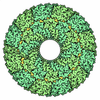
 emd_45896.png
 http://ftp.pdbj.org/pub/emdb/structures/EMD-45896


 Z (Sec.)
 Y (Row.)
 X (Col.)


 試料の構成要素
 解析
解析 電子顕微鏡法
 FIELD EMISSION GUN


