[English] 日本語
Yorodumi
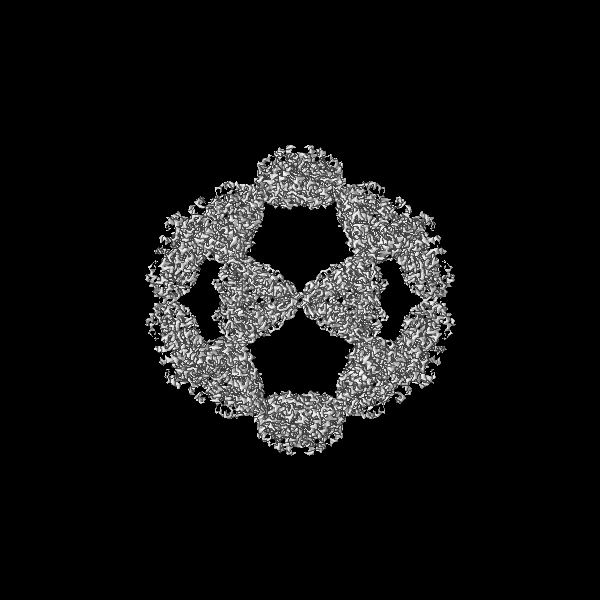
- EMDB-45736: Novel designed icosahedral nanoparticle I3-D12 -

+
Open data


ID or keywords:

Loading...

-
Basic information

Entry
Database: EMDB / ID: EMD-45736
TitleNovel designed icosahedral nanoparticle I3-D12
Map dataNovel designed icosahedral nanoparticle I3-D12
Sample
  • Complex: Novel designed icosahedral nanoparticle I3-D12
    • Protein or peptide: Phosphosulfolactate synthase
KeywordsThermophile / nanoparticle / icosahedron / dehydratase / VIRUS LIKE PARTICLE
Function / homology
Function and homology information


phosphosulfolactate synthase / phosphosulfolactate synthase activity / coenzyme M biosynthetic process / sulfopyruvate decarboxylase activity
Similarity search - Function
Phosphosulpholactate synthase / (2R)-phospho-3-sulpholactate synthase, ComA / (2R)-phospho-3-sulpholactate synthase, ComA superfamily / (2R)-phospho-3-sulfolactate synthase (ComA) / Aldolase-type TIM barrel
Similarity search - Domain/homology
Phosphosulfolactate synthase
Similarity search - Component
Biological speciesEscherichia coli (E. coli)
Methodsingle particle reconstruction / cryo EM / Resolution: 3.5 Å
AuthorsHaas CM / Jasti N / Dosey AM / Gillespie R / McGowan J / Allen JD / Leaf EM / Crispin M / DeForest C / Kanekiyo M / King NP
Funding support United States, 1 items
OrganizationGrant numberCountry
National Institutes of Health/National Institute Of Allergy and Infectious Diseases (NIH/NIAID) United States
CitationJournal: Proc Natl Acad Sci U S A / Year: 2025
Title: From sequence to scaffold: Computational design of protein nanoparticle vaccines from AlphaFold2-predicted building blocks.
Authors: Cyrus M Haas / Naveen Jasti / Annie Dosey / Joel D Allen / Rebecca Gillespie / Jackson McGowan / Elizabeth M Leaf / Max Crispin / Cole A DeForest / Masaru Kanekiyo / Neil P King /
Abstract: Self-assembling protein nanoparticles are being increasingly utilized in the design of next-generation vaccines due to their ability to induce antibody responses of superior magnitude, breadth, and ...Self-assembling protein nanoparticles are being increasingly utilized in the design of next-generation vaccines due to their ability to induce antibody responses of superior magnitude, breadth, and durability. Computational protein design offers a route to nanoparticle scaffolds with structural and biochemical features tailored to specific vaccine applications. Although strategies for designing self-assembling proteins have been established, the recent development of powerful machine learning (ML)-based tools for protein structure prediction and design provides an opportunity to overcome several of their limitations. Here, we leveraged these tools to develop a generalizable method for designing self-assembling proteins starting from AlphaFold2 predictions of oligomeric protein building blocks. We used the method to generate six 60-subunit protein nanoparticles with icosahedral symmetry, and single-particle cryoelectron microscopy reconstructions of three of them revealed that they were designed with atomic-level accuracy. To transform one of these nanoparticles into a functional immunogen, we reoriented its termini through circular permutation, added a genetically encoded oligomannose-type glycan, and displayed a stabilized trimeric variant of the influenza hemagglutinin receptor-binding domain through a rigid de novo linker. The resultant immunogen elicited potent receptor-blocking and neutralizing antibody responses in mice. Our results demonstrate the practical utility of ML-based protein modeling tools in the design of nanoparticle vaccines. More broadly, by eliminating the requirement for experimentally determined structures of protein building blocks, our method dramatically expands the number of starting points available for designing self-assembling proteins.
History
DepositionJul 12, 2024-
Header (metadata) releaseJul 16, 2025-
Map releaseJul 16, 2025-
UpdateJan 28, 2026-
Current statusJan 28, 2026Processing site: RCSB / Status: Released

-
Structure visualization

Supplemental images

Downloads & links

-
Map

FileDownload / File: emd_45736.map.gz / Format: CCP4 / Size: 824 MB / Type: IMAGE STORED AS FLOATING POINT NUMBER (4 BYTES)
AnnotationNovel designed icosahedral nanoparticle I3-D12
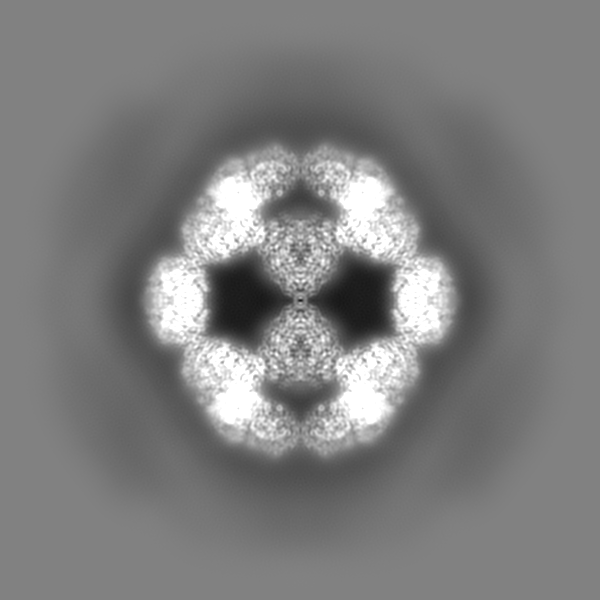
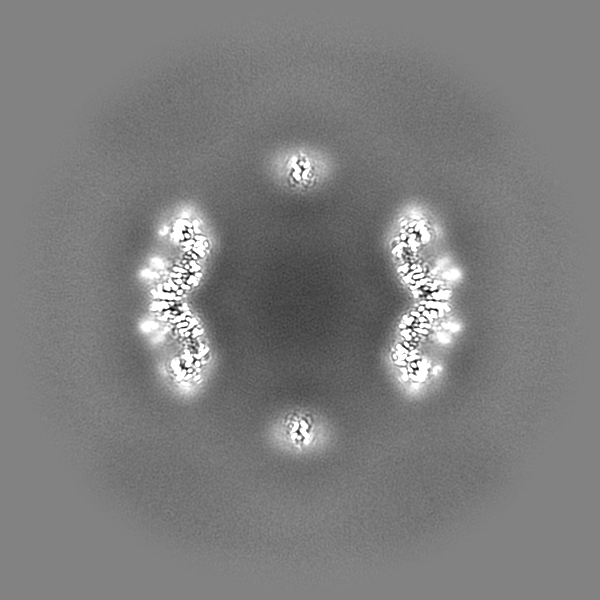
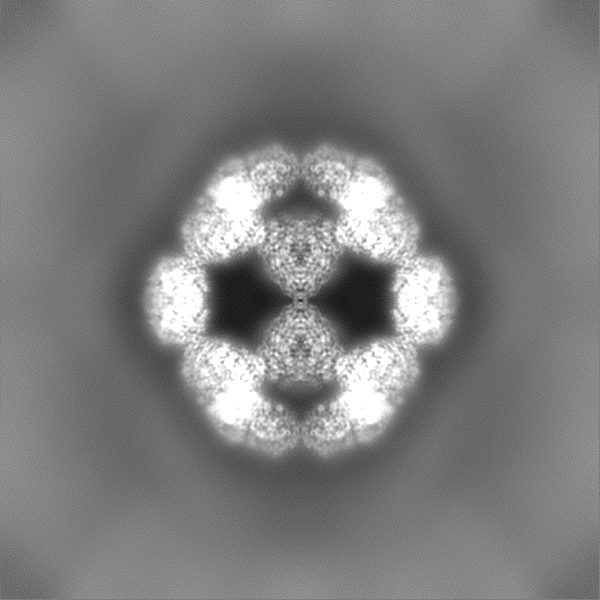
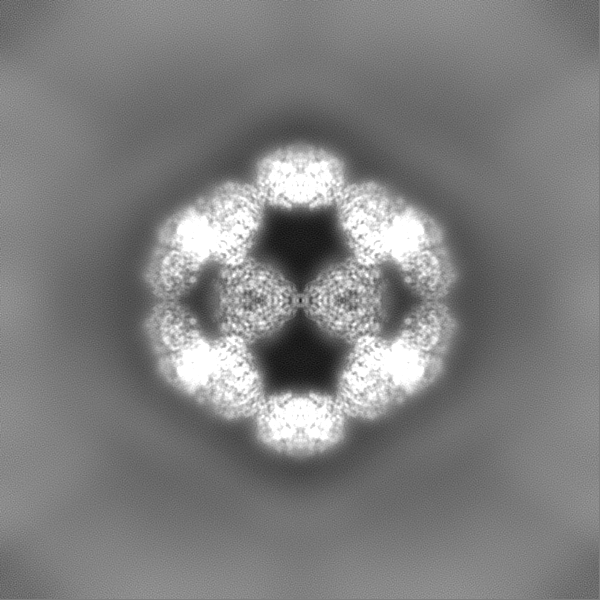
Projections & slices

Image control

Size
Brightness
Contrast
Others
AxesZ (Sec.)Y (Row.)X (Col.)
0.84 Å/pix.
x 600 pix.
= 505.8 Å
0.84 Å/pix.
x 600 pix.
= 505.8 Å
0.84 Å/pix.
x 600 pix.
= 505.8 Å

Surface

Projections

Slices (1/3)

Slices (1/2)

Slices (2/3)

Images are generated by Spider.

Voxel sizeX=Y=Z: 0.843 Å
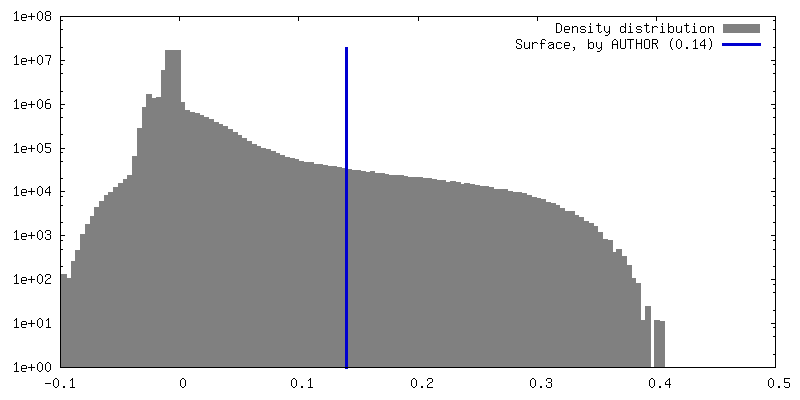
Density
Contour LevelBy AUTHOR: 0.14
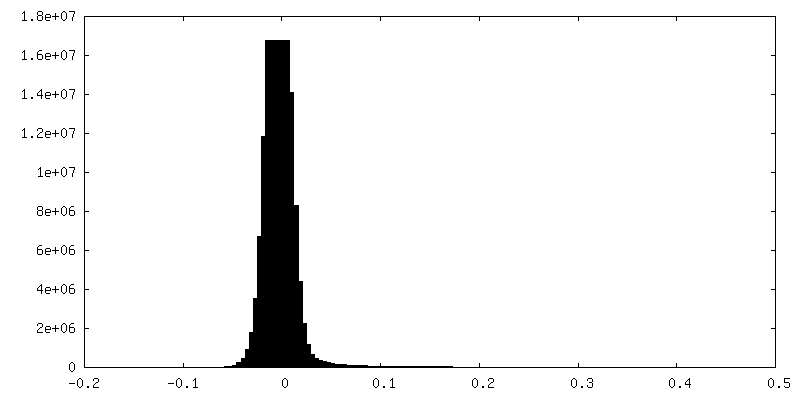
Minimum - Maximum-0.09714371 - 0.4086359
Average (Standard dev.)-0.00016562059 (±0.016772846)
SymmetrySpace group: 1
Details

EMDB XML:

Map geometry
Axis orderXYZ
Origin000
Dimensions600600600
Spacing600600600
CellA=B=C: 505.8 Å
α=β=γ: 90.0 °

-
Supplemental data

-
Half map: Half Map A icosahedral nanoparticle I3-D12

Fileemd_45736_half_map_1.map
AnnotationHalf Map A icosahedral nanoparticle I3-D12
Projections & Slices
AxesZYX

Projections

Slices (1/2)
Density Histograms

-
Half map: Half Map B icosahedral nanoparticle I3-D12

Fileemd_45736_half_map_2.map
AnnotationHalf Map B icosahedral nanoparticle I3-D12
Projections & Slices
AxesZYX

Projections

Slices (1/2)
Density Histograms

-
Sample components

-
Entire : Novel designed icosahedral nanoparticle I3-D12

EntireName: Novel designed icosahedral nanoparticle I3-D12
Components
  • Complex: Novel designed icosahedral nanoparticle I3-D12
    • Protein or peptide: Phosphosulfolactate synthase

-
Supramolecule #1: Novel designed icosahedral nanoparticle I3-D12

SupramoleculeName: Novel designed icosahedral nanoparticle I3-D12 / type: complex / ID: 1 / Parent: 0 / Macromolecule list: all
Source (natural)Organism: Escherichia coli (E. coli)

-
Macromolecule #1: Phosphosulfolactate synthase

MacromoleculeName: Phosphosulfolactate synthase / type: protein_or_peptide / ID: 1 / Number of copies: 60 / Enantiomer: LEVO
Source (natural)Organism: Escherichia coli (E. coli)
Molecular weightTheoretical: 29.228348 KDa
Recombinant expressionOrganism: Escherichia coli (E. coli)
SequenceString: MKAFEFLYED FQRGLTVVLD KGLPPKFVED YLKVCGDYID FVKFGWGTSA VIDRDVVKEK INYYKDWGIK VYPGGTLFEY AYSKGEAAE FIAECKKLGF EAVEISDGSS DISLDDRKAA IWGAKWAGFM VLTEVGKKMP DKDKQLTIDD RIKLINFDLD A GADYVIIE ...String:
MKAFEFLYED FQRGLTVVLD KGLPPKFVED YLKVCGDYID FVKFGWGTSA VIDRDVVKEK INYYKDWGIK VYPGGTLFEY AYSKGEAAE FIAECKKLGF EAVEISDGSS DISLDDRKAA IWGAKWAGFM VLTEVGKKMP DKDKQLTIDD RIKLINFDLD A GADYVIIE GRESGKGIGL FDKEGKVKEN ELDVLAKNVD INKVIFEAPQ KSQQVAFILK FGSSVNLANI AFDEVISLET LR RGLRGDT FGKVLEHHHH HH

UniProtKB: Phosphosulfolactate synthase

-
Experimental details

-
Structure determination

Methodcryo EM
Processingsingle particle reconstruction
Aggregation stateparticle

-
Sample preparation

BufferpH: 8
VitrificationCryogen name: ETHANE

-
Electron microscopy

MicroscopeTFS KRIOS
Image recordingFilm or detector model: GATAN K3 (6k x 4k) / Average electron dose: 52.0 e/Å2
Electron beamAcceleration voltage: 300 kV / Electron source: FIELD EMISSION GUN
Electron opticsIllumination mode: FLOOD BEAM / Imaging mode: BRIGHT FIELD / Nominal defocus max: 2.0 µm / Nominal defocus min: 0.5 µm
Experimental equipment
Model: Titan Krios / Image courtesy: FEI Company

+
Image processing

CTF correctionType: PHASE FLIPPING AND AMPLITUDE CORRECTION
Startup modelType of model: OTHER / Details: Ab Initio Model
Final reconstructionResolution.type: BY AUTHOR / Resolution: 3.5 Å / Resolution method: FSC 0.143 CUT-OFF / Number images used: 165931
Initial angle assignmentType: MAXIMUM LIKELIHOOD
Final angle assignmentType: MAXIMUM LIKELIHOOD
FSC plot (resolution estimation)

+
About Yorodumi

-
News

-
Feb 9, 2022. New format data for meta-information of EMDB entries

New format data for meta-information of EMDB entries

  • Version 3 of the EMDB header file is now the official format.
  • The previous official version 1.9 will be removed from the archive.

Related info.:EMDB header

External links:wwPDB to switch to version 3 of the EMDB data model

-
Aug 12, 2020. Covid-19 info

Covid-19 info

URL: https://pdbj.org/emnavi/covid19.php

New page: Covid-19 featured information page in EM Navigator.

Related info.:Covid-19 info / Mar 5, 2020. Novel coronavirus structure data

+
Mar 5, 2020. Novel coronavirus structure data

Novel coronavirus structure data

Related info.:Yorodumi Speices / Aug 12, 2020. Covid-19 info

External links:COVID-19 featured content - PDBj / Molecule of the Month (242):Coronavirus Proteases

+
Jan 31, 2019. EMDB accession codes are about to change! (news from PDBe EMDB page)

EMDB accession codes are about to change! (news from PDBe EMDB page)

  • The allocation of 4 digits for EMDB accession codes will soon come to an end. Whilst these codes will remain in use, new EMDB accession codes will include an additional digit and will expand incrementally as the available range of codes is exhausted. The current 4-digit format prefixed with “EMD-” (i.e. EMD-XXXX) will advance to a 5-digit format (i.e. EMD-XXXXX), and so on. It is currently estimated that the 4-digit codes will be depleted around Spring 2019, at which point the 5-digit format will come into force.
  • The EM Navigator/Yorodumi systems omit the EMD- prefix.

Related info.:Q: What is EMD? / ID/Accession-code notation in Yorodumi/EM Navigator

External links:EMDB Accession Codes are Changing Soon! / Contact to PDBj

+
Jul 12, 2017. Major update of PDB

Major update of PDB

  • wwPDB released updated PDB data conforming to the new PDBx/mmCIF dictionary.
  • This is a major update changing the version number from 4 to 5, and with Remediation, in which all the entries are updated.
  • In this update, many items about electron microscopy experimental information are reorganized (e.g. em_software).
  • Now, EM Navigator and Yorodumi are based on the updated data.

External links:wwPDB Remediation / Enriched Model Files Conforming to OneDep Data Standards Now Available in the PDB FTP Archive

-
Yorodumi

Thousand views of thousand structures

  • Yorodumi is a browser for structure data from EMDB, PDB, SASBDB, etc.
  • This page is also the successor to EM Navigator detail page, and also detail information page/front-end page for Omokage search.
  • The word "yorodu" (or yorozu) is an old Japanese word meaning "ten thousand". "mi" (miru) is to see.

Related info.:EMDB / PDB / SASBDB / Comparison of 3 databanks / Yorodumi Search / Aug 31, 2016. New EM Navigator & Yorodumi / Yorodumi Papers / Jmol/JSmol / Function and homology information / Changes in new EM Navigator and Yorodumi

Read more