 Movie
Movie Controller

[English] 日本語
 Yorodumi
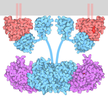
- EMDB-41880: Cryo-EM structure of long form insulin receptor (IR-B) with three... -
+ Open data

- Basic information
| Entry |  | |||||||||
|---|---|---|---|---|---|---|---|---|---|---|
| Title | Cryo-EM structure of long form insulin receptor (IR-B) with three IGF2 bound, asymmetric conformation. | |||||||||
 Map data Map data | Cryo-EM structure of long form insulin receptor (IR-B) with three IGF2 bound, asymmetric conformation. | |||||||||
 Sample Sample |
| |||||||||
 Keywords Keywords | Insulin receptor / IGF2 / RTK / SIGNALING PROTEIN | |||||||||
| Function / homology |  Function and homology information Function and homology informationembryonic placenta morphogenesis / negative regulation of muscle cell differentiation / positive regulation of skeletal muscle tissue growth / Signaling by Type 1 Insulin-like Growth Factor 1 Receptor (IGF1R) / regulation of muscle cell differentiation / IRS-related events triggered by IGF1R / positive regulation of organ growth / regulation of female gonad development / positive regulation of meiotic cell cycle / insulin-like growth factor II binding ...embryonic placenta morphogenesis / negative regulation of muscle cell differentiation / positive regulation of skeletal muscle tissue growth / Signaling by Type 1 Insulin-like Growth Factor 1 Receptor (IGF1R) / regulation of muscle cell differentiation / IRS-related events triggered by IGF1R / positive regulation of organ growth / regulation of female gonad development / positive regulation of meiotic cell cycle / insulin-like growth factor II binding / positive regulation of developmental growth / embryonic placenta development / insulin receptor complex / insulin-like growth factor I binding / insulin receptor activity / positive regulation of protein-containing complex disassembly / genomic imprinting / adrenal gland development / positive regulation of activated T cell proliferation / dendritic spine maintenance / insulin binding / Signaling by Insulin receptor / PTB domain binding / IRS activation / cargo receptor activity / neuronal cell body membrane / positive regulation of respiratory burst / amyloid-beta clearance / heart morphogenesis / positive regulation of receptor internalization / insulin receptor substrate binding / positive regulation of insulin receptor signaling pathway / positive regulation of glycogen biosynthetic process / Signal attenuation / protein kinase activator activity / SHC-related events triggered by IGF1R / phosphatidylinositol 3-kinase binding / Insulin receptor recycling / transport across blood-brain barrier / insulin-like growth factor receptor signaling pathway / insulin-like growth factor receptor binding / positive regulation of D-glucose import across plasma membrane / positive regulation of mitotic nuclear division / neuron projection maintenance / in utero embryonic development / receptor-mediated endocytosis / male gonad development / hormone activity / platelet alpha granule lumen / positive regulation of glycolytic process / regulation of embryonic development / Insulin receptor signalling cascade / protein serine/threonine kinase activator activity / learning / dendrite membrane / growth factor activity / insulin receptor binding / memory / receptor protein-tyrosine kinase / CHD6, CHD7, CHD8, CHD9 subfamily / osteoblast differentiation / caveola / integrin binding / insulin receptor signaling pathway / Regulation of Insulin-like Growth Factor (IGF) transport and uptake by Insulin-like Growth Factor Binding Proteins (IGFBPs) / positive regulation of nitric oxide biosynthetic process / cellular response to insulin stimulus / Platelet degranulation / glucose homeostasis / late endosome / protein autophosphorylation / amyloid-beta binding / PI5P, PP2A and IER3 Regulate PI3K/AKT Signaling / protein tyrosine kinase activity / positive regulation of phosphatidylinositol 3-kinase/protein kinase B signal transduction / positive regulation of canonical NF-kappaB signal transduction / positive regulation of MAPK cascade / signaling receptor complex / lysosome / endosome membrane / positive regulation of cell migration / G protein-coupled receptor signaling pathway / receptor ligand activity / protein domain specific binding / external side of plasma membrane / axon / positive regulation of cell population proliferation / symbiont entry into host cell / regulation of DNA-templated transcription / GTP binding / positive regulation of DNA-templated transcription / protein-containing complex binding / negative regulation of transcription by RNA polymerase II / extracellular exosome / ATP binding / extracellular region / membrane / identical protein binding / plasma membrane Similarity search - Function | |||||||||
| Biological species |  Homo sapiens (human) Homo sapiens (human) | |||||||||
| Method | single particle reconstruction / cryo EM / Resolution: 4.2 Å | |||||||||
 Authors Authors | An W / Hall C / Li J / Huang A / Wu J / Park J / Bai XC / Choi E | |||||||||
| Funding support |  United States, 1 items United States, 1 items
| |||||||||
 Citation Citation | Journal: Nat Commun / Year: 2024 Title: Activation of the insulin receptor by insulin-like growth factor 2. Authors: Weidong An / Catherine Hall / Jie Li / Albert Hung / Jiayi Wu / Junhee Park / Liwei Wang / Xiao-Chen Bai / Eunhee Choi / Abstract: Insulin receptor (IR) controls growth and metabolism. Insulin-like growth factor 2 (IGF2) has different binding properties on two IR isoforms, mimicking insulin's function. However, the molecular ...Insulin receptor (IR) controls growth and metabolism. Insulin-like growth factor 2 (IGF2) has different binding properties on two IR isoforms, mimicking insulin's function. However, the molecular mechanism underlying IGF2-induced IR activation remains unclear. Here, we present cryo-EM structures of full-length human long isoform IR (IR-B) in both the inactive and IGF2-bound active states, and short isoform IR (IR-A) in the IGF2-bound active state. Under saturated IGF2 concentrations, both the IR-A and IR-B adopt predominantly asymmetric conformations with two or three IGF2s bound at site-1 and site-2, which differs from that insulin saturated IR forms an exclusively T-shaped symmetric conformation. IGF2 exhibits a relatively weak binding to IR site-2 compared to insulin, making it less potent in promoting full IR activation. Cell-based experiments validated the functional importance of IGF2 binding to two distinct binding sites in optimal IR signaling and trafficking. In the inactive state, the C-terminus of α-CT of IR-B contacts FnIII-2 domain of the same protomer, hindering its threading into the C-loop of IGF2, thus reducing the association rate of IGF2 with IR-B. Collectively, our studies demonstrate the activation mechanism of IR by IGF2 and reveal the molecular basis underlying the different affinity of IGF2 to IR-A and IR-B. | |||||||||
| History |
|
- Structure visualization
| Supplemental images |
|---|

- Downloads & links
-EMDB archive
| Map data | emd_41880.map.gz | 102.3 MB | EMDB map data format | |
|---|---|---|---|---|
| Header (meta data) | emd-41880-v30.xmlemd-41880.xml | 18.4 KB 18.4 KB | Display Display | EMDB header |
| Images |  emd_41880.png emd_41880.png | 28.5 KB | ||
| Filedesc metadata | emd-41880.cif.gz | 6.6 KB | ||
| Others | emd_41880_half_map_1.map.gzemd_41880_half_map_2.map.gz | 141.6 MB 141.6 MB | ||
| Archive directory |  https://data.pdbj.org/pub/emdb/structures/EMD-41880ftp://data.pdbj.org/pub/emdb/structures/EMD-41880 https://data.pdbj.org/pub/emdb/structures/EMD-41880ftp://data.pdbj.org/pub/emdb/structures/EMD-41880 | HTTPS FTP |
-Related structure data
| Related structure data | 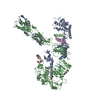 8u4eMC  8u4bC 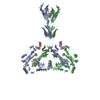 8u4cC  8vjbC 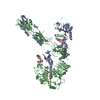 8vjcC M: atomic model generated by this map C: citing same article ( |
|---|---|
| Similar structure data |


-Links
| EMDB pages | EMDB (EBI/PDBe) / EMDataResource |
|---|---|
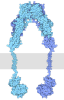
| Related items in Molecule of the Month |
-Map
| File | Download / File: emd_41880.map.gz / Format: CCP4 / Size: 178 MB / Type: IMAGE STORED AS FLOATING POINT NUMBER (4 BYTES) | ||||||||||||||||||||||||||||||||||||
|---|---|---|---|---|---|---|---|---|---|---|---|---|---|---|---|---|---|---|---|---|---|---|---|---|---|---|---|---|---|---|---|---|---|---|---|---|---|
| Annotation | Cryo-EM structure of long form insulin receptor (IR-B) with three IGF2 bound, asymmetric conformation. | ||||||||||||||||||||||||||||||||||||
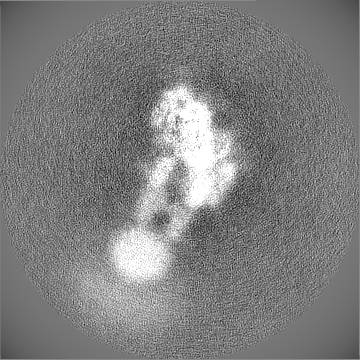
| Projections & slices | Image control
Images are generated by Spider. | ||||||||||||||||||||||||||||||||||||
| Voxel size | X=Y=Z: 1.08 Å | ||||||||||||||||||||||||||||||||||||
| Density |
| ||||||||||||||||||||||||||||||||||||
| Symmetry | Space group: 1 | ||||||||||||||||||||||||||||||||||||
| Details | EMDB XML:
|
 Z (Sec.)
 Y (Row.)
 X (Col.)




-Supplemental data
-Half map: Cryo-EM structure of long form insulin receptor (IR-B)...
| File | emd_41880_half_map_1.map | ||||||||||||
|---|---|---|---|---|---|---|---|---|---|---|---|---|---|
| Annotation | Cryo-EM structure of long form insulin receptor (IR-B) with three IGF2 bound, asymmetric conformation. Half map 1. | ||||||||||||
| Projections & Slices |
| ||||||||||||
| Density Histograms |



-Half map: Cryo-EM structure of long form insulin receptor (IR-B)...
| File | emd_41880_half_map_2.map | ||||||||||||
|---|---|---|---|---|---|---|---|---|---|---|---|---|---|
| Annotation | Cryo-EM structure of long form insulin receptor (IR-B) with three IGF2 bound, asymmetric conformation. Half map 2. | ||||||||||||
| Projections & Slices |
| ||||||||||||
| Density Histograms |



- Sample components
-Entire : Long form insulin receptor (IR-B) with three IGF2 bound, asymmetr...
| Entire | Name: Long form insulin receptor (IR-B) with three IGF2 bound, asymmetric conformation. |
|---|---|
| Components |
|
-Supramolecule #1: Long form insulin receptor (IR-B) with three IGF2 bound, asymmetr...
| Supramolecule | Name: Long form insulin receptor (IR-B) with three IGF2 bound, asymmetric conformation. type: complex / ID: 1 / Parent: 0 / Macromolecule list: all |
|---|---|
| Source (natural) | Organism: Homo sapiens (human) |
-Macromolecule #1: Insulin receptor
| Macromolecule | Name: Insulin receptor / type: protein_or_peptide / ID: 1 / Number of copies: 2 / Enantiomer: LEVO |
|---|---|
| Source (natural) | Organism: Homo sapiens (human) |
| Molecular weight | Theoretical: 156.518328 KDa |
| Recombinant expression | Organism: Homo sapiens (human) |
| Sequence | String: MATGGRRGAA AAPLLVAVAA LLLGAAGHLY PGEVCPGMDI RNNLTRLHEL ENCSVIEGHL QILLMFKTRP EDFRDLSFPK LIMITDYLL LFRVYGLESL KDLFPNLTVI RGSRLFFNYA LVIFEMVHLK ELGLYNLMNI TRGSVRIEKN NELCYLATID W SRILDSVE ...String: MATGGRRGAA AAPLLVAVAA LLLGAAGHLY PGEVCPGMDI RNNLTRLHEL ENCSVIEGHL QILLMFKTRP EDFRDLSFPK LIMITDYLL LFRVYGLESL KDLFPNLTVI RGSRLFFNYA LVIFEMVHLK ELGLYNLMNI TRGSVRIEKN NELCYLATID W SRILDSVE DNYIVLNKDD NEECGDICPG TAKGKTNCPA TVINGQFVER CWTHSHCQKV CPTICKSHGC TAEGLCCHSE CL GNCSQPD DPTKCVACRN FYLDGRCVET CPPPYYHFQD WRCVNFSFCQ DLHHKCKNSR RQGCHQYVIH NNKCIPECPS GYT MNSSNL LCTPCLGPCP KVCHLLEGEK TIDSVTSAQE LRGCTVINGS LIINIRGGNN LAAELEANLG LIEEISGYLK IRRS YALVS LSFFRKLRLI RGETLEIGNY SFYALDNQNL RQLWDWSKHN LTITQGKLFF HYNPKLCLSE IHKMEEVSGT KGRQE RNDI ALKTNGDQAS CENELLKFSY IRTSFDKILL RWEPYWPPDF RDLLGFMLFY KEAPYQNVTE FDGQDACGSN SWTVVD IDP PLRSNDPKSQ NHPGWLMRGL KPWTQYAIFV KTLVTFSDER RTYGAKSDII YVQTDATNPS VPLDPISVSN SSSQIIL KW KPPSDPNGNI THYLVFWERQ AEDSELFELD YCLKGLKLPS RTWSPPFESE DSQKHNQSEY EDSAGECCSC PKTDSQIL K ELEESSFRKT FEDYLHNVVF VPRKTSSGTG AEDPRPSRKR RSLGDVGNVT VAVPTVAAFP NTSSTSVPTS PEEHRPFEK VVNKESLVIS GLRHFTGYRI ELQACNQDTP EERCSVAAYV SARTMPEAKA DDIVGPVTHE IFENNVVHLM WQEPKEPNGL IVLYEVSYR RYGDEELHLC VSRKHFALER GCRLRGLSPG NYSVRIRATS LAGNGSWTEP TYFYVTDYLD VPSNIAKIII G PLIFVFLF SVVIGSIYLF LRKRQPDGPL GPLYASSNPE YLSASDVFPC SVYVPDEWEV SREKITLLRE LGQGSFGMVY EG NARDIIK GEAETRVAVK TVNESASLRE RIEFLNEASV MKGFTCHHVV RLLGVVSKGQ PTLVVMELMA HGDLKSYLRS LRP EAENNP GRPPPTLQEM IQMAAEIADG MAYLNAKKFV HRDLAARNCM VAHDFTVKIG DFGMTRDIYE TDYYRKGGKG LLPV RWMAP ESLKDGVFTT SSDMWSFGVV LWEITSLAEQ PYQGLSNEQV LKFVMDGGYL DQPDNCPERV TDLMRMCWQF NPKMR PTFL EIVNLLKDDL HPSFPEVSFF HSEENKAPES EELEMEFEDM ENVPLDRSSH CQREEAGGRD GGSSLGFKRS YEEHIP YTH MNGGKKNGRI LTLPRSNPS UniProtKB: Insulin receptor |
-Macromolecule #2: Insulin-like growth factor II
| Macromolecule | Name: Insulin-like growth factor II / type: protein_or_peptide / ID: 2 / Number of copies: 3 / Enantiomer: LEVO |
|---|---|
| Source (natural) | Organism: Homo sapiens (human) |
| Molecular weight | Theoretical: 20.170398 KDa |
| Recombinant expression | Organism:   Escherichia coli (E. coli) Escherichia coli (E. coli) |
| Sequence | String: MGIPMGKSML VLLTFLAFAS CCIAAYRPSE TLCGGELVDT LQFVCGDRGF YFSRPASRVS RRSRGIVEEC CFRSCDLALL ETYCATPAK SERDVSTPPT VLPDNFPRYP VGKFFQYDTW KQSTQRLRRG LPALLRARRG HVLAKELEAF REAKRHRPLI A LPTQDPAH GGAPPEMASN RK UniProtKB: Insulin-like growth factor 2 |
-Experimental details
-Structure determination
| Method | cryo EM |
|---|---|
 Processing Processing | single particle reconstruction |
| Aggregation state | particle |
-Sample preparation
| Buffer | pH: 7.5 |
|---|---|
| Vitrification | Cryogen name: ETHANE |
- Electron microscopy
| Microscope | FEI TITAN KRIOS |
|---|---|
| Specialist optics | Energy filter - Name: GIF Bioquantum / Energy filter - Slit width: 20 eV |
| Image recording | Film or detector model: GATAN K3 BIOQUANTUM (6k x 4k) / Average electron dose: 60.0 e/Å2 |
| Electron beam | Acceleration voltage: 300 kV / Electron source:  FIELD EMISSION GUN FIELD EMISSION GUN |
| Electron optics | Illumination mode: FLOOD BEAM / Imaging mode: BRIGHT FIELD / Nominal defocus max: 2.6 µm / Nominal defocus min: 1.6 µm |
| Sample stage | Specimen holder model: FEI TITAN KRIOS AUTOGRID HOLDER / Cooling holder cryogen: NITROGEN |
| Experimental equipment |  Model: Titan Krios / Image courtesy: FEI Company |
+Image processing
-Atomic model buiding 1
| Refinement | Space: REAL / Protocol: RIGID BODY FIT |
|---|---|
| Output model | PDB-8u4e: |
