National Institutes of Health/National Institute of General Medical Sciences (NIH/NIGMS)
R35GM151876
United States
Citation
Journal: Protein Sci / Year: 2026 Title: Cryo-EM reveals an ensemble of cytochrome P450 reductase conformations in solution. Authors: Galina I Lepesheva / Tatiana Y Hargrove / Yi Ren / Abstract: The eukaryotic electron transport system, mediated by cytochrome P450 reductase (CPR), plays a crucial role in driving myriads of reactions involved in the biosynthesis of physiologically active ...The eukaryotic electron transport system, mediated by cytochrome P450 reductase (CPR), plays a crucial role in driving myriads of reactions involved in the biosynthesis of physiologically active compounds (such as sterols, steroids, vitamins, and natural products), as well as in the metabolism of drugs, toxins, and carcinogens. CPR is a diflavin-containing enzyme found ubiquitously on the cytosolic side of the endoplasmic reticulum. While several crystal structures of CPR are available, its conformational states in solution, along with the molecular details of action, remain debatable. Here, we determined the 3.3 Å cryo-EM structure of rat CPR, marking the first electron microscopy structure of this relatively small protein (77 kDa). In this structure, the full-length, fully active enzyme adopts a compact conformation, which, however, is more relaxed than in crystal structures. Moreover, we structurally characterized less populated variations of compact CPR conformations and identified a fraction of molecules (~20%) with the FMN-binding domain either not visible or positioned far from the rest of the catalytic core. These results support the idea that large-scale interdomain rearrangements serve as the structural basis for CPR function and suggest that cryo-EM techniques can help uncover the intricate molecular mechanisms governing the CPR-mediated electron transfer cycle.
Cryogen name: ETHANE / Chamber humidity: 100 % / Chamber temperature: 277 K / Instrument: FEI VITROBOT MARK IV
-
Electron microscopy
Microscope
TFS KRIOS
Temperature
Min: 77.0 K / Max: 77.0 K
Image recording
Film or detector model: GATAN K3 BIOQUANTUM (6k x 4k) / Number grids imaged: 1 / Number real images: 31000 / Average exposure time: 0.899 sec. / Average electron dose: 53.0 e/Å2
Electron beam
Acceleration voltage: 300 kV / Electron source: FIELD EMISSION GUN
In the structure databanks used in Yorodumi, some data are registered as the other names, "COVID-19 virus" and "2019-nCoV". Here are the details of the virus and the list of structure data.
Jan 31, 2019. EMDB accession codes are about to change! (news from PDBe EMDB page)
EMDB accession codes are about to change! (news from PDBe EMDB page)
The allocation of 4 digits for EMDB accession codes will soon come to an end. Whilst these codes will remain in use, new EMDB accession codes will include an additional digit and will expand incrementally as the available range of codes is exhausted. The current 4-digit format prefixed with “EMD-” (i.e. EMD-XXXX) will advance to a 5-digit format (i.e. EMD-XXXXX), and so on. It is currently estimated that the 4-digit codes will be depleted around Spring 2019, at which point the 5-digit format will come into force.
The EM Navigator/Yorodumi systems omit the EMD- prefix.
Related info.:Q: What is EMD? / ID/Accession-code notation in Yorodumi/EM Navigator
Yorodumi is a browser for structure data from EMDB, PDB, SASBDB, etc.
This page is also the successor to EM Navigator detail page, and also detail information page/front-end page for Omokage search.
The word "yorodu" (or yorozu) is an old Japanese word meaning "ten thousand". "mi" (miru) is to see.
Related info.:EMDB / PDB / SASBDB / Comparison of 3 databanks / Yorodumi Search / Aug 31, 2016. New EM Navigator & Yorodumi / Yorodumi Papers / Jmol/JSmol / Function and homology information / Changes in new EM Navigator and Yorodumi
 Movie
Movie Controller


 Open data
 Basic information
 Map data
 Sample
 Keywords
 Function and homology information
 Rattus norvegicus (Norway rat)
 Authors
 United States, 1 items
  Citation
 Structure visualization
 Downloads & links
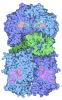
 emd_40857.png
 http://ftp.pdbj.org/pub/emdb/structures/EMD-40857
 Z (Sec.)
 Y (Row.)
 X (Col.)


 Sample components
 Escherichia coli (E. coli)
 Processing
 Electron microscopy
 FIELD EMISSION GUN


