Journal: J Biol Chem / Year: 2024 Title: Different charged biopolymers induce α-synuclein to form fibrils with distinct structures. Authors: Yuxuan Yao / Qinyue Zhao / Youqi Tao / Kaien Liu / Tianyi Cao / Zipeng Chen / Cong Liu / WeiDong Le / Jing Zhao / Dan Li / Wenyan Kang / Abstract: The aggregation of α-synuclein (α-syn) into amyloid fibrils, a key process in the development of Parkinson's disease (PD) and other synucleinopathies, is influenced by a range of factors such as ...The aggregation of α-synuclein (α-syn) into amyloid fibrils, a key process in the development of Parkinson's disease (PD) and other synucleinopathies, is influenced by a range of factors such as charged biopolymers, chaperones, and metabolites. However, the specific impacts of different biopolymers on α-syn fibril structure are not well understood. In our work, we found that different polyanions and polycations, such as polyphosphate (polyP), polyuridine (polyU), and polyamines (including putrescine, spermidine, and spermine), markedly altered the fibrillation kinetics of α-syn in vitro. Furthermore, the seeding assay revealed distinct cross-seeding capacities across different biopolymer-induced α-syn fibrils, suggesting the formation of structurally distinct strains under different conditions. Utilizing cryo-electron microscopy (cryo-EM), we further examined the detailed structural configuration of α-syn fibrils formed in the presence of these biopolymers. Notably, we found that while polyamines do not change the atomic structure of α-syn fibrils, polyU and polyP induce the formation of distinct amyloid fibrils, exhibiting a range of structural polymorphs. Our work offers valuable insights into how various charged biopolymers affect the aggregation process and the resultant structures of α-syn fibrils, thereby enhancing our understanding of the structural variations in α-syn fibrils across different pathological conditions.
In the structure databanks used in Yorodumi, some data are registered as the other names, "COVID-19 virus" and "2019-nCoV". Here are the details of the virus and the list of structure data.
Jan 31, 2019. EMDB accession codes are about to change! (news from PDBe EMDB page)
EMDB accession codes are about to change! (news from PDBe EMDB page)
The allocation of 4 digits for EMDB accession codes will soon come to an end. Whilst these codes will remain in use, new EMDB accession codes will include an additional digit and will expand incrementally as the available range of codes is exhausted. The current 4-digit format prefixed with “EMD-” (i.e. EMD-XXXX) will advance to a 5-digit format (i.e. EMD-XXXXX), and so on. It is currently estimated that the 4-digit codes will be depleted around Spring 2019, at which point the 5-digit format will come into force.
The EM Navigator/Yorodumi systems omit the EMD- prefix.
Related info.:Q: What is EMD? / ID/Accession-code notation in Yorodumi/EM Navigator
Yorodumi is a browser for structure data from EMDB, PDB, SASBDB, etc.
This page is also the successor to EM Navigator detail page, and also detail information page/front-end page for Omokage search.
The word "yorodu" (or yorozu) is an old Japanese word meaning "ten thousand". "mi" (miru) is to see.
Related info.:EMDB / PDB / SASBDB / Comparison of 3 databanks / Yorodumi Search / Aug 31, 2016. New EM Navigator & Yorodumi / Yorodumi Papers / Jmol/JSmol / Function and homology information / Changes in new EM Navigator and Yorodumi
 Movie
Movie Controller


 Open data
 Basic information
 Map data
 Sample
 Keywords
 Function and homology information
 Homo sapiens (human)
 Authors
 Citation
 Structure visualization
 Downloads & links
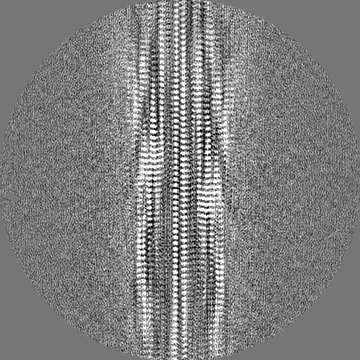
 emd_38862.png
 http://ftp.pdbj.org/pub/emdb/structures/EMD-38862


 Z (Sec.)
 Y (Row.)
 X (Col.)










 Sample components
 Escherichia coli K-12 (bacteria)
 Processing
 Electron microscopy
 FIELD EMISSION GUN