Journal: J Immunol / Year: 2025 Title: Rapid clonal expansion and somatic hypermutation contribute to the fate of SARS-CoV-2 broadly neutralizing antibodies. Authors: Miao Wang / Congcong Liu / Qing Fan / Yuehong Sun / Shilong Tang / Huimin Guo / Bing Zhou / Haiyan Wang / Xiangyang Ge / Zheng Zhang / Bin Ju / Abstract: Several vaccines and immunization strategies, including inactivated vaccines, have proven effective in eliciting antibodies against severe acute respiratory syndrome coronavirus 2 (SARS-CoV-2), ...Several vaccines and immunization strategies, including inactivated vaccines, have proven effective in eliciting antibodies against severe acute respiratory syndrome coronavirus 2 (SARS-CoV-2), providing an opportunity to characterize the antibody response. In this study, we investigated the monoclonal antibody responses elicited by wild-type SARS-CoV-2 inactivated vaccination compared to those elicited by natural infection and mRNA vaccination. The analysis showed that antibodies encoded by biased germline genes were shared between SARS-CoV-2 vaccinated and naturally infected individuals. Among the 35 shared clonotypes identified, besides the well-known IGHV3-53 and IGHV1-58, we identified a class of IGHV4-59 antibodies characterized by rapid response and neutralizing activity, elicited by 3 doses of inactivated vaccine. Members of this lineage exhibited similar sensitivity against wild-type SARS-CoV-2, whereas different neutralizing activities against SARS-CoV-2 variants, especially against various Omicron subvariants, BA.1, BA.2, BA.2.12.1, BA.4/5, and BA.2.75. Structural analysis of BA.1 spike complexed with VacBB-639 revealed that the IGHV4-59-lineage antibodies belonged to the Class 2/3 group. Using sequence alignment, site-mutation assays, and functional verification, we identified two substitutions, N60K in HFR3 and S56G in HCDR2, contributing to opposite neutralization changes of IGHV4-59-lineage antibodies against these Omicron subvariants. These results demonstrate the importance of somatic hypermutation in the evolution of prototypical antigen-elicited antibodies in terms of their neutralization breadth and potency against SARS-CoV-2 Omicron variants.
Model: Quantifoil R1.2/1.3 / Material: COPPER / Support film - Material: CARBON / Support film - topology: HOLEY
Vitrification
Cryogen name: ETHANE / Chamber humidity: 100 % / Chamber temperature: 277 K / Instrument: FEI VITROBOT MARK IV / Details: blot for 5s, wait for 2s, blot force:0.
Details
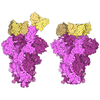
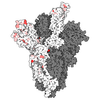
SARS-COV-2 spike proteins were concentrated to about 2mg/mL and incubated with VacBB-639 Fab for 30min (1:2 molar ratio)
-
Electron microscopy
Microscope
FEI TITAN KRIOS
Temperature
Min: 90.0 K / Max: 90.0 K
Specialist optics
Energy filter - Name: GIF Bioquantum / Energy filter - Slit width: 20 eV
Image recording
Film or detector model: GATAN K3 (6k x 4k) / Digitization - Dimensions - Width: 5760 pixel / Digitization - Dimensions - Height: 4092 pixel / Number grids imaged: 1 / Number real images: 4899 / Average exposure time: 1.82 sec. / Average electron dose: 50.0 e/Å2
Electron beam
Acceleration voltage: 300 kV / Electron source: FIELD EMISSION GUN
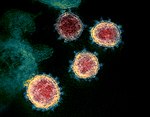
In the structure databanks used in Yorodumi, some data are registered as the other names, "COVID-19 virus" and "2019-nCoV". Here are the details of the virus and the list of structure data.
Jan 31, 2019. EMDB accession codes are about to change! (news from PDBe EMDB page)
EMDB accession codes are about to change! (news from PDBe EMDB page)
The allocation of 4 digits for EMDB accession codes will soon come to an end. Whilst these codes will remain in use, new EMDB accession codes will include an additional digit and will expand incrementally as the available range of codes is exhausted. The current 4-digit format prefixed with “EMD-” (i.e. EMD-XXXX) will advance to a 5-digit format (i.e. EMD-XXXXX), and so on. It is currently estimated that the 4-digit codes will be depleted around Spring 2019, at which point the 5-digit format will come into force.
The EM Navigator/Yorodumi systems omit the EMD- prefix.
Related info.:Q: What is EMD? / ID/Accession-code notation in Yorodumi/EM Navigator
Yorodumi is a browser for structure data from EMDB, PDB, SASBDB, etc.
This page is also the successor to EM Navigator detail page, and also detail information page/front-end page for Omokage search.
The word "yorodu" (or yorozu) is an old Japanese word meaning "ten thousand". "mi" (miru) is to see.
Related info.:EMDB / PDB / SASBDB / Comparison of 3 databanks / Yorodumi Search / Aug 31, 2016. New EM Navigator & Yorodumi / Yorodumi Papers / Jmol/JSmol / Function and homology information / Changes in new EM Navigator and Yorodumi
 Movie
Movie Controller


 Open data
 Basic information
 Map data
 Sample
 Keywords
 Function and homology information
 Severe acute respiratory syndrome coronavirus 2 /
  Homo sapiens (human)
 Authors
 China, 1 items
  Citation
 Structure visualization
 Downloads & links
 emd_38610.png
 http://ftp.pdbj.org/pub/emdb/structures/EMD-38610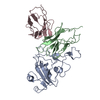
 Z (Sec.)
 Y (Row.)
 X (Col.)


 Sample components
 Processing
 Electron microscopy
 FIELD EMISSION GUN

