Journal: Antiviral Res / Year: 2023 Title: A bivalent form of a RBD-specific synthetic antibody effectively neutralizes SARS-CoV-2 variants. Authors: Dong-Gun Kim / Uijin Kim / In Ho Park / Bumhan Ryu / Youngki Yoo / Jeong Seok Cha / Ga-Yeon Yoon / Sung-Hee Kim / Heeju Oh / Jun-Young Seo / Ki Taek Nam / Je Kyung Seong / Jeon-Soo Shin / ...Authors: Dong-Gun Kim / Uijin Kim / In Ho Park / Bumhan Ryu / Youngki Yoo / Jeong Seok Cha / Ga-Yeon Yoon / Sung-Hee Kim / Heeju Oh / Jun-Young Seo / Ki Taek Nam / Je Kyung Seong / Jeon-Soo Shin / Hyun-Soo Cho / Hak-Sung Kim / Abstract: Coronavirus Disease 2019 (COVID-19) pandemic is severely impacting the world, and tremendous efforts have been made to deal with it. Despite many advances in vaccines and therapeutics, severe acute ...Coronavirus Disease 2019 (COVID-19) pandemic is severely impacting the world, and tremendous efforts have been made to deal with it. Despite many advances in vaccines and therapeutics, severe acute respiratory syndrome coronavirus 2 (SARS-CoV-2) variants remains an intractable challenge. We present a bivalent Receptor Binding Domain (RBD)-specific synthetic antibody, specific for the RBD of wild-type (lineage A), developed from a non-antibody protein scaffold composed of LRR (Leucine-rich repeat) modules through phage display. We further reinforced the unique feature of the synthetic antibody by constructing a tandem dimeric form. The resulting bivalent form showed a broader neutralizing activity against the variants. The in vivo neutralizing efficacy of the bivalent synthetic antibody was confirmed using a human ACE2-expressing mouse model that significantly alleviated viral titer and lung infection. The present approach can be used to develop a synthetic antibody showing a broader neutralizing activity against a multitude of SARS-CoV-2 variants.
Model: Quantifoil R1.2/1.3 / Material: COPPER / Mesh: 200 / Support film - Material: CARBON / Support film - topology: HOLEY / Support film - Film thickness: 12 / Pretreatment - Type: GLOW DISCHARGE / Pretreatment - Time: 60 sec. / Pretreatment - Atmosphere: AIR
Vitrification
Cryogen name: ETHANE / Chamber humidity: 95 % / Chamber temperature: 277.15 K / Instrument: FEI VITROBOT MARK IV
-
Electron microscopy
Microscope
FEI TITAN KRIOS
Image recording
Film or detector model: GATAN K3 BIOQUANTUM (6k x 4k) / Average electron dose: 62.11 e/Å2
Electron beam
Acceleration voltage: 300 kV / Electron source: FIELD EMISSION GUN
In the structure databanks used in Yorodumi, some data are registered as the other names, "COVID-19 virus" and "2019-nCoV". Here are the details of the virus and the list of structure data.
Jan 31, 2019. EMDB accession codes are about to change! (news from PDBe EMDB page)
EMDB accession codes are about to change! (news from PDBe EMDB page)
The allocation of 4 digits for EMDB accession codes will soon come to an end. Whilst these codes will remain in use, new EMDB accession codes will include an additional digit and will expand incrementally as the available range of codes is exhausted. The current 4-digit format prefixed with “EMD-” (i.e. EMD-XXXX) will advance to a 5-digit format (i.e. EMD-XXXXX), and so on. It is currently estimated that the 4-digit codes will be depleted around Spring 2019, at which point the 5-digit format will come into force.
The EM Navigator/Yorodumi systems omit the EMD- prefix.
Related info.:Q: What is EMD? / ID/Accession-code notation in Yorodumi/EM Navigator
Yorodumi is a browser for structure data from EMDB, PDB, SASBDB, etc.
This page is also the successor to EM Navigator detail page, and also detail information page/front-end page for Omokage search.
The word "yorodu" (or yorozu) is an old Japanese word meaning "ten thousand". "mi" (miru) is to see.
Related info.:EMDB / PDB / SASBDB / Comparison of 3 databanks / Yorodumi Search / Aug 31, 2016. New EM Navigator & Yorodumi / Yorodumi Papers / Jmol/JSmol / Function and homology information / Changes in new EM Navigator and Yorodumi
 Movie
Movie Controller

 Yorodumi
 Open data
 Basic information
 Map data
 Sample
 Keywords
 Function and homology information
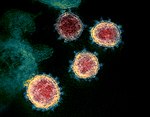 Severe acute respiratory syndrome coronavirus 2 /
  Cyclostomatida (invertebrata)
 Authors
 Korea, Republic Of, 2 items
  Citation
 Structure visualization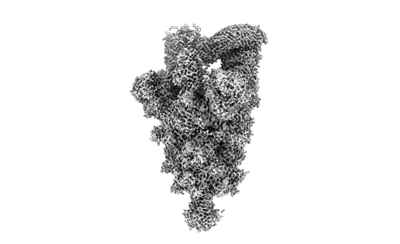
 Downloads & links
 emd_34501.png
 https://data.pdbj.org/pub/emdb/structures/EMD-34501

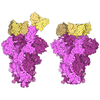
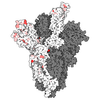
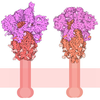
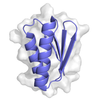
 Z (Sec.)
 Y (Row.)
 X (Col.)








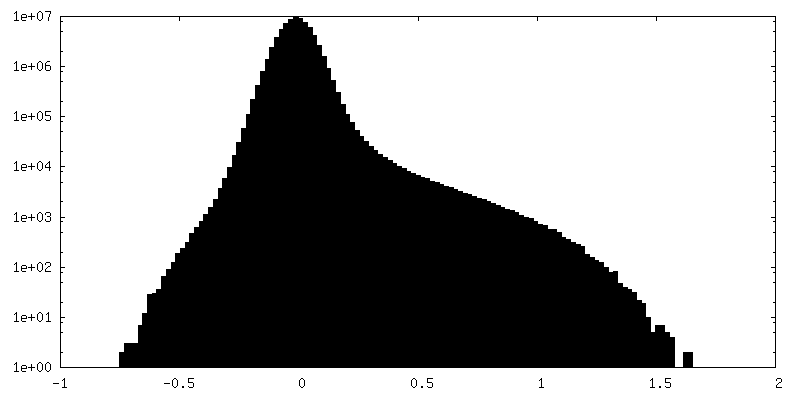
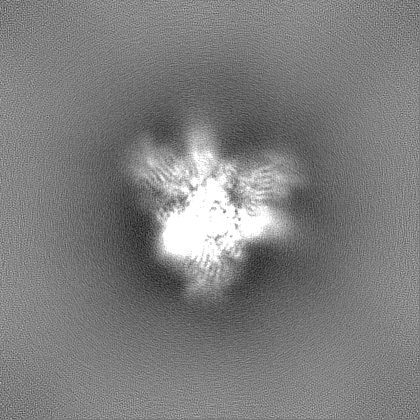

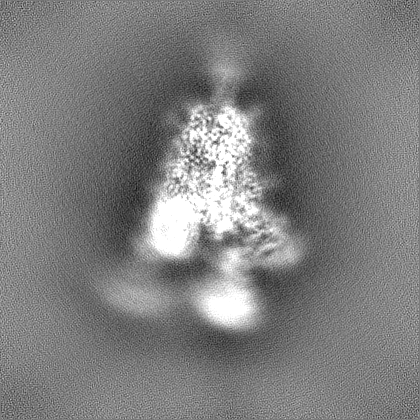
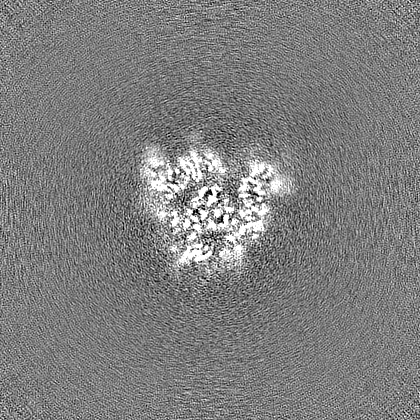

 Sample components
 Spodoptera frugiperda (fall armyworm)
 Processing
 Electron microscopy
 FIELD EMISSION GUN

