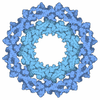
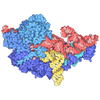
- EMDB-3104: The human Nuclear Pore Complex with nucleoporin 358 knockdown -
+
データを開く
IDまたはキーワード:
読み込み中...
-
基本情報
登録情報
データベース: EMDB / ID: EMD-3104
タイトル
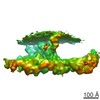
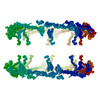
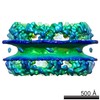
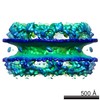
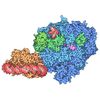
The human Nuclear Pore Complex with nucleoporin 358 knockdown
マップデータ
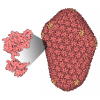
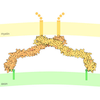
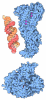
Reconstruction of human nuclear pore complex after Nup358 knockdown
試料
試料: Human nuclear pore complex with nucleoporin 358 knockdown
タンパク質・ペプチド: nuclear pore complex
キーワード
nuclear pore complex / Nup358 knockdown
機能・相同性
機能・相同性情報
nephron development / GATOR2 complex / Seh1-associated complex / nuclear pore inner ring / COPII-coated vesicle budding / protein exit from endoplasmic reticulum / transcription-dependent tethering of RNA polymerase II gene DNA at nuclear periphery / telomere tethering at nuclear periphery / nuclear pore complex assembly / nuclear pore outer ring ...nephron development / GATOR2 complex / Seh1-associated complex / nuclear pore inner ring / COPII-coated vesicle budding / protein exit from endoplasmic reticulum / transcription-dependent tethering of RNA polymerase II gene DNA at nuclear periphery / telomere tethering at nuclear periphery / nuclear pore complex assembly / nuclear pore outer ring / protein localization to nuclear inner membrane / COPII-coated vesicle cargo loading / nuclear pore organization / somite development / nuclear envelope organization / nuclear pore cytoplasmic filaments / atrial cardiac muscle cell action potential / COPII vesicle coat / paraxial mesoderm development / Nuclear Pore Complex (NPC) Disassembly / post-transcriptional tethering of RNA polymerase II gene DNA at nuclear periphery / nuclear inclusion body / Regulation of Glucokinase by Glucokinase Regulatory Protein / Defective TPR may confer susceptibility towards thyroid papillary carcinoma (TPC) / nuclear pore nuclear basket / Transport of Ribonucleoproteins into the Host Nucleus / attachment of mitotic spindle microtubules to kinetochore / miRNA processing / Transport of the SLBP independent Mature mRNA / Transport of the SLBP Dependant Mature mRNA / Amino acids regulate mTORC1 / NS1 Mediated Effects on Host Pathways / SUMOylation of SUMOylation proteins / structural constituent of nuclear pore / positive regulation of mRNA splicing, via spliceosome / Transport of Mature mRNA Derived from an Intronless Transcript / Rev-mediated nuclear export of HIV RNA / SUMOylation of RNA binding proteins / Nuclear import of Rev protein / NEP/NS2 Interacts with the Cellular Export Machinery / Transport of Mature mRNA derived from an Intron-Containing Transcript / RNA export from nucleus / tRNA processing in the nucleus / COPII-mediated vesicle transport / Postmitotic nuclear pore complex (NPC) reformation / neural tube development / protein-containing complex localization / nuclear localization sequence binding / nucleocytoplasmic transport / lamellipodium assembly / Viral Messenger RNA Synthesis / poly(A)+ mRNA export from nucleus / mitotic metaphase chromosome alignment / SUMOylation of ubiquitinylation proteins / Vpr-mediated nuclear import of PICs / female gonad development / macrophage chemotaxis / SUMOylation of DNA replication proteins / 加水分解酵素; プロテアーゼ; ペプチド結合加水分解酵素; セリンエンドペプチターゼ / Regulation of HSF1-mediated heat shock response / positive regulation of TOR signaling / mRNA transport / nuclear pore / mRNA export from nucleus / SUMOylation of DNA damage response and repair proteins / negative regulation of TORC1 signaling / Amplification of signal from unattached kinetochores via a MAD2 inhibitory signal / positive regulation of TORC1 signaling / MHC class II antigen presentation / nuclear periphery / neurogenesis / Mitotic Prometaphase / EML4 and NUDC in mitotic spindle formation / cellular response to nutrient levels / serine-type peptidase activity / cellular response to amino acid starvation / SUMOylation of chromatin organization proteins / Resolution of Sister Chromatid Cohesion / HCMV Late Events / Antigen Presentation: Folding, assembly and peptide loading of class I MHC / chromosome segregation / promoter-specific chromatin binding / ER to Golgi transport vesicle membrane / molecular condensate scaffold activity / Transcriptional regulation by small RNAs / RHO GTPases Activate Formins / intracellular protein transport / kinetochore / ISG15 antiviral mechanism / spindle / HCMV Early Events / protein import into nucleus / Separation of Sister Chromatids / nuclear envelope / protein transport / actin cytoskeleton / snRNP Assembly / nuclear membrane / transcription coactivator activity / nuclear speck 類似検索 - 分子機能
ジャーナル: Nature / 年: 2015 タイトル: In situ structural analysis of the human nuclear pore complex. 著者: Alexander von Appen / Jan Kosinski / Lenore Sparks / Alessandro Ori / Amanda L DiGuilio / Benjamin Vollmer / Marie-Therese Mackmull / Niccolo Banterle / Luca Parca / Panagiotis Kastritis / ...著者: Alexander von Appen / Jan Kosinski / Lenore Sparks / Alessandro Ori / Amanda L DiGuilio / Benjamin Vollmer / Marie-Therese Mackmull / Niccolo Banterle / Luca Parca / Panagiotis Kastritis / Katarzyna Buczak / Shyamal Mosalaganti / Wim Hagen / Amparo Andres-Pons / Edward A Lemke / Peer Bork / Wolfram Antonin / Joseph S Glavy / Khanh Huy Bui / Martin Beck / 要旨: Nuclear pore complexes are fundamental components of all eukaryotic cells that mediate nucleocytoplasmic exchange. Determining their 110-megadalton structure imposes a formidable challenge and ...Nuclear pore complexes are fundamental components of all eukaryotic cells that mediate nucleocytoplasmic exchange. Determining their 110-megadalton structure imposes a formidable challenge and requires in situ structural biology approaches. Of approximately 30 nucleoporins (Nups), 15 are structured and form the Y and inner-ring complexes. These two major scaffolding modules assemble in multiple copies into an eight-fold rotationally symmetric structure that fuses the inner and outer nuclear membranes to form a central channel of ~60 nm in diameter. The scaffold is decorated with transport-channel Nups that often contain phenylalanine-repeat sequences and mediate the interaction with cargo complexes. Although the architectural arrangement of parts of the Y complex has been elucidated, it is unclear how exactly it oligomerizes in situ. Here we combine cryo-electron tomography with mass spectrometry, biochemical analysis, perturbation experiments and structural modelling to generate, to our knowledge, the most comprehensive architectural model of the human nuclear pore complex to date. Our data suggest previously unknown protein interfaces across Y complexes and to inner-ring complex members. We show that the transport-channel Nup358 (also known as Ranbp2) has a previously unanticipated role in Y-complex oligomerization. Our findings blur the established boundaries between scaffold and transport-channel Nups. We conclude that, similar to coated vesicles, several copies of the same structural building block--although compositionally identical--engage in different local sets of interactions and conformations.
 ムービー
ムービー コントローラー


 データを開く
 基本情報
基本情報 マップデータ
 試料
試料 キーワード
キーワード 機能・相同性情報
 Homo sapiens (ヒト)
 データ登録者
 引用
引用


 構造の表示
構造の表示
 ダウンロードとリンク
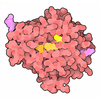
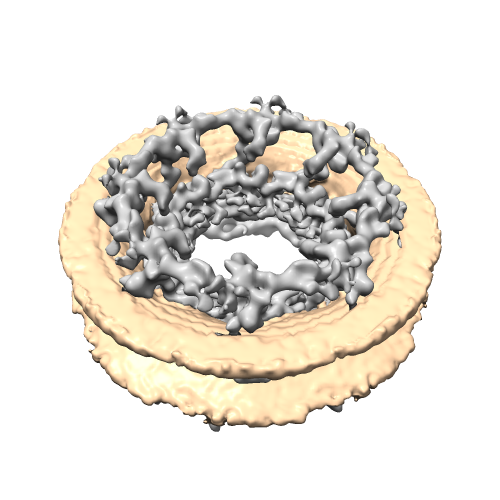 EMD-3104.png
 http://ftp.pdbj.org/pub/emdb/structures/EMD-3104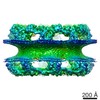
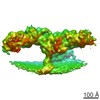
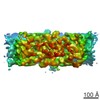


 Z (Sec.)
 Y (Row.)
 X (Col.)


 試料の構成要素
 解析
解析 電子顕微鏡法
 FIELD EMISSION GUN
