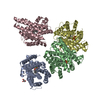
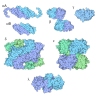
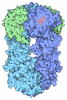
Journal: Proc Natl Acad Sci U S A / Year: 2013 Title: Regulated structural transitions unleash the chaperone activity of αB-crystallin. Authors: Jirka Peschek / Nathalie Braun / Julia Rohrberg / Katrin Christiane Back / Thomas Kriehuber / Andreas Kastenmüller / Sevil Weinkauf / Johannes Buchner / Abstract: The small heat shock protein αB-crystallin is an oligomeric molecular chaperone that binds aggregation-prone proteins. As a component of the proteostasis system, it is associated with cataract, ...The small heat shock protein αB-crystallin is an oligomeric molecular chaperone that binds aggregation-prone proteins. As a component of the proteostasis system, it is associated with cataract, neurodegenerative diseases, and myopathies. The structural determinants for the regulation of its chaperone function are still largely elusive. Combining different experimental approaches, we show that phosphorylation-induced destabilization of intersubunit interactions mediated by the N-terminal domain (NTD) results in the remodeling of the oligomer ensemble with an increase in smaller, activated species, predominantly 12-mers and 6-mers. Their 3D structures determined by cryo-electron microscopy and biochemical analyses reveal that the NTD in these species gains flexibility and solvent accessibility. These modulated properties are accompanied by an increase in chaperone activity in vivo and in vitro and a more efficient cooperation with the heat shock protein 70 system in client folding. Thus, the modulation of the structural flexibility of the NTD, as described here for phosphorylation, appears to regulate the chaperone activity of αB-crystallin rendering the NTD a conformational sensor for nonnative proteins.
History
Deposition
Apr 21, 2013
-
Header (metadata) release
May 29, 2013
-
Map release
Sep 25, 2013
-
Update
Oct 9, 2013
-
Current status
Oct 9, 2013
Processing site: PDBe / Status: Released
-
Structure visualization
Movie
Surface view with section colored by density value
In the structure databanks used in Yorodumi, some data are registered as the other names, "COVID-19 virus" and "2019-nCoV". Here are the details of the virus and the list of structure data.
Jan 31, 2019. EMDB accession codes are about to change! (news from PDBe EMDB page)
EMDB accession codes are about to change! (news from PDBe EMDB page)
The allocation of 4 digits for EMDB accession codes will soon come to an end. Whilst these codes will remain in use, new EMDB accession codes will include an additional digit and will expand incrementally as the available range of codes is exhausted. The current 4-digit format prefixed with “EMD-” (i.e. EMD-XXXX) will advance to a 5-digit format (i.e. EMD-XXXXX), and so on. It is currently estimated that the 4-digit codes will be depleted around Spring 2019, at which point the 5-digit format will come into force.
The EM Navigator/Yorodumi systems omit the EMD- prefix.
Related info.:Q: What is EMD? / ID/Accession-code notation in Yorodumi/EM Navigator
Yorodumi is a browser for structure data from EMDB, PDB, SASBDB, etc.
This page is also the successor to EM Navigator detail page, and also detail information page/front-end page for Omokage search.
The word "yorodu" (or yorozu) is an old Japanese word meaning "ten thousand". "mi" (miru) is to see.
Related info.:EMDB / PDB / SASBDB / Comparison of 3 databanks / Yorodumi Search / Aug 31, 2016. New EM Navigator & Yorodumi / Yorodumi Papers / Jmol/JSmol / Function and homology information / Changes in new EM Navigator and Yorodumi
 Movie
Movie Controller

 Yorodumi
 Open data
 Basic information
 Map data
 Sample
 Keywords
 Function and homology information
 Homo sapiens (human)
 Authors
 Citation
 Structure visualization
 UCSF Chimera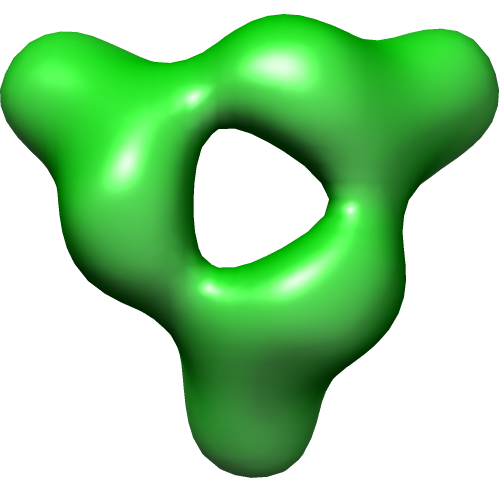
 Downloads & links
 EMD-2366.png
 https://data.pdbj.org/pub/emdb/structures/EMD-2366




 Z (Sec.)
 Y (Row.)
 X (Col.)


 Sample components
 Escherichia coli (E. coli)
 Processing
 Electron microscopy