Journal: Proc Natl Acad Sci U S A / Year: 2004 Title: The structure of a thermophilic archaeal virus shows a double-stranded DNA viral capsid type that spans all domains of life. Authors: George Rice / Liang Tang / Kenneth Stedman / Francisco Roberto / Josh Spuhler / Eric Gillitzer / John E Johnson / Trevor Douglas / Mark Young / Abstract: Of the three domains of life (Eukarya, Bacteria, and Archaea), the least understood is Archaea and its associated viruses. Many Archaea are extremophiles, with species that are capable of growth at ...Of the three domains of life (Eukarya, Bacteria, and Archaea), the least understood is Archaea and its associated viruses. Many Archaea are extremophiles, with species that are capable of growth at some of the highest temperatures and extremes of pH of all known organisms. Phylogenetic rRNA-encoding DNA analysis places many of the hyperthermophilic Archaea (species with an optimum growth > or = 80 degrees C) at the base of the universal tree of life, suggesting that thermophiles were among the first forms of life on earth. Very few viruses have been identified from Archaea as compared to Bacteria and Eukarya. We report here the structure of a hyperthermophilic virus isolated from an archaeal host found in hot springs in Yellowstone National Park. The sequence of the circular double-stranded DNA viral genome shows that it shares little similarity to other known genes in viruses or other organisms. By comparing the tertiary and quaternary structures of the coat protein of this virus with those of a bacterial and an animal virus, we find conformational relationships among all three, suggesting that some viruses may have a common ancestor that precedes the division into three domains of life >3 billion years ago.
History
Deposition
Aug 19, 2019
-
Header (metadata) release
Sep 25, 2019
-
Map release
Sep 25, 2019
-
Update
Dec 25, 2019
-
Current status
Dec 25, 2019
Processing site: RCSB / Status: Released
-
Structure visualization
Movie
Surface view with section colored by density value
In the structure databanks used in Yorodumi, some data are registered as the other names, "COVID-19 virus" and "2019-nCoV". Here are the details of the virus and the list of structure data.
Jan 31, 2019. EMDB accession codes are about to change! (news from PDBe EMDB page)
EMDB accession codes are about to change! (news from PDBe EMDB page)
The allocation of 4 digits for EMDB accession codes will soon come to an end. Whilst these codes will remain in use, new EMDB accession codes will include an additional digit and will expand incrementally as the available range of codes is exhausted. The current 4-digit format prefixed with “EMD-” (i.e. EMD-XXXX) will advance to a 5-digit format (i.e. EMD-XXXXX), and so on. It is currently estimated that the 4-digit codes will be depleted around Spring 2019, at which point the 5-digit format will come into force.
The EM Navigator/Yorodumi systems omit the EMD- prefix.
Related info.:Q: What is EMD? / ID/Accession-code notation in Yorodumi/EM Navigator
Yorodumi is a browser for structure data from EMDB, PDB, SASBDB, etc.
This page is also the successor to EM Navigator detail page, and also detail information page/front-end page for Omokage search.
The word "yorodu" (or yorozu) is an old Japanese word meaning "ten thousand". "mi" (miru) is to see.
Related info.:EMDB / PDB / SASBDB / Comparison of 3 databanks / Yorodumi Search / Aug 31, 2016. New EM Navigator & Yorodumi / Yorodumi Papers / Jmol/JSmol / Function and homology information / Changes in new EM Navigator and Yorodumi
 Movie
Movie Controller


 Open data
 Basic information
 Map data
 Sample

 Sulfolobus turreted icosahedral virus 1
 Authors
 United States, 1 items
  Citation
 Structure visualization
 Movie viewer
 UCSF Chimera
 Downloads & links
 emd_20618.png
 http://ftp.pdbj.org/pub/emdb/structures/EMD-20618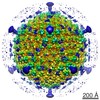
 Z (Sec.)
 Y (Row.)
 X (Col.)


 Sample components
 Processing
 Electron microscopy