 Movie
Movie Controller


+ Open data

- Basic information
| Entry | Database: PDB / ID: 9z03 | |||||||||
|---|---|---|---|---|---|---|---|---|---|---|
| Title | Cryo-EM structure of VVD-908 NLRP3 complex | |||||||||
 Components Components | NACHT, LRR and PYD domains-containing protein 3 | |||||||||
 Keywords Keywords | IMMUNE SYSTEM / inflammasome / NLRP3 / allosteric | |||||||||
| Function / homology |  Function and homology information Function and homology informationdetection of biotic stimulus / molecular sensor activity / positive regulation of type 2 immune response / phosphatidylinositol phosphate binding / positive regulation of T-helper 2 cell differentiation / positive regulation of T-helper 2 cell cytokine production / interphase microtubule organizing center / NLRP3 inflammasome complex / peptidoglycan binding / NLRP3 inflammasome complex assembly ...detection of biotic stimulus / molecular sensor activity / positive regulation of type 2 immune response / phosphatidylinositol phosphate binding / positive regulation of T-helper 2 cell differentiation / positive regulation of T-helper 2 cell cytokine production / interphase microtubule organizing center / NLRP3 inflammasome complex / peptidoglycan binding / NLRP3 inflammasome complex assembly / cysteine-type endopeptidase activator activity / phosphatidylinositol-4-phosphate binding / negative regulation of non-canonical NF-kappaB signal transduction / osmosensory signaling pathway / negative regulation of interleukin-1 beta production / pattern recognition receptor signaling pathway / positive regulation of interleukin-4 production / negative regulation of acute inflammatory response / microtubule organizing center / The NLRP3 inflammasome / pyroptotic inflammatory response / Purinergic signaling in leishmaniasis infection / signaling adaptor activity / positive regulation of interleukin-1 beta production / cellular response to virus / protein maturation / defense response / molecular condensate scaffold activity / Cytoprotection by HMOX1 / negative regulation of inflammatory response / positive regulation of non-canonical NF-kappaB signal transduction / ADP binding / protein homooligomerization / Hydrolases; Acting on acid anhydrides; Acting on acid anhydrides to facilitate cellular and subcellular movement / positive regulation of inflammatory response / Metalloprotease DUBs / SARS-CoV-1 activates/modulates innate immune responses / cellular response to lipopolysaccharide / regulation of inflammatory response / DNA-binding transcription factor binding / sequence-specific DNA binding / molecular adaptor activity / protein-macromolecule adaptor activity / inflammatory response / Golgi membrane / innate immune response / apoptotic process / SARS-CoV-2 activates/modulates innate and adaptive immune responses / signal transduction / endoplasmic reticulum / positive regulation of transcription by RNA polymerase II / ATP hydrolysis activity / mitochondrion / DNA-templated transcription / extracellular region / ATP binding / membrane / identical protein binding / nucleus / cytosol / cytoplasm Similarity search - Function | |||||||||
| Biological species |  Homo sapiens (human) Homo sapiens (human) | |||||||||
| Method | ELECTRON MICROSCOPY / single particle reconstruction / cryo EM / Resolution: 3.03 Å | |||||||||
 Authors Authors | Bernard, S.M. | |||||||||
| Funding support | 1items
| |||||||||
 Citation Citation | Journal: Br J Pharmacol / Year: 2026 Title: Chemoproteomic discovery of a brain-penetrant, covalent NLRP3 inhibitor that binds a novel allosteric pocket. Authors: Donald C Rogness / Evelyn P Sievert / Vincent F Vartabedian / Steffen M Bernard / Erick Aitchison / William Tao / Mikaela Lindvall / Jing Qian / Christie L Eissler / Brian E Nordin / ...Authors: Donald C Rogness / Evelyn P Sievert / Vincent F Vartabedian / Steffen M Bernard / Erick Aitchison / William Tao / Mikaela Lindvall / Jing Qian / Christie L Eissler / Brian E Nordin / Benjamin D Horning / Cian Kingston / Kelsey N Lamb / Joshua C Bell / Bingwen Lu / Jonathan Pollock / Jun Shi / Roli Khattri / David S Weinstein / Matthew P Patricelli / Brian N Cook / Gabriel M Simon /  Abstract: BACKGROUND AND PURPOSE: The NLRP3 inflammasome is an attractive therapeutic target for multiple inflammatory conditions. Although inhibitors have been developed, their chemical diversity is limited, ...BACKGROUND AND PURPOSE: The NLRP3 inflammasome is an attractive therapeutic target for multiple inflammatory conditions. Although inhibitors have been developed, their chemical diversity is limited, and their properties are not ideal for brain penetrance, which is desirable for treating neuroinflammatory disorders. EXPERIMENTAL APPROACH: We applied our chemoproteomics platform to survey our electrophilic fragment collection to identify inhibitors of NLRP3. We focused our attention on compounds that bind Cys463, ...EXPERIMENTAL APPROACH: We applied our chemoproteomics platform to survey our electrophilic fragment collection to identify inhibitors of NLRP3. We focused our attention on compounds that bind Cys463, as this residue was identified as an allosteric sensor of NLRP3 function. KEY RESULTS: A novel inhibitor series was identified bearing a butynamide electrophile and a unique spirocyclic lactam core. Compounds from this series displayed mid-nanomolar potency and were found ...KEY RESULTS: A novel inhibitor series was identified bearing a butynamide electrophile and a unique spirocyclic lactam core. Compounds from this series displayed mid-nanomolar potency and were found to inhibit IL-1β secretion in a Cys463-dependent manner. Cryo-EM structures revealed that ligand binding to Cys463 stabilizes an inactive conformation, thereby preventing structural rearrangements required for inflammasome activation. These compounds displayed attractive pharmacokinetic properties and, notably, Kp,uu values >0.5, suggesting the potential to address neuroinflammatory disorders. Administration of a representative compound to humanized mice resulted in clear NLRP3 Cys463 target-engagement and profound suppression of LPS- and ATP-induced IL-1β secretion, demonstrating clear proof-of-concept in vivo. CONCLUSION AND IMPLICATIONS: Chemoproteomics-based ligand discovery is intrinsically function-agnostic and has the potential to identify novel pockets on even well-characterized protein targets. ...CONCLUSION AND IMPLICATIONS: Chemoproteomics-based ligand discovery is intrinsically function-agnostic and has the potential to identify novel pockets on even well-characterized protein targets. Here, optimization of ligands targeting Cys463 of NLRP3 within a previously uncharacterized allosteric pocket led to a unique and potent inhibitor series with attractive physicochemical and pharmacokinetic properties for the potential treatment of diseases involving aberrant innate immune activation in both central and peripheral tissues. | |||||||||
| History |
|
- Structure visualization
| Structure viewer | Molecule: MolmilJmol/JSmol |
|---|
- Downloads & links
-Download
| PDBx/mmCIF format | 9z03.cif.gz | 176.7 KB | Display | PDBx/mmCIF format |
|---|---|---|---|---|
| PDB format | pdb9z03.ent.gz | Display | PDB format | |
| PDBx/mmJSON format | 9z03.json.gz | Tree view | PDBx/mmJSON format | |
| Others |  Other downloads Other downloads |
-Validation report
| Arichive directory | https://data.pdbj.org/pub/pdb/validation_reports/z0/9z03ftp://data.pdbj.org/pub/pdb/validation_reports/z0/9z03 | HTTPS FTP |
|---|
-Related structure data
| Related structure data |  73688MC M: map data used to model this data C: citing same article ( |
|---|---|
| Similar structure data |
-Links
 PDBj
PDBj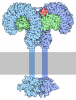

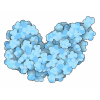
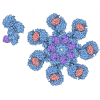
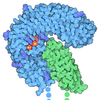

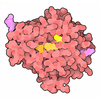
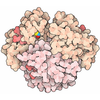
- Assembly
| Deposited unit | 
|
|---|---|
| 1 |
|
-Components
| #1: Protein | Mass: 102690.508 Da / Num. of mol.: 1 Source method: isolated from a genetically manipulated source Source: (gene. exp.) Homo sapiens (human) / Gene: NLRP3, C1orf7, CIAS1, NALP3, PYPAF1 / Production host: Homo sapiens (human)References: UniProt: Q96P20, Hydrolases; Acting on acid anhydrides; Acting on acid anhydrides to facilitate cellular and subcellular movement |
|---|---|
| #2: Chemical | ChemComp-ADP / 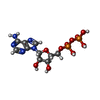 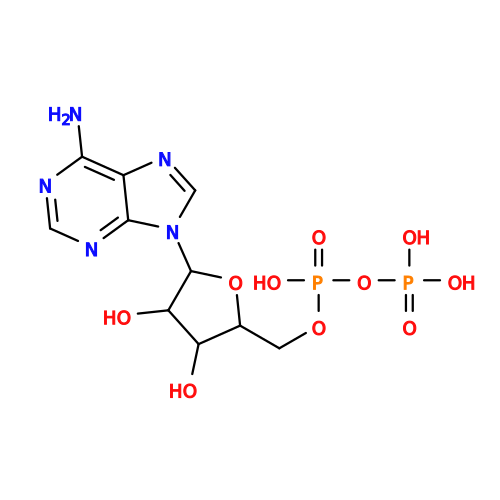 Mass: 427.201 Da / Num. of mol.: 1 / Source method: obtained synthetically / Formula: C10H15N5O10P2 / Comment: ADP, energy-carrying molecule*YM Mass: 427.201 Da / Num. of mol.: 1 / Source method: obtained synthetically / Formula: C10H15N5O10P2 / Comment: ADP, energy-carrying molecule*YM |
| #3: Chemical | ChemComp-A1CZP / ( Mass: 412.884 Da / Num. of mol.: 1 / Source method: obtained synthetically / Formula: C23H22ClFN2O2 / Feature type: SUBJECT OF INVESTIGATION |
| #4: Chemical | ChemComp-MG /   Mass: 24.305 Da / Num. of mol.: 1 / Source method: obtained synthetically / Formula: Mg Mass: 24.305 Da / Num. of mol.: 1 / Source method: obtained synthetically / Formula: Mg |
| Has ligand of interest | Y |
| Has protein modification | Y |
-Experimental details
-Experiment
| Experiment | Method: ELECTRON MICROSCOPY |
|---|---|
| EM experiment | Aggregation state: PARTICLE / 3D reconstruction method: single particle reconstruction |
- Sample preparation
| Component | Name: NLRP3 hexamer / Type: COMPLEX / Entity ID: #1 / Source: RECOMBINANT |
|---|---|
| Molecular weight | Value: 0.615 MDa / Experimental value: NO |
| Source (natural) | Organism: Homo sapiens (human) |
| Source (recombinant) | Organism: Homo sapiens (human) |
| Buffer solution | pH: 7.5 |
| Specimen | Embedding applied: NO / Shadowing applied: NO / Staining applied: NO / Vitrification applied: YES |
| Vitrification | Cryogen name: ETHANE |
- Electron microscopy imaging
| Experimental equipment |  Model: Titan Krios / Image courtesy: FEI Company |
|---|---|
| Microscopy | Model: TFS KRIOS |
| Electron gun | Electron source:  FIELD EMISSION GUN / Accelerating voltage: 300 kV / Illumination mode: FLOOD BEAM FIELD EMISSION GUN / Accelerating voltage: 300 kV / Illumination mode: FLOOD BEAM |
| Electron lens | Mode: BRIGHT FIELD / Nominal defocus max: 1500 nm / Nominal defocus min: 800 nm |
| Image recording | Electron dose: 52 e/Å2 / Film or detector model: GATAN K3 BIOQUANTUM (6k x 4k) |
- Processing
| EM software |
| ||||||||||||||||||||||||
|---|---|---|---|---|---|---|---|---|---|---|---|---|---|---|---|---|---|---|---|---|---|---|---|---|---|
| CTF correction | Type: PHASE FLIPPING AND AMPLITUDE CORRECTION | ||||||||||||||||||||||||
| 3D reconstruction | Resolution: 3.03 Å / Resolution method: FSC 0.143 CUT-OFF / Num. of particles: 870000 / Symmetry type: POINT | ||||||||||||||||||||||||
| Refinement | Highest resolution: 3.03 Å Stereochemistry target values: REAL-SPACE (WEIGHTED MAP SUM AT ATOM CENTERS) | ||||||||||||||||||||||||
| Refine LS restraints |
|
